Bakkt shifts strategy to stablecoin services amid 77% Q1 revenue decline
In the first quarter, Bakkt reported a net loss of $0.41 per share while experiencing a 77% revenue drop to $243.6 million, driven by reduced crypto trading activity.

The digital asset platform Bakkt recorded its first quarterly loss as revenue from crypto services plummeted 77%, highlighting the company's strategic shift toward AI-enabled financial infrastructure and stablecoin payment solutions.
The company disclosed on Monday a net loss attributable to Bakkt totaling $11.7 million, equivalent to 41 cents per basic and diluted share, during the three-month period that concluded on March 31. This represents a reversal from the same quarter last year, when Bakkt posted net income attributable to the company of $7.7 million, or $1.13 per diluted share.
Revenue from crypto services dropped to $243.6 million compared to $1.07 billion during the equivalent period in the previous year, according to Bakkt's announcement. The company explained that the downturn was chiefly driven by decreased crypto trading volumes. Nevertheless, this revenue is almost entirely counterbalanced by brokerage fees and crypto costs, which reached $242 million during the quarter.
When crypto costs are excluded from the calculation, operating expenses remained relatively flat at $18.5 million, representing a modest decrease from $18.9 million in the year-ago period. The net loss stood at $11.7 million, a stark contrast to the net income of $7.7 million recorded twelve months earlier.
The company concluded the quarter holding $82.6 million in cash reserves, which included $69.6 million generated through equity offerings executed during the three-month period. Bakkt also disclosed that it maintains zero long-term debt obligations.
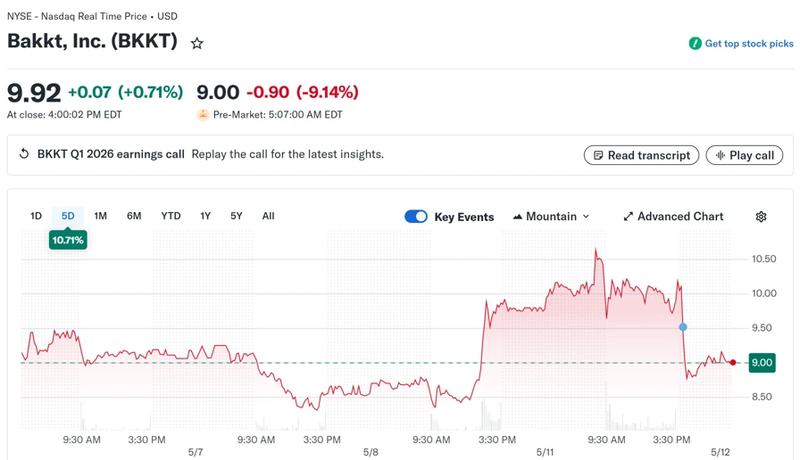
On Monday, shares finished the trading session higher by 0.71% at $9.92, but subsequently declined 9.14% to $9.00 during Tuesday's pre-market trading session after the earnings release.
Bakkt goes all in on stablecoins
The company's contracting revenue coincides with Bakkt navigating through a significant strategic transformation, transitioning from crypto trading infrastructure toward agentic AI and stablecoin payment solutions.
On April 30, the company finalized its acquisition of Distributed Technologies Research, securing an AI-native payments engine along with a stablecoin compliance stack. Additionally, Bakkt has entered into a memorandum of understanding (MoU) with Zoth, a stablecoin provider with ambitions of achieving $1 billion in annualized payment volumes throughout Sub-Saharan Africa, the Middle East and South Asia.
We believe stablecoin infrastructure represents one of the most significant structural transformations in global finance in decades.
CEO Akshay Naheta
According to Naheta, the CLARITY Act and GENIUS Act represent regulatory tailwinds with the potential to enhance the value proposition of Bakkt's licensed infrastructure.
Stablecoin infrastructure draws interest
The strategic transformation at Bakkt is occurring at a time when public-market investors are demonstrating increasing appetite for companies focused on stablecoin infrastructure.
On Monday, shares of Circle Internet Group surged by nearly 16% following the USDC (USDC) issuer's announcement of a 20% increase in first-quarter total revenue and reserve income, reaching $694 million, and revealing a $222 million presale of its ARC blockchain token valued at a $3 billion fully diluted network valuation.
The financial results from Circle demonstrated that USDC in circulation expanded 28% on a year-over-year basis to reach $77 billion at the end of the quarter, while onchain transaction volume experienced a remarkable 263% surge to $21.5 trillion.