Analyst: Growing ETF Demand Could Shield Bitcoin From Traditional Bear Market Declines
The ongoing Bitcoin downturn shows significantly less severity compared to previous bear cycles that saw 75%-85% declines, with ETF capital inflows and corporate treasury purchases providing fresh demand sources.

While Bitcoin (BTC) has retreated 36% from its peak price of $126,000, an industry analyst suggests that this fourth bear market cycle represents a "material decoupling" from historical bearish patterns, driven by substantial exchange-traded fund (ETF) capital flows and increased corporate Bitcoin acquisition strategies.
Corporate accumulation and ETF capital may prevent deeper losses
Pierre Rochard, CEO of Bitcoin Bond Company, conducted a comparative analysis of Bitcoin's price drawdowns throughout various market cycles, concluding that the present correction exhibits distinct characteristics from historical bear markets. During the 2013–2015 period, Bitcoin experienced approximately 85% value erosion, whereas both the 2017–2018 and 2021–2022 cycles registered declines approaching 77% before reaching their respective bottoms.
By contrast, the present downturn demonstrates considerably less severity. Bitcoin's price dropped to approximately $60,000 from its record high approaching $126,000, representing roughly a 52% decrease.
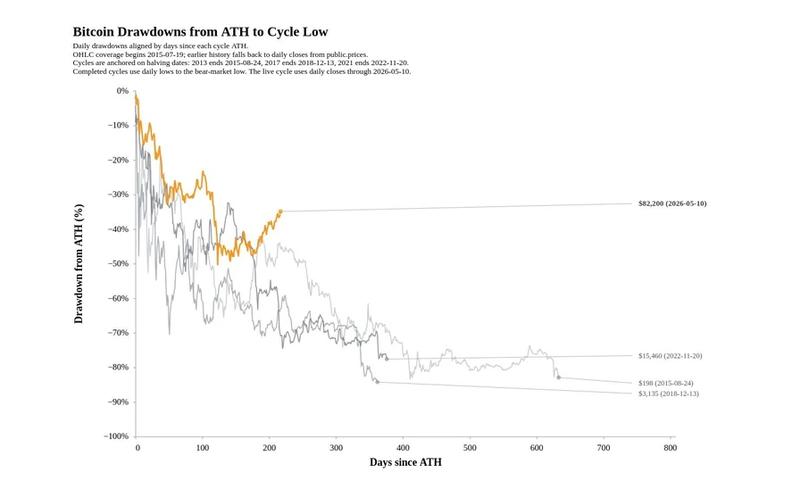
According to Rochard's analysis, Bitcoin ETFs have emerged as a significant new demand driver during the last two years. Spot Bitcoin ETFs trading on US exchanges have accumulated aggregate net inflows exceeding $59 billion since their inception, with $4.5 billion of that total arriving since March.
Additionally, corporate Bitcoin acquisition activity has intensified significantly. Strategy expanded its Bitcoin treasury from 640,031 BTC in October 2025 to 818,869 BTC, representing an addition of approximately 179,000 BTC. The firm's average acquisition cost stands at roughly $75,543.
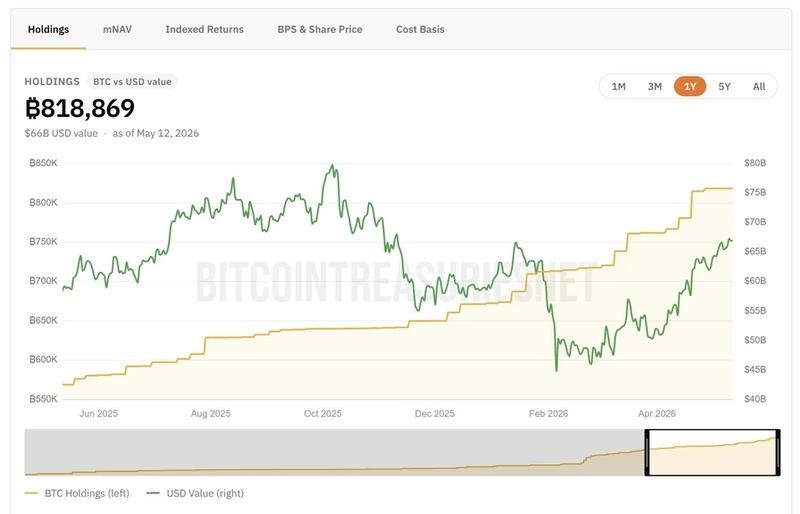
In Rochard's assessment, both ETF market participants and corporate treasury operations are delivering persistent demand that was absent throughout the 2018 and 2022 bearish cycles.
Michaël van de Poppe, founder of MN Capital, concurred that current market conditions bear little resemblance to the 2022 cycle. Van de Poppe said,
"The most overcrowded thesis right now is that Bitcoin makes a bear flag and that we're going to bottom out in October '26."
Van de Poppe identified multiple distinguishing factors characterizing this cycle, including the Nasdaq reaching fresh record highs at 29,372 on Monday, the forthcoming legislative decision on the CLARITY Act, ongoing deliberations regarding a strategic Bitcoin reserve, and the selection of a new Federal Reserve chair.
Retail investor demand shows signs of recovery
Cryptocurrency analyst MorenoDV observed that Bitcoin recently registered its initial "early bull" indication since March 2023 according to CryptoQuant's Bull-Bear Market Cycle indicator. This analytical tool monitors whether markets are transitioning into bullish or bearish territory through examination of price momentum dynamics and moving average patterns.
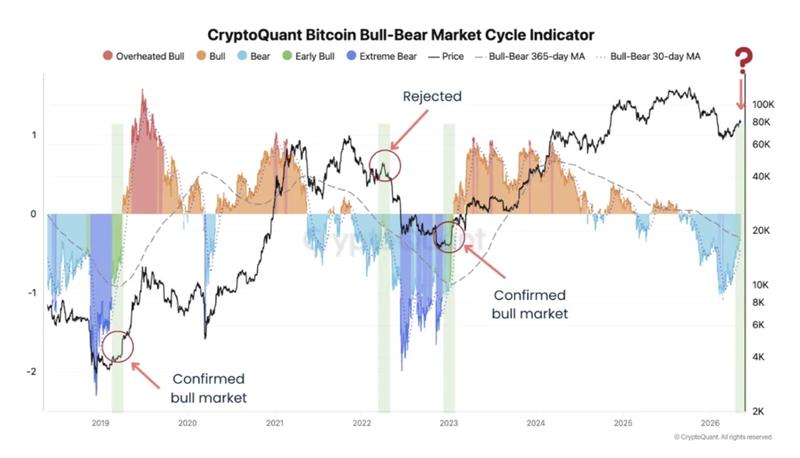
MorenoDV highlighted that comparable indicators emerged during 2019 and early 2023, preceding Bitcoin rallies of 1280% and 461%, respectively. Nevertheless, the most recent signal requires additional price validation for confirmation. MorenoDV said,
"Several other market metrics are already showing signs of exhaustion. That makes this signal less clean than a classic early-cycle confirmation."
Meanwhile, blockchain data revealed indications that smaller-scale investors are reentering the market following diminished activity throughout April. Bitcoin researcher Axel Adler Jr. monitored the 30-day variation in Bitcoin transaction volumes originating from wallets containing between $0 and $10,000, a metric commonly employed to gauge retail investor engagement levels.
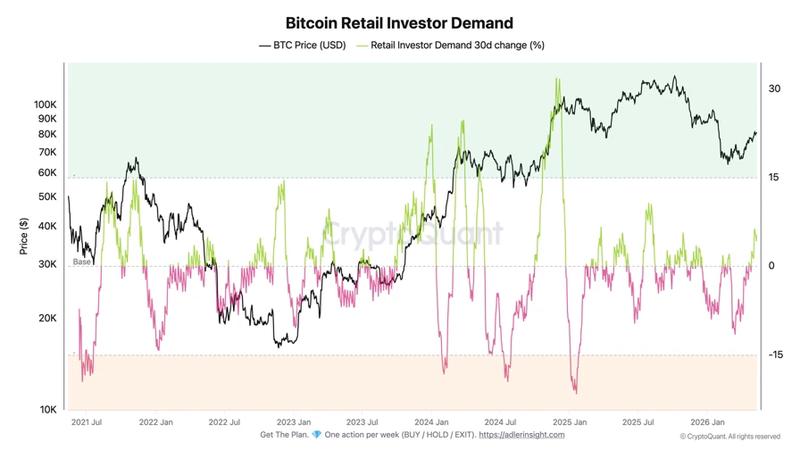
This measurement declined to -8.2% on April 5 before climbing back into positive range during the latter portion of the month. The metric achieved 6.31% on May 6 and held near 4.38% on May 12 as Bitcoin exchanged hands at $80,625.
Retail transfer volumes experienced a modest increase to $351 million from $336 million recorded in mid-April. Nonetheless, Adler Jr. noted that current activity levels remain beneath February benchmarks, when transaction volumes fluctuated between $365 million and $375 million.
According to Cointelegraph's previous reporting, there are mounting indicators suggesting that the initial phases of a fresh bull market are currently developing.