$27M Liquidation Wave Hits Aave Following wstETH Oracle Malfunction
An oracle pricing error in Capo, utilized by Aave for risk assessment, led to approximately $27 million worth of liquidations, with the DeFi lending protocol now moving forward to reimburse affected parties.

An erroneous configuration within a risk-oracle mechanism utilized by the Aave decentralized lending platform resulted in the liquidation of approximately $27 million worth of wrapped staked Ether (wstETH) holdings, leading the protocol to initiate compensation measures for users who were impacted.
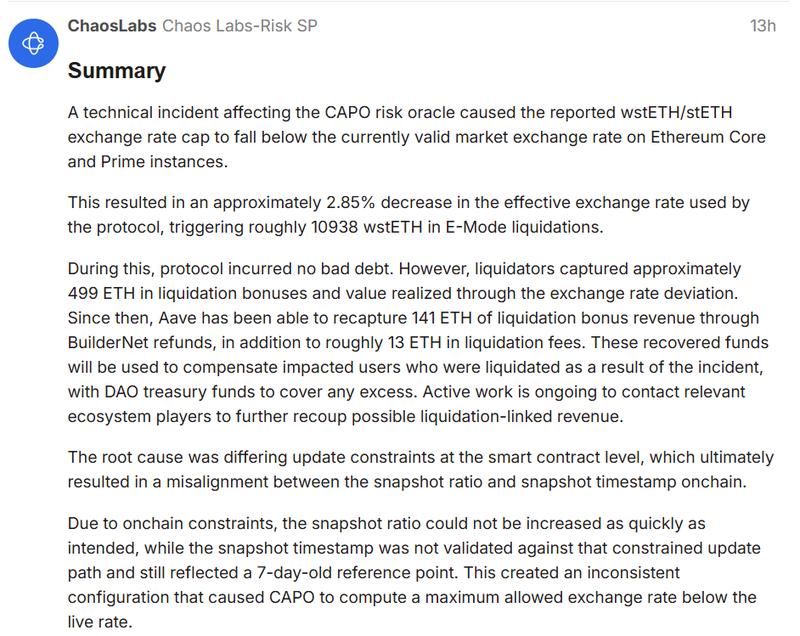
According to a post-mortem analysis released on Tuesday, Aave disclosed that roughly 10,938 wstETH tokens valued at approximately $27.1 million underwent liquidation following the protocol's application of an exchange rate that fell 2.85% beneath the current market valuation for wstETH relative to Lido staked Ether.
The root cause of the problem originated from a discrepancy between a snapshot ratio and its corresponding snapshot timestamp within the Capo risk-oracle's configuration settings, resulting in the system computing a maximum permissible exchange rate that fell short of the genuine onchain rate.
According to Aave's statement, the event did not result in any bad debt accumulation for the protocol itself, though liquidators managed to collect approximately 499 Ether (ETH) through bonuses and value associated with the pricing discrepancy.
Chaos Risk Oracles represents an external service integrated within Aave's infrastructure, which had successfully handled more than 1,200 payloads and 3,000 parameters without encountering problems, according to Aave's founder and CEO, Stani Kulechov, who shared this information in an X post on Wednesday.
"A technical misconfiguration resulted in the liquidation of positions that were already close to their liquidation thresholds," Kulechov said, adding that the "configuration issue has already been remediated."
According to his statement, the Aave protocol did not suffer any bad debt, and liquidators received a total of 345 Ether ($700,000) as an excessive liquidation windfall.
Aave to compensate liquidated users
According to Aave's announcement, the protocol successfully recovered 141 ETH ($285,000) through liquidation bonus revenue via BuilderNet refunds, along with an additional 13 ETH collected from liquidation fees, both of which will be allocated toward compensating affected users whose positions were liquidated as a result of this incident. Any remaining shortfall will be covered using funds from the DAO treasury.
This incident contributes to increasing examination of collateral valuation mechanisms and oracle-related risk management controls throughout decentralized finance lending platforms. Toward the end of February, malicious actors successfully extracted approximately $10 million from a YieldBlox DAO-operated lending pool constructed on the Blend protocol by executing a price manipulation exploit.
Aave's governance rift deepens following ACI exit
The liquidation incident also occurs amid a time of internal friction within the Aave ecosystem after the Aave Chan Initiative announced earlier this month that it would not be continuing its involvement with the DAO.
The ACI pointed to issues regarding governance standards and the dynamics of voting throughout the proposal process as reasons for their departure. Responding to the governance controversy, Kulechov expressed that DAOs must reconsider how they balance the influence of token holders' votes against contributions from leadership figures.
According to Kulechov's position, token holders should not be voting on every matter, given that managing blockchain protocols demands a dedicated team and leadership structure, rather than thousands of individual votes that could result in governance processes becoming politicized or operationally inefficient.