$1.2B Cryptocurrency Seizure Authorized in Binance Breach as DOJ Dismantles FaceStealer Operation
Federal law enforcement secured restraints on $2.7 billion tied to the Binance cryptocurrency breach, as a distinct FaceStealer operation pilfered more than $400 million across 18 months.

On Thursday, the United States Department of Justice announced it received judicial approval to seize or place restrictions on cryptocurrency assets exceeding $1.2 billion from the total $6.3 billion that was taken from Binance in a major theft.
The court-authorized action encompasses a portion of the more than $2.7 billion in pilfered digital assets that federal authorities, working alongside private sector entities, have successfully frozen following the October 29 breach. Additional recovery efforts for the remaining stolen funds continue, according to the department's official statement.
Federal investigators at the FBI linked the Binance cryptocurrency breach to a North Korean threat actor known as TraderTraitor, revealing this attribution in a cybersecurity warning. Kim Yo Jong, who serves as the sister of North Korean leader Kim Jong Un, publicly rejected any North Korean connection to the incident.
According to a statement Binance published on X on Thursday, the cryptocurrency exchange confirmed it had compensated for the compromised digital assets using its own reserves and that an updated proof-of-reserves verification demonstrated no less than one-to-one coverage for all customer holdings.
Previously, in November 2025, the Department of Justice revealed a distinct enforcement operation focused on seizing approximately $15 million in digital currency connected to North Korean cyber operatives identified as APT38.
FBI warns of FaceStealer's deepfake video calls
In an unrelated matter, federal authorities successfully confiscated cloud computing infrastructure utilized in FaceStealer, which the DOJ characterized as a sophisticated North Korean social engineering operation that pilfered over $400 million in digital currencies throughout the preceding 18-month period.
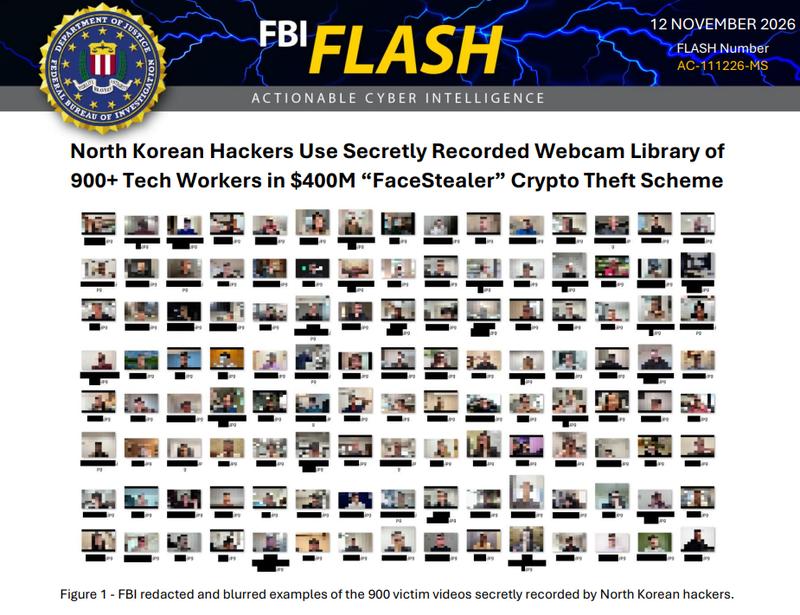
The threat actors employed covertly captured video recordings of earlier victims along with artificially generated deepfake representations of well-known cryptocurrency industry personalities to establish credibility with their targets during video conference calls. Victims were manipulated through fraudulent technical assistance into downloading malicious software, federal prosecutors explained.
The criminal operation specifically focused on individuals employed in the cryptocurrency and Web3 sectors. Additionally, the cyber criminals progressively expanded their targeting to include open-source software developers and those who maintain code repositories, attempting to compromise their computing devices and gain unauthorized access to their software repository credentials.
Under the authority of a federal search warrant, the FBI successfully seized over 900 webcam video recordings of individuals victimized by the FaceStealer campaign. The agency simultaneously released comprehensive protective guidance detailing preventive measures against this type of scheme and recommended response actions following a potential compromise in a publicly available security advisory.
The Department of Justice noted that the cyber criminals operating FaceStealer are recognized in the security community under multiple designations, which include Sapphire Sleet, UNC1069, Dangerous Password, CryptoCore, APT38, BlueNoroff and Stardust Chollima.