USDC's Decade-Long Network Effect Creates Competitive Moat as OUSD Enters Market, Says Circle CEO
Investment firm Bernstein suggests OUSD may pose the most significant threat yet to Circle and Tether's market dominance, though concerns persist regarding governance structures, operational frameworks and profit distribution models.

Jeremy Allaire, chief executive of Circle, has asserted that USDC's ten-year history of building integrations, establishing liquidity channels and developing regulatory infrastructure provides a fundamental competitive edge against emerging stablecoin rivals, while simultaneously questioning central aspects of the business strategy behind Open USD.
Through a post published on X this Wednesday, Allaire characterized stablecoin ecosystems as platform-oriented businesses powered by network effects, emphasizing that continuous investment in integration development, liquidity provision, regulatory clearances, banking partnerships and reserve asset management establishes competitive moats that prove challenging for newcomers to duplicate.
Allaire additionally raised doubts about the long-term viability of providing perpetual fee-free, unlimited minting and redemption services when operating at significant scale, and expressed concern that distributing virtually all reserve-generated revenue to ecosystem partners could result in "starving an infrastructure."
These remarks underscore the escalating rivalry within the stablecoin issuer landscape as emerging competitors attempt to disrupt USDC and USDT's dominance by providing corporate partners with larger portions of reserve-derived income and enhanced governance participation.
The Open Standard initiative unveiled Open USD (OUSD) this Tuesday, backed by more than 140 organizations spanning payments processing, banking services, technology infrastructure and cryptocurrency sectors, with participants including Visa, Mastercard, Stripe, Coinbase, BlackRock and Google. The digital currency's launch is anticipated to occur sometime during 2026.
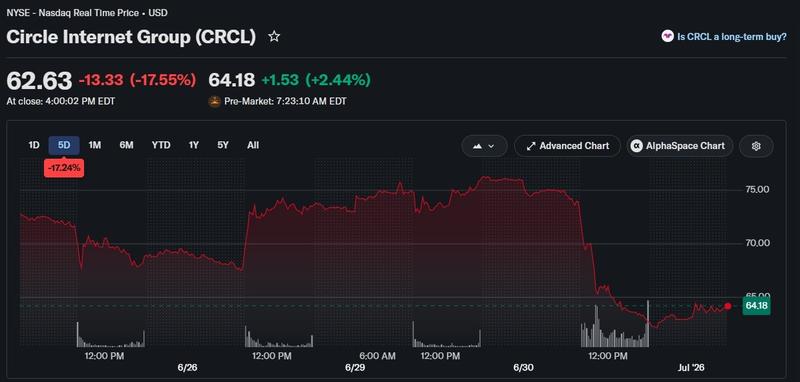
Shares of Circle concluded Tuesday's trading session at $62.63, representing a 17.55% decline compared to the prior day's close, before climbing 2.44% to reach $64.18 during premarket activity as of 11 am UTC on Wednesday, based on data compiled by Yahoo Finance.
OUSD could challenge the Circle-Tether duopoly: Bernstein
Within a research memorandum, Bernstein's analytical team indicated that OUSD has potential to emerge as the "strongest and first new entrant to challenge the duopoly of Circle and Tether," pointing to its extensive footprint spanning payment systems, financial institutions, technology platforms and commercial sectors.
Nevertheless, Bernstein noted that governance structures, operational frameworks and revenue distribution formulas remain unresolved issues, given that orchestrating collaboration among more than 140 partner organizations will demand considerable effort. Bernstein highlighted that Circle allocates approximately $500 million toward marketing initiatives, infrastructure development, technology advancement and compliance operations, illustrating the substantial resource commitment required to expand a stablecoin network successfully.
Lorenzo Valente, who serves as director of research at ARK Invest, adopted a more doubtful perspective. Through a statement on X, Valente argued that OUSD continues to confront the cold-start challenge created by the deeply embedded liquidity that USDC and USDT command throughout the cryptocurrency ecosystem. He characterized the announcement as a "giant" letter of intent and noted that numerous participants simultaneously support competing stablecoin projects or maintain their own proprietary infrastructure.
"The partners are backing rivals: Stripe owns Bridge and has its own stack, Coinbase is wedded to USDC, banks are building their own deposit tokens and the card networks support every token out there,"
Lorenzo Valente, ARK Invest