Southern US ice storm forces Bitcoin mining operations to prepare for power grid relief
Bitcoin mining facilities across more than a dozen states in the southern United States may need to temporarily halt operations as a severe winter storm threatens to strain electrical infrastructure.

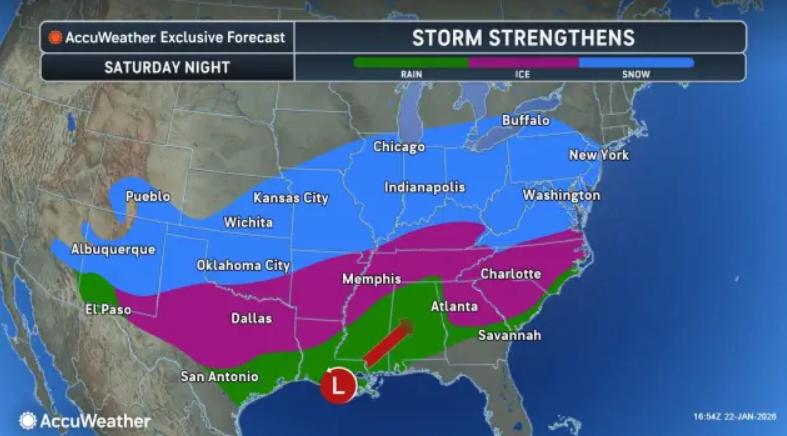
Bitcoin mining companies may find themselves temporarily shutting down their operations as a severe winter storm approaches the southern United States this weekend, threatening to dump significant ice and snow across the region.
According to a Thursday forecast from AccuWeather, an American weather prediction company, the "massive winter storm" is expected to span an enormous 1,800 miles, stretching from the westernmost regions of Texas all the way to the mid-Atlantic coastline, potentially disrupting power supplies, halting transportation across more than a dozen states, and impacting as many as 60 million residents.
Historical precedent shows that when significant storms have threatened power grid stability, Bitcoin mining operations have voluntarily shut down their energy-intensive equipment to reduce strain on electrical infrastructure. During a significant winter storm event in Texas in 2022, cryptocurrency mining companies throughout the state chose to voluntarily reduce their operations.
According to Daniel Batten, a researcher focused on Bitcoin (BTC) environmental, social and governance matters, who spoke with Cointelegraph, mining operations will probably adopt the same approach once again.
I think that with extreme weather events becoming more common in jurisdictions throughout the world, the need for Bitcoin mining loadbalancing, particularly as more solar and wind go onto grids, is only going to increase.
Through load balancing capabilities, Bitcoin mining operations can contribute to power grid stability by functioning as rapidly adjustable, controllable demand response resources. Mining facilities established in proximity to wind or solar energy installations can increase operations to absorb excess power generation and power down operations during periods of grid constraint.
According to a Tuesday publication from the Digital Assets Research Institute, Bitcoin mining operations have contributed approximately $18 billion in savings for Texas by removing the requirement for additional gas peaker plant construction.
Bitdeer doesn't expect the storm to shut it down
Bitdeer, a mining company headquartered in Singapore that runs more than 293,000 mining rigs across the globe, with operations in Texas and additional US sites, informed Cointelegraph that it does not foresee the approaching storm creating significant operational disruptions for its equipment.
Storms typically do not directly impact our operations. We have standard operating procedures as the season changes, such as winterizing of pipes. The site team monitors the weather situation, so they are responsive.
Bitdeer spokesperson
According to the spokesperson, the Electric Reliability Council of Texas categorizes Bitcoin mining operations as "large flexible loads," which enables them to reduce their power consumption upon request, distinguishing them from other industrial electricity consumers that have fixed electrical requirements.
Bitdeer stands ready to fully support the grid should supply constraints occur.
US miners control the largest share of hashrate
Mining operations form the foundational infrastructure of the Bitcoin network. These miners are responsible for validating and documenting all Bitcoin transactions into newly created blocks. As more mining participants join the network, the hashrate increases, which strengthens the overall network security.
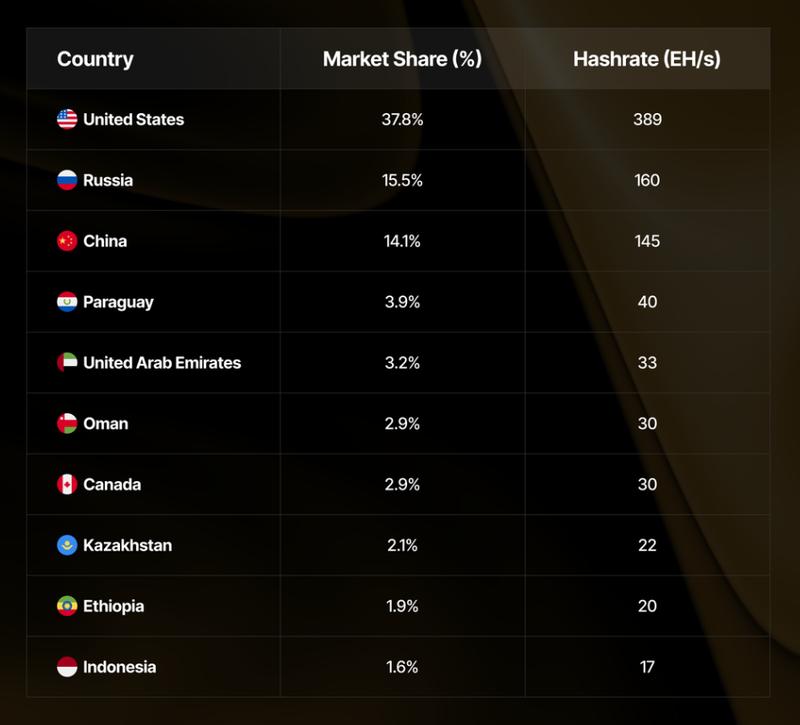
The United States hosts a substantial portion of global mining capacity, with the Hashrate Index, a Bitcoin mining data analytics platform, calculating that the nation commands approximately 38% of the worldwide hashrate.
Among the largest mining companies operating within the United States are Marathon Digital Holdings and Riot Platforms.
Additionally, the United States contains a substantial number of mining installations. Research conducted by the federal Energy Information Administration in 2024 identified more than 137 cryptocurrency mining facilities operating within the US, with the heaviest concentrations located in Texas, Georgia and New York.