South Korean Central Bank Chief Reveals Strategy for Tokenized Bonds and Integrated Ledger System
During a panel at the ECB Forum, the governor of South Korea's central bank highlighted how tokenized government bonds streamline debt issuance and administrative processes.
The governor of the Bank of Korea, Hyun Song Shin, highlighted tokenization as a transformative tool that streamlines both the issuance process and ongoing management of government bonds.
During a panel discussion held on Wednesday at the European Central Bank (ECB) Forum on Central Banking in Sintra, Portugal, Shin explained that tokenized bonds would streamline the verification of collateral, facilitate the crediting of asset providers' accounts, and enable transaction reversals to occur at the proper times.
According to Shin, "The big prize is tokenizing government bonds," further noting that the process is "much easier, much less prone to mistakes if you have everything tokenized."
Data from RWA.xyz, a provider of real-world asset data, indicates that US Treasury debt represents the most substantial category of tokenized real-world assets, accounting for $14.6 billion, which constitutes approximately 46% of the total $31.7 billion RWA market.
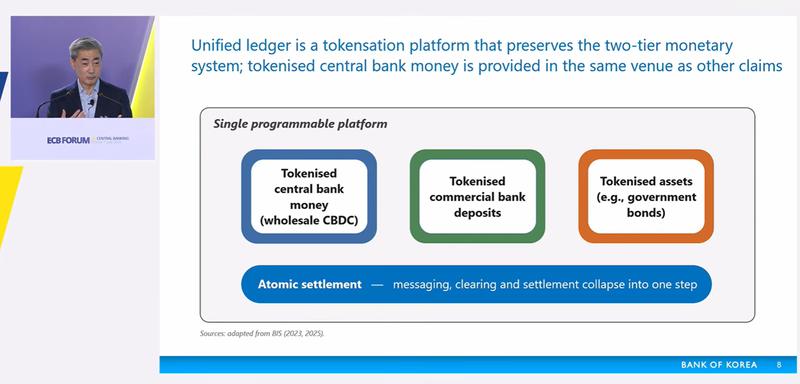
The governor also presented a roadmap for consolidating tokenized government bonds, wholesale central bank digital currencies, and tokenized commercial bank deposits onto a single unified ledger. This initiative represents an expansion of "Project Hangang," a pilot program led by the Bank of Korea that evaluates a blockchain-based wholesale CBDC system.
BIS suggests tokenized government bonds could drive financial innovation forward
The tokenization of government bonds has the potential to enhance market efficiency and drive financial innovation forward, as long as challenges related to regulation and infrastructure receive proper attention, according to a report released in July 2025 by the Bank for International Settlements (BIS).
According to the report, government securities serve an essential function within the financial system, functioning as both a savings instrument for households and companies and as collateral across various types of transactions. The report further stated:
"By enabling the contingent execution of actions, tokenisation can help to enhance the efficiency of markets, reduce settlement risk, broaden investment access and spur the creation of new financial services."
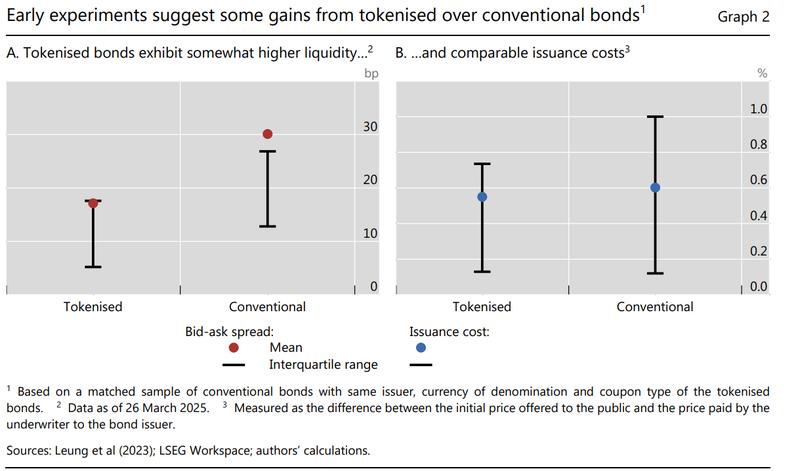
The research analyzed 39 tokenized bonds in total, comprising 24 bonds issued by corporate entities and 15 issued by governments. When comparing these to traditional, non-tokenized bonds, the BIS discovered "suggestive evidence" indicating lower bid-ask spreads while issuance costs and yields remained comparable.