Solana Foundation unveils protocol governance framework for network validators
A new governance framework has been introduced by the Solana Foundation, allowing validators who have a minimum of 100,000 delegated SOL to create and submit protocol proposals.

A newly introduced framework for protocol-level governance has been launched by the Solana Foundation, the Switzerland-based entity responsible for supporting development on the Solana network, which allows for proposing and voting on governance matters affecting the Solana blockchain.
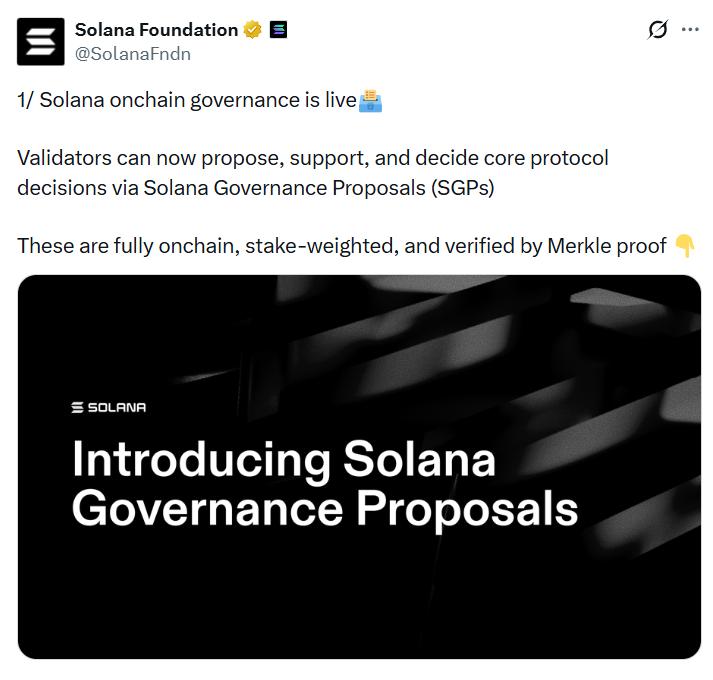
According to a Thursday announcement posted on X by the Foundation, the Solana Governance Proposals (SGPs) create a standardized process allowing validators to propose core protocol changes and cast onchain votes, with their voting strength determined by the amount of delegated Solana (SOL) stake they hold.
"An SGP captures a stake-weighted directional decision. It records what the community wants. It is not strictly focused on the technical detail of how to build the feature," states the GitHub repository, which went live on Thursday.
This newly implemented framework provides Solana with a transparent, community-led approach to making significant protocol-level decisions, decreasing dependence on centralized coordination mechanisms while maintaining separation between technical implementations, known as Solana Improvement Documents (SIMDs), and community governance processes.
Similar stake-weighted governance systems are utilized by other blockchain networks such as Polkadot, Cosmos, Cardano, Tezos and Avalanche.
Proposals require minimum 15% support
To qualify for a formal onchain vote, a proposal needs to obtain endorsements from validators who collectively represent a minimum of 15% of actively staked Solana tokens, a requirement designed to eliminate proposals of insufficient quality.
Validators holding at least 100,000 delegated SOL tokens have the ability to initiate a new governance proposal through the SGP system. Token holders who stake SOL can delegate their stake to validators, which enables these validators to represent them in the governance process.
Delegators who find themselves in disagreement with the voting choices made by their validator now have the ability to override that validator and cast their own vote on any proposal, thereby superseding the validator's vote for that specific proposal.
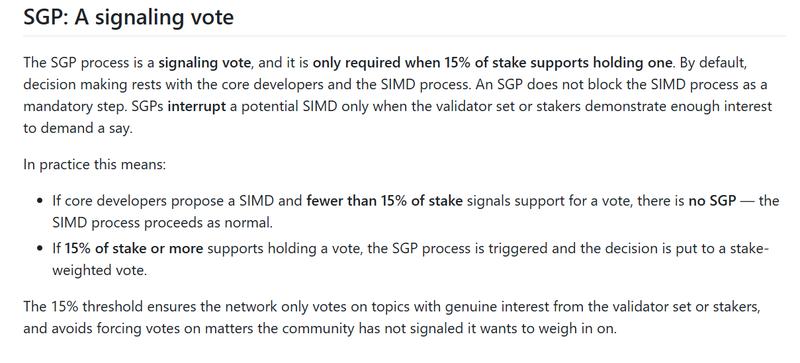
According to the Solana Foundation, governance-level matters will be addressed through SGPs, whereas smaller SIMD proposals will concentrate on technical protocol enhancements.
"SIMDs should focus on protocol changes, SGPs should be signals from the ecosystem," wrote the Foundation.
Last April, the Solana Foundation rolled out a new security auditing framework alongside an incident-response network designed for Solana-based protocols, developed in collaboration with Web3 security company Asymmetric Research.
This new program, called the Solana Trust, Resilience and Infrastructure for DeFi Enterprises (STRIDE), represents a "structured program for evaluating, monitoring and escalating security across Solana projects," as stated in the April announcement.
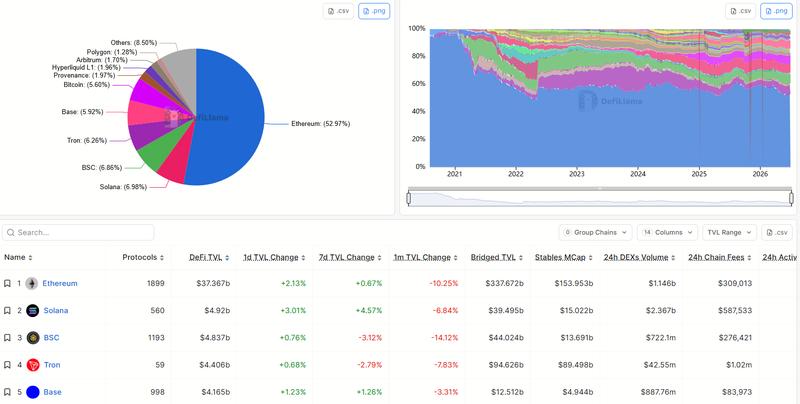
Currently holding the position as the second-largest blockchain network, Solana boasts $4.92 billion in total value locked (TVL), trailing behind Ethereum's $37.3 billion. Over the past 24 hours, Solana has generated more than $587,000 in blockchain fees, based on the most recent data from DefiLlama.