Samson Mow Cautions Against Hasty Quantum Cryptography Implementation for Bitcoin
Jan3 founder Samson Mow challenges industry demands for accelerated adoption of post-quantum cryptography in Bitcoin, cautioning that premature implementation may create fresh security weaknesses.

Implementing hasty quantum computing solutions for Bitcoin may expose the network to additional security threats, according to a warning issued by Samson Mow following public statements from senior Coinbase leadership advocating for more immediate measures.
The Jan3 founder and prominent Bitcoin supporter, Mow, utilized the X platform on Saturday to respond to recent statements made by Coinbase's chief executive Brian Armstrong alongside chief security officer Philip Martin, both of whom encouraged the cryptocurrency sector to accelerate preparations addressing quantum computing risks.
According to Mow, although post-quantum (PQ) cryptographic systems have the potential to protect Bitcoin (BTC) from emerging quantum computer capabilities, accelerating their deployment might generate fresh security gaps including compatibility challenges and diminished network performance stemming from increased signature dimensions.
"Simply put: make Bitcoin safe against quantum computers just to get pwned by normal computers," Mow said, adding that a poorly timed transition could weaken Bitcoin against today's threats before addressing future ones.
This discussion highlights an expanding conversation within the cryptocurrency community regarding appropriate strategies for safeguarding Bitcoin's future, particularly as recent breakthrough developments from Google and Caltech have renewed industry attention on quantum computing advancements.
Why Mow is pushing back and how it ties to the block size wars
Among Mow's primary apprehensions regarding an accelerated quantum solution for Bitcoin centers on possible performance ramifications, especially concerning block size, which determines the volume of transaction information that can be accommodated within an individual block.
"PQ signatures will likely be 10-125x larger than current ones, and massively reduce throughput," Mow said, citing former Bitcoin developer Jonas Schnelli.
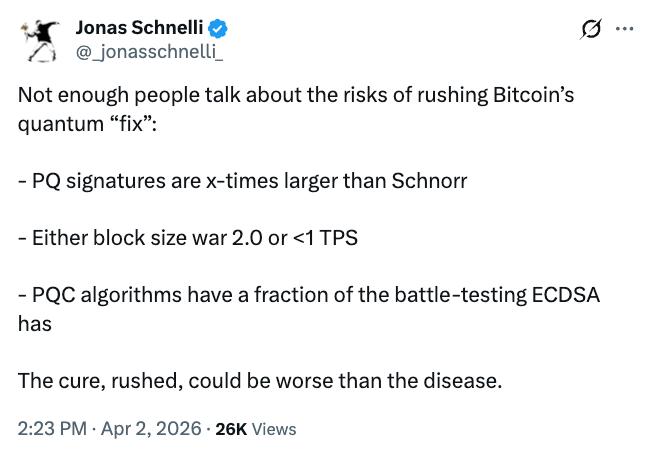
This challenge related to signature dimensions could potentially trigger "Blocksize Wars 2.0," according to Mow's continued assessment.
The original block size conflict in Bitcoin's history emerged approximately in 2015 and reached its climax during 2017, during which the community experienced a fundamental division regarding whether increasing block size capacity would enable greater transaction processing.
The contentious debate generated significant concerns surrounding decentralization principles, network security integrity and governance authority over Bitcoin's developmental trajectory, which eventually resulted in the adoption of alternative scaling methodologies instead of implementing a straightforward block size expansion.
While maintaining his position against hastening the transition toward post-quantum cryptographic systems for Bitcoin, Mow emphasized that development efforts on prospective solutions should remain ongoing.
"Given that quantum computers don't actually exist and likely won't exist for another 10-20 years, the worst possible course of action is to rush a fix," he said. "That's not to say work shouldn't be done to prepare, and there is already much work being done."