Privacy-Centric Venice AI Achieves Billion-Dollar Valuation Amid Rising Data Security Concerns
Venice AI, created by Erik Voorhees, secures $65 million in funding achieving a $1 billion valuation as venture capitalists anticipate increased appetite for AI platforms prioritizing user privacy.

Venice AI, established by Erik Voorhees, has reached unicorn status following a successful Series A funding round that brought in $65 million and valued the company at $1 billion.
The funding round, disclosed on Wednesday, was spearheaded by Dragonfly and supported by notable investors including Coinbase Ventures, F-Prime, North Island Ventures, Morgan Creek and additional partners. This represents the first time the company has secured external investment since its 2024 inception.
The timing of this capital injection is notable, arriving in the same month that Anthropic made the abrupt decision to restrict international access to a pair of its newest AI models. This development follows closely on the heels of a class-action lawsuit filed against OpenAI, alleging the company shared ChatGPT user data with external parties. These incidents underscore the growing market opportunity for AI platforms that prioritize user privacy.
"This capital will be used to uphold the First and Fourth Amendments to the Constitution as they relate to mankind's interaction with AI," Voorhees said in an X post on Wednesday.
Among the protections outlined in the United States Constitution, the First Amendment safeguards five fundamental freedoms, including freedom of speech. Meanwhile, the Fourth Amendment provides citizens with protection against unreasonable government searches and seizures.
Venice AI courts privacy-focused users
Boasting a user base of 3.5 million, Venice AI provides access to more than 200 AI models while implementing a proxy layer positioned between users and the models themselves. The platform empowers users to select their preferred privacy level.
When utilizing models from OpenAI, Anthropic, xAI and Google, the proxy system conceals users' IP addresses, account information and session data. Additional models on the platform provide even greater privacy protections.
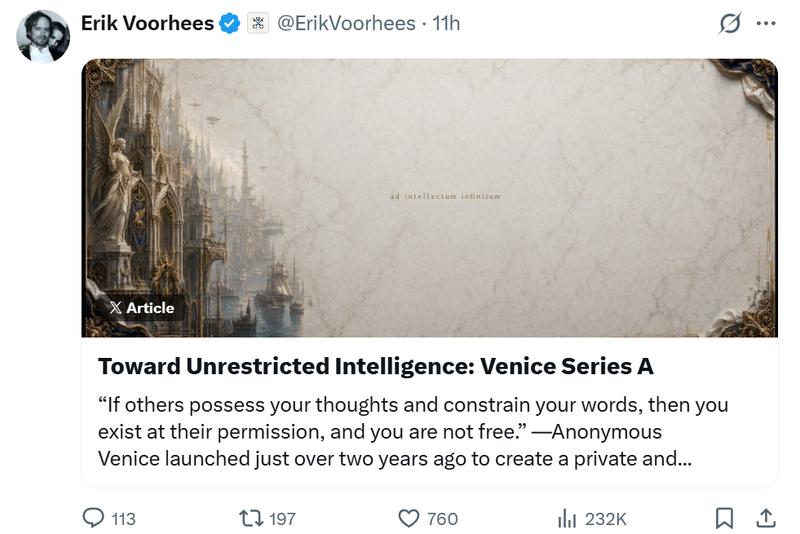
"Control over intelligence is the defining fight of the coming decade," Haseeb Qureshi, managing partner at Dragonfly, said on Wednesday.
"Whoever owns the AI delivery stack owns a direct window into your interior life. They log all your chats, train on them, and will hand them over when asked. And in the end, they decide the terms on which you'll get to access the most powerful systems humankind has ever built."
Haseeb Qureshi, managing partner at Dragonfly
According to Voorhees, the newly acquired capital will be allocated toward expanding the company's proprietary data center infrastructure, enabling Venice AI to own the GPUs that drive its platform instead of incurring the elevated expenses associated with renting them.
The balance of the funding will be directed toward expanding the company's customer base, penetrating new markets, recruiting talent and pursuing acquisitions of "additive businesses," he added.
AI privacy concerns in spotlight
This funding round arrives at a time when user privacy concerns related to AI model usage are escalating significantly.
Earlier this year, lawyers told Cointelegraph that a user consulting an AI for legal matters could have their chat logs used against them in court.
During February, Ethereum Foundation AI lead Davide Crapis alongside Ethereum co-founder Vitalik Buterin put forward a proposal utilizing zero-knowledge proofs combined with other methodologies to guarantee privacy for users engaging with large language models.
Discussion surrounding AI privacy intensified once more in May, following the filing of a proposed class action lawsuit in California federal court. The complaint accused OpenAI of revealing private ChatGPT user information to Google and Meta.