Polymarket Experiences First Monthly Trading Volume Drop Since August
After months of consecutive growth, prediction markets platform sees trading activity decrease as competitive landscape intensifies and new players enter the short-term trading space.


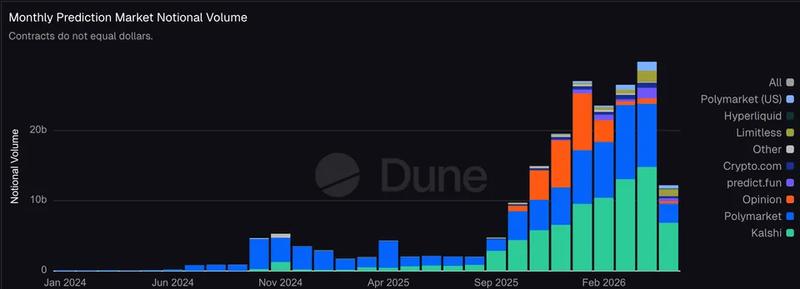
The prediction market platform Polymarket experienced an approximately 8.9% decrease in monthly trading volume during April, marking the first month-over-month decline in trading activity since August as competitors such as Kalshi capture greater portions of the market.
Combined figures for Polymarket and its US-focused trading application reached over $10.2 billion in volume throughout April, down from the more than $11.2 billion recorded in March, based on information from Dune Analytics.
In contrast, competing platform Kalshi saw its April trading volume jump approximately 13%, reaching roughly $14.8 billion, according to data from Dune.
The overall monthly trading volume across all prediction markets rose to approximately $29.8 billion in April, up from roughly $26.5 billion in March, representing an uptick of approximately 12.4%.
The decline in Polymarket's volume occurred during the company's efforts to completely reintegrate US markets, happening alongside heightened legal and regulatory examination of prediction markets by United States legislators following the sector's explosive expansion throughout the 2024 elections.
Indeed, prediction markets are demonstrating their appeal to a growing array of new market entrants.
Last week, Prophet, a prediction market platform built with AI-native capabilities, unveiled its initial live trading tranche, rolling out a framework in which an AI model serves as the counterparty utilizing actual capital. Earlier in the week, financial technology firm MoonPay introduced an AI-powered technology tool designed for trading strategies within prediction markets.
Polymarket eyes US expansion as prediction markets come under fire
Polymarket is working to broaden its operations in the US following its departure in 2022 as part of an agreement with the US Commodity Futures Trading Commission (CFTC), which prohibited the platform from permitting US residents access to its main, worldwide exchange.
In an effort to reestablish its presence, the company unveiled a dedicated app specifically for US customers in December 2025, though it operates as a platform that remains isolated from Polymarket's global platform and its available liquidity.
Multiple US lawmakers and regulatory authorities have expressed concerns regarding insider trading activities on prediction markets, especially in markets connected to war, energy prices, and other issues with geopolitical sensitivity.
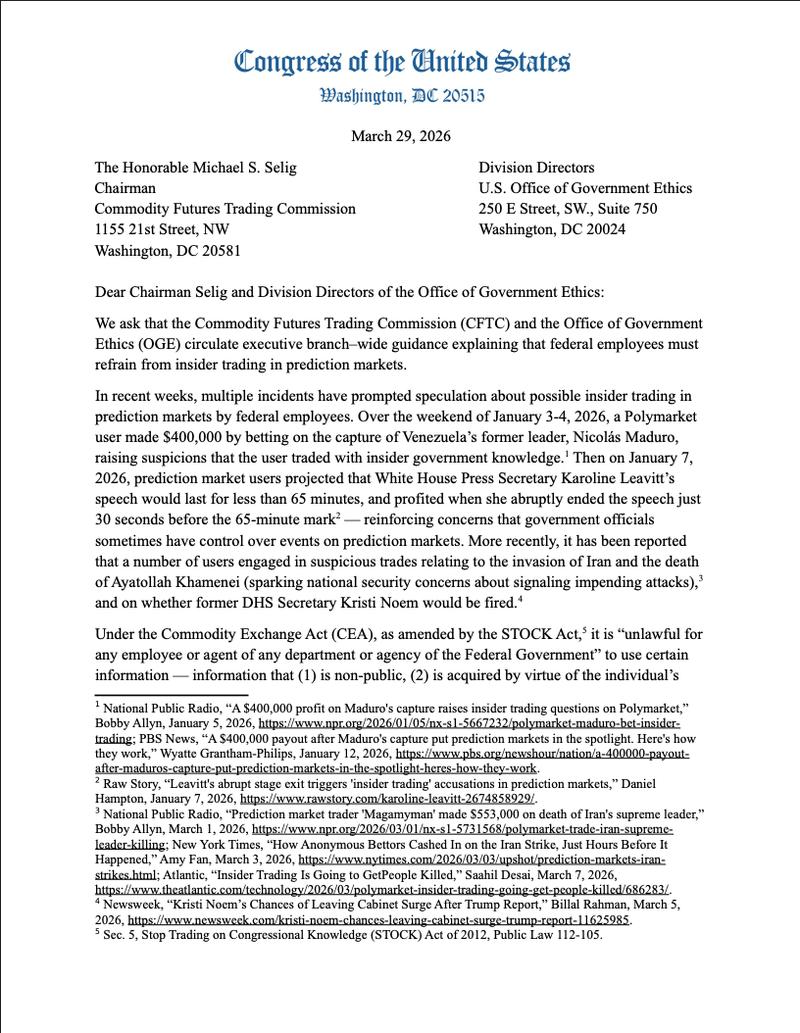
During March, Senator Elizabeth Warren alongside more than 40 Congressional representatives sent correspondence to the CFTC calling for a prohibition on government insiders leveraging prediction market platforms for profit while holding office or serving in an official capacity.
The CFTC maintains that event contracts are a type of swap subject to its jurisdiction, and, therefore, it should ensure that federal employees understand existing restrictions on prediction market insider trading.
US lawmakers in letter to CFTC
Additionally, Wisconsin Attorney General Josh Kaul initiated lawsuits against Kalshi, Polymarket, and other prediction markets during April, alleging that the platforms violated state sports betting laws.