Pentagon negotiations resume with Anthropic amid industry pressure on Trump over security classification: FT
The AI company had previously obtained a Pentagon deal valued at $200 million, with its technology deployed in sensitive military operations, including assistance for American airstrikes targeting Iran, according to the Financial Times.

The chief executive of Anthropic, Dario Amodei, has reportedly initiated fresh talks with the United States Department of Defense in what appears to be an eleventh-hour attempt to maintain the company's eligibility for Pentagon contracts, even as the Trump administration considers designating the firm as a potential supply chain security threat.
According to the Financial Times, which cited sources with knowledge of the situation, Amodei has been engaged in conversations with Emil Michael, who serves as the US undersecretary of defense for research and engineering, with the goal of hammering out final terms that would govern how the military utilizes Anthropic's artificial intelligence technology.
Should a fresh agreement be reached, it would enable the Pentagon to continue deploying the company's AI systems and might head off an official designation that would compel defense supply chain contractors to sever their relationships with the artificial intelligence firm, according to the report.
These renewed discussions come on the heels of a dramatic collapse in negotiations during the previous week. According to reports, Michael allegedly called Amodei a "liar" and accused him of possessing a "God complex," while the talks ultimately broke down when both parties were unable to reach consensus on specific wording that Anthropic maintained was essential to prevent the misuse of its artificial intelligence technology.
Pentagon negotiations stall over bulk data analysis clause
According to an internal staff memorandum reviewed by the FT, Amodei reportedly indicated that toward the conclusion of the negotiation process, the Pentagon proposed accepting Anthropic's more comprehensive terms on the condition that the company eliminate a provision that restricted the "analysis of bulk acquired data." Amodei explained that this particular phrase was intended as a safeguard against the possibility of widespread domestic surveillance activities, a use case that Anthropic considers an absolute red line, similar to its prohibition on deploying AI in lethal autonomous weapons systems.
The controversy intensified following Defense Secretary Pete Hegseth's public warning that Anthropic might face designation as a supply chain security risk, a classification that would effectively exclude the company from participation in United States military procurement channels.
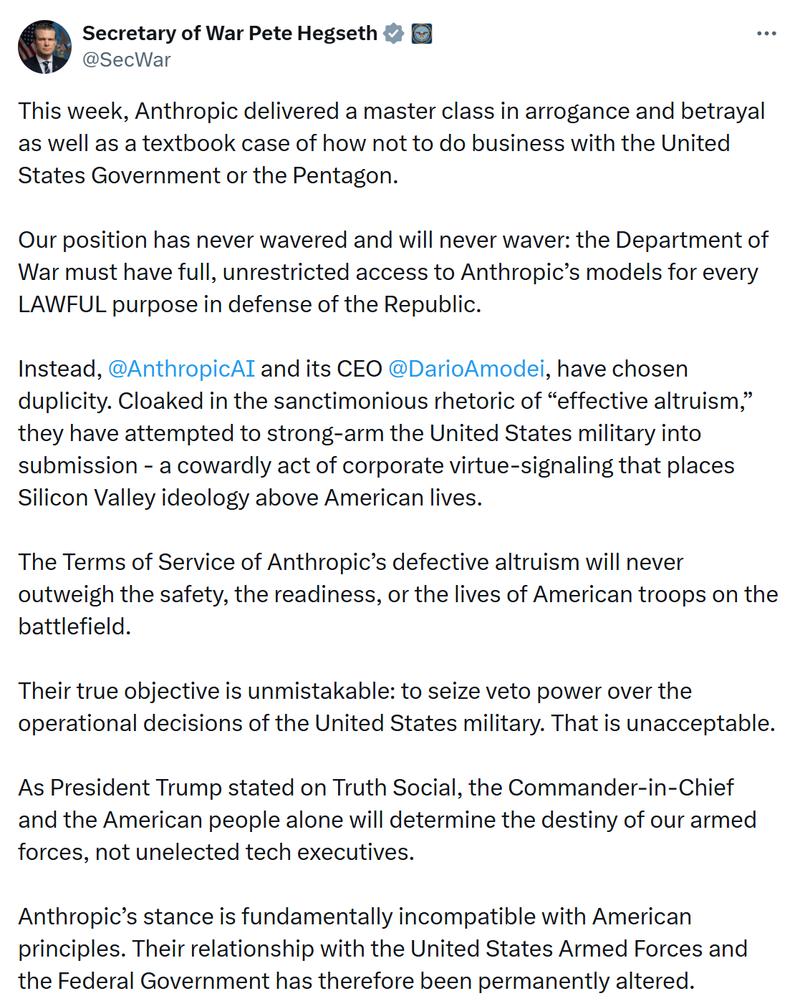
This impasse is particularly notable given Anthropic's established relationships within the defense industry. The company received a contract from the US Defense Department valued at up to $200 million in July 2025 and achieved the distinction of being the first artificial intelligence provider to have its models deployed in classified settings and utilized by national security organizations.
According to previous Cointelegraph coverage, the United States military actually employed Anthropic's Claude AI technology to provide support for a significant air strike operation against Iran mere hours after President Donald Trump had directed federal agencies to cease using the company's technological solutions.
Tech groups warn risk label could hurt US AI leadership
At the same time, multiple technology industry organizations issued a letter to Trump on Wednesday, cautioning that classifying a domestically-based AI company as a supply chain risk could seriously damage United States leadership in the artificial intelligence sector. These groups contended that treating an American technology enterprise "as a foreign adversary, rather than an asset," has the potential to stifle innovation and diminish America's competitive position against China in the worldwide race for AI dominance.
Organizations that signed the letter included the Software & Information Industry Association, TechNet, the Computer & Communications Industry Association and the Business Software Alliance. These industry associations collectively represent hundreds of American technology corporations, including artificial intelligence chip manufacturers Nvidia, Alphabet's Google and Apple.