Paxful Hit With $4M Penalty for Facilitating Criminal Money Transfers
Federal authorities revealed that Paxful promoted itself as a platform without KYC requirements while maintaining anti-money laundering protocols that were never actually "implemented or enforced."

A peer-to-peer cryptocurrency exchange platform, Paxful, has received an order to pay a $4 million penalty following its admission that it deliberately earned profits from criminal actors who utilized the platform specifically because it lacked proper anti-money laundering safeguards.
Federal prosecutors announced on Wednesday that the cryptocurrency exchange received its sentence to pay the monetary penalty after entering a guilty plea in December on charges including conspiracy to promote illegal prostitution activities, knowingly processing transfers of criminally-derived funds, and failing to meet anti-money laundering regulatory standards.
"Paxful profited from moving money for criminals that it attracted by touting its lack of anti-money laundering controls and failure to comply with applicable money-laundering laws, all while knowing that these criminals were engaged in fraud, extortion, prostitution and commercial sex trafficking," said Andrew Tysen Duva, the assistant attorney general of the Justice Department's Criminal Division.
Federal prosecutors revealed that during the period spanning from January 2017 through September 2019, the platform Paxful processed more than 26 million individual transactions totaling approximately $3 billion in overall value while generating revenue exceeding $29.7 million.
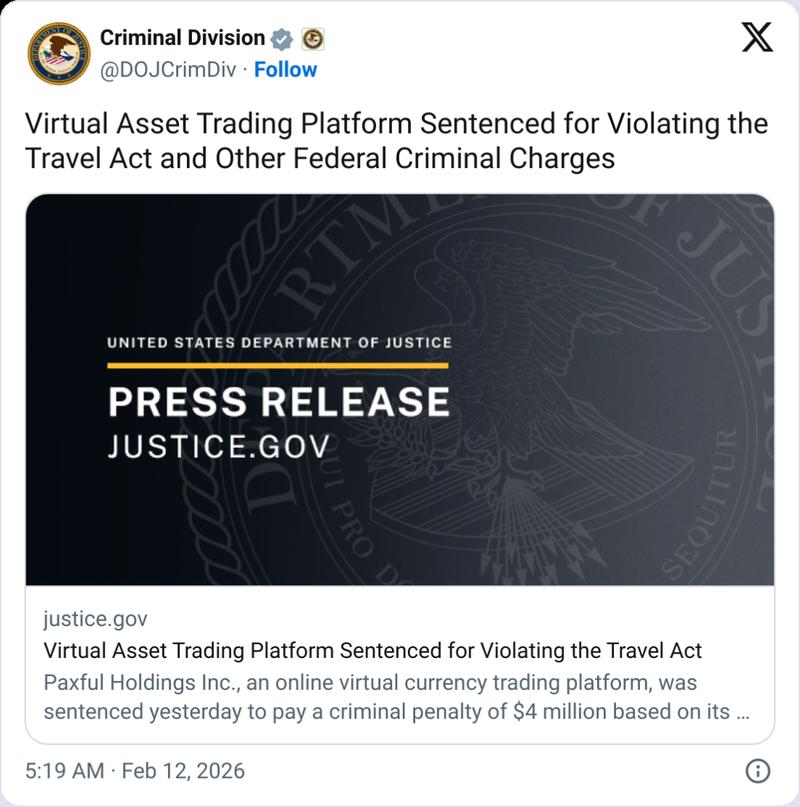
Federal prosecutors stated that Paxful had acknowledged that an appropriate criminal financial penalty would amount to $112.5 million, however authorities concluded the organization lacked the financial capacity to pay any amount beyond the $4 million fine.
Paxful made millions from illegal prostitution ads
The Department of Justice revealed that Paxful positioned itself in the marketplace as a service that did not mandate customer identification information while presenting fraudulent anti-money laundering compliance policies that company executives knew "were not implemented or enforced."
Based on court documents, prosecutors identified one of Paxful's commercial clients as Backpage, a classified advertisement website that law enforcement agencies ultimately shut down for publishing advertisements promoting illegal prostitution services.
"Paxful's founders boasted about the 'Backpage Effect,' which enabled the business to grow," the Justice Department said, adding that Paxful's collaboration with Backpage and a similar site between 2015 and 2022 saw the crypto platform earn $2.7 million in profits.
The cryptocurrency exchange Paxful ceased its business operations in November and, through a blog post published in October that has since been removed from the internet, attributed the closure decision to "the lasting impact of historic misconduct by former co-founders Ray Youssef and Artur Schaback prior to 2023, combined with unsustainable operational costs from extensive compliance remediation efforts."
Youssef said in response to Paxful's post that the company "should have closed down when I left the company two years ago."
Schaback, who is also Paxful's former chief technology officer, pleaded guilty in July 2024 to conspiring to fail to maintain an effective anti-money laundering program.
The former executive Schaback remains in waiting for his official sentencing hearing, with a federal judge in California granting approval in December to postpone a scheduled sentencing conference from January to May following prosecutors' explanation that he continues to supply information relevant to the government's ongoing investigation into Paxful, "which may bear on the government's sentencing recommendation."
US authorities have not publicly named or charged Youssef in connection with Paxful.