Morpho integration brings native stablecoin yield earnings to Trezor Suite
Users can now generate returns on USDt and USDC stablecoins directly within Trezor Suite, eliminating the need for third-party DeFi platforms or external wallet connections.

The hardware wallet manufacturer Trezor has introduced native stablecoin yield earning capabilities within Trezor Suite, its desktop and mobile wallet application, representing a significant step toward making yield generation more approachable for cryptocurrency holders who have historically steered clear of decentralized finance platforms because of their technical complexity and associated security concerns.
The functionality, which was revealed on Thursday, arrives via a partnership with Morpho, an Ethereum-based decentralized lending protocol. Through this collaboration, users gain the ability to deposit USDt (USDT) and USDC (USDC) into carefully selected Morpho vaults directly within Trezor Suite, eliminating the requirement to connect third-party wallets or navigate standalone DeFi platforms.
As outlined by Trezor, all deposits, withdrawals and reward claims undergo direct signing on users' hardware wallet devices via the company's clear-signing interface, a feature that presents transaction information in plain language on the physical device display.
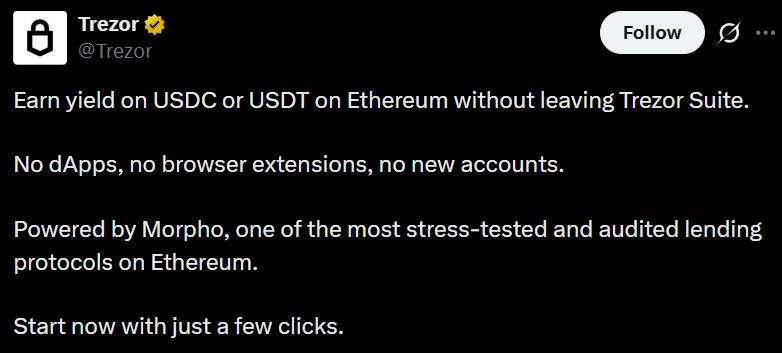
For the initial rollout, Trezor has chosen two Morpho vaults managed by Steakhouse Financial — specifically USDC Prime and USDT Prime. According to the company's statement, the yield generation stems from actual borrowing demand within Morpho's ecosystem rather than relying on token-based incentive mechanisms.
As one of the most prominent cryptocurrency hardware wallet manufacturers globally, Trezor holds a position as the market's second-largest competitor, trailing only behind Ledger.
Hardware wallet manufacturers have increasingly been pursuing a strategic initiative to embed decentralized finance capabilities directly within their custody solutions, simultaneously working to minimize the technical barriers that have traditionally characterized DeFi protocol interactions.
Ledger has already implemented native stablecoin yield generation within Ledger Live through Kiln-enabled integrations that connect to various protocols such as Morpho, Aave and Compound.
Stablecoin yield draws growing interest — and scrutiny
Yield-generating strategies for stablecoins have emerged as among the most rapidly expanding applications within DeFi, providing users with opportunities to generate returns on assets pegged to the dollar by supplying them to onchain lending protocols.
Based on information from CoinMarketCap data, annual percentage yields on USDC demonstrate significant variability depending on the platform and prevailing market dynamics, with certain protocols delivering annual returns exceeding ten percent. Proponents argue that yield-bearing stablecoin offerings present cryptocurrency investors with viable methods for generating passive revenue streams.
Nevertheless, these strategies come with inherent risks, which include potential smart contract security flaws, challenges related to liquidity availability, and dependencies on centralized stablecoin issuing entities or counterparty exposures.
Vitalik Buterin, who co-founded Ethereum, recently articulated a clear differentiation between genuine decentralized finance and numerous yield-generating stablecoin offerings currently available in the marketplace. In a recent social media post, Buterin argued that many "USDC yield" strategies maintain substantial reliance on centralized issuing authorities while not sufficiently mitigating counterparty-related risks.

Buterin put forward two alternative frameworks that he suggested better align with the decentralized principles foundational to DeFi: algorithmic stablecoins backed by Ether reserves and stablecoins supported by overcollateralized real-world assets.