Housing legislation carrying CBDC prohibition through 2030 awaits Trump's signature
Following House approval of a housing measure that prohibits central bank digital currencies through 2030, the legislation awaits final approval from President Donald Trump.

A comprehensive housing measure containing provisions that would prohibit central bank digital currencies through 2030 has secured passage in the US House of Representatives, marking what appears to be a significant victory for Republican lawmakers who have persistently advocated for this restriction.
On Tuesday, the House approved the 21st Century ROAD to Housing Act by a vote of 358-32, following the Senate's 85-5 vote in favor of the legislation one day earlier. The bill's primary objective addresses housing affordability concerns. President Donald Trump will receive the legislation next, having already indicated his support for the measure, with expectations pointing to his signature on Wednesday.
Today, Congress delivered a major win for families working toward the American Dream. I look forward to President Trump signing it into law.
Senate Banking Committee Chairman Tim Scott
Central bank digital currencies represent fiat currency issued by a central bank and recorded on a digital ledger. The bill's enactment will mark a victory for Republican lawmakers who have pursued CBDC prohibition legislation for several years, as well as cryptocurrency supporters who view CBDCs as an effort to convert technology originally designed for decentralized digital assets into a tool for centralized control.
Within the housing legislation, specific language prohibits the Federal Reserve from, either directly or indirectly, "issue or create a central bank digital currency or any digital asset that is substantially similar to a central bank digital currency," with this provision set to expire on Dec. 31, 2030.
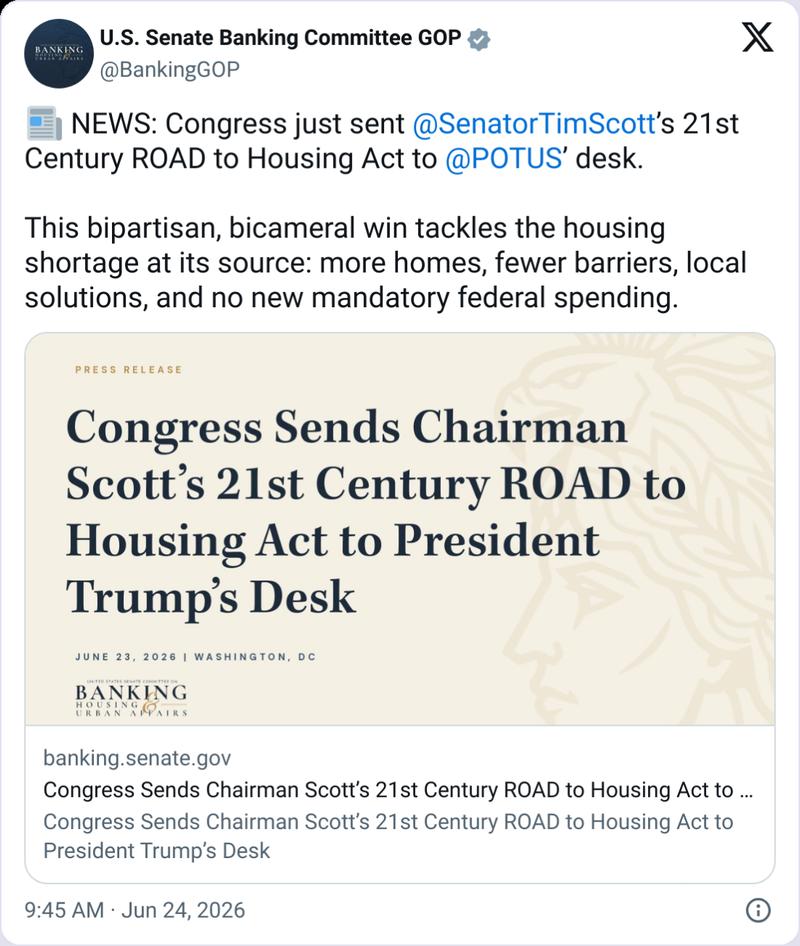
The legislation's rapid advancement follows an agreement reached last week between House and Senate leadership to proceed with the housing bill, after prior disagreements over various components of the proposed legislation.
The CBDC prohibition has been incorporated into the bill since the Senate approved its version in March. Additionally, the legislation includes an exception for cryptocurrency stablecoins, permitting "dollar-denominated currency that is open, permissionless and private."
The CBDC prohibition incorporated language previously featured in Republican Representative Tom Emmer's Anti-CBDC Surveillance State Act. Emmer's bill was introduced in June 2025 and secured House passage one month later, though it failed to gain traction in the Senate.
Having cleared the housing bill from their legislative calendar, Congress can now turn its attention toward passing additional legislation ahead of the August recess and the November midterm elections.
Among the bills attracting significant attention is the Senate's cryptocurrency market structure legislation, known as the CLARITY Act, which numerous lawmakers have been advocating to move forward.
Notwithstanding months of negotiations between legislators and lobbyists representing the cryptocurrency and banking sectors, the CLARITY Act continues to face opposition, and the likelihood of its passage this year has diminished.
Earlier this month, Galaxy Digital revised downward its projection for Senate passage of the bill before year's end, assigning it a 60% probability as the congressional calendar becomes increasingly constrained.