Grvt Partners with Plume to Introduce Three Tokenized RWA Yield Products
Through a collaboration with Plume, Grvt plans to introduce three tokenized products featuring fixed-income and structured credit offerings linked to institutional-quality real world assets alongside onchain yield mechanisms.

In collaboration with Plume, decentralized perpetual futures platform Grvt plans to introduce three yield products based on tokenized real-world assets (RWA), providing traders with access to structured credit and fixed-income instruments via self-custodial wallet infrastructure.
The products will be natively integrated into Grvt's existing platform and feature exposure to tokenized assets of institutional quality, including the iShares AAA CLO Active ETF, which holds $2.2 billion in assets, according to an announcement made on Tuesday.
Three distinct investment vehicles—the Base Yield Fund, the Balanced Fund, and the Opportunistic Fund—will be added to Grvt's trading infrastructure through this integration, enabling users to gain access to tokenized yield products using the same self-custodial balance they utilize for trading activities, eliminating the need to move assets between different wallets, brokerage platforms or custodial service providers.
A blockchain infrastructure designed for tokenized real-world assets, Plume will facilitate the integration. The products merge tokenized exposure to fixed-income instruments with onchain yield mechanisms developed on Plume's network, according to the announcement.
Financial instruments known as perpetual futures contracts, commonly called perps, enable traders to gain exposure to price movements of underlying assets without taking ownership of those assets. Perps differ from conventional futures contracts in that they lack an expiration date, allowing market participants to hold their positions indefinitely.
Data from CoinGecko indicates that total trading volume across perpetual DEX platforms reached $15.2 billion during the 24-hour period ending at 8 p.m. UTC on Monday. During that same timeframe, Grvt recorded $1.23 billion in trading volume.

Earlier this year in February, Grvt integrated Aave, a decentralized lending protocol, enabling traders to generate yield on their margin collateral without closing their perpetual futures positions.
Platforms increasingly integrate tokenized RWAs
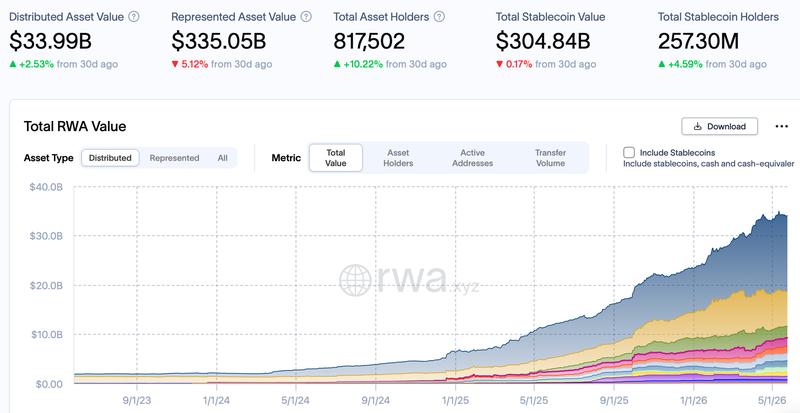
According to data from RWA.xyz, the tokenized real-world asset market has expanded to exceed $34 billion in onchain valuation, marking a substantial increase from approximately $5.8 billion recorded at the beginning of 2025.
This expansion has occurred alongside increasing efforts by cryptocurrency exchanges, trading infrastructure providers and tokenization firms to introduce blockchain-enabled versions of conventional financial instruments onchain.
Last March, EtherFi committed $25 million to Plume's Nest protocol, providing users with access to tokenized yield products connected to institutional-grade assets and government securities. During the same month, BTC Markets, an Australian cryptocurrency exchange, disclosed that it had informed the nation's securities regulator of its intention to seek a markets license for offering tokenized real-world assets, including bonds and equities.
During February, Binance introduced tokenized equities and exchange-traded funds sourced from Ondo Finance onto its Binance Alpha platform, featuring blockchain-based representations of commodities, ETFs and stocks. Also during February, Securitize entered into a partnership with stablecoin infrastructure provider STBL, OKX Ventures and Hamilton Lane to introduce a stablecoin supported by tokenized private credit assets.
A report released by Boston Consulting Group earlier this month identified tokenized fixed-income products, collateral and funds as the blockchain-based financial instruments most positioned for widespread institutional acceptance throughout the next decade.
According to the report, digital assets are progressively moving beyond purely speculative trading activities toward foundational infrastructure connected to capital markets, settlement processes and payments.