European Banking Authority Unveils Severe Cryptocurrency Penalties Under New MiCA Framework
A comprehensive penalty structure targeting non-compliant major token issuers has been introduced by the European Banking Authority, with potential fines of up to 12.5% of revenue under the new MiCA regulations.

A comprehensive enforcement framework targeting cryptocurrency issuers who breach the European Union's digital-asset regulations was introduced Friday by the European Banking Authority, marking a more aggressive regulatory posture as the bloc completes its groundbreaking legislative infrastructure for the sector.
Released on June 26, the consultation document sets forth a uniform methodology for imposing potentially massive euro-denominated fines on issuers of tokens classified as "significant" by the EBA when they fail to meet compliance standards. The Paris-headquartered regulator's proposal outlines a rigorous two-tier methodology for calculating penalties, beginning with an evaluation of the fundamental gravity of violations before incorporating factors that either aggravate or mitigate the offense.
This development marks an escalation in enforcement capabilities for the European Union's groundbreaking Markets in Crypto-Assets (MiCA) regulation. Designed to impose structure on a sector previously characterized by minimal oversight, MiCA stands as the planet's inaugural all-encompassing regulatory framework for digital assets, mandating that token issuers and cryptocurrency service providers maintain banking-sector-level compliance standards, consumer safeguards and capital requirements as a condition for accessing the unified European marketplace.
The consequences for failing to comply are intentionally crafted to inflict significant financial pain. Based on the EBA's consultation document, ultimate penalties may climb to legislative maximums of 12.5% of yearly turnover for entities issuing significant asset-referenced tokens and 10% for those issuing significant e-money tokens, or alternatively twice the profits derived from the violation—thresholds intended to discourage even the most substantial international digital-asset firms from infractions.
The introduction of this penalty structure arrives at a pivotal moment for the European digital asset sector, emerging merely days before an essential July 1 compliance threshold. Before the beginning of next month, cryptocurrency companies must obtain official licenses from national regulatory bodies to lawfully provide their services or advertise stablecoins throughout the 27-member union, bringing to a close a transitional accommodation period that permitted numerous operators to function under less stringent domestic regulations.
Companies that do not obtain their regulatory authorization by July 1 encounter the possibility of being compelled to cease operations completely or face triggering the precise violations, including unauthorized public announcements or organizational deficiencies, that the EBA's newly established framework was constructed to punish.
Binance pushes "pause" on EU operations after license fail
Binance, the planet's largest exchange operator, informed European Union customers last week that their access to essential services would be curtailed following the exchange's inability to obtain MiCA authorization from a member nation before the July 1 cutoff date, after withdrawing its MiCA license submission in Greece.
These limitations encompass stopping the registration of additional EU customers and restricting particular services for accounts based in the EU beginning July 1, based on exchange communications distributed by users across social media platforms.
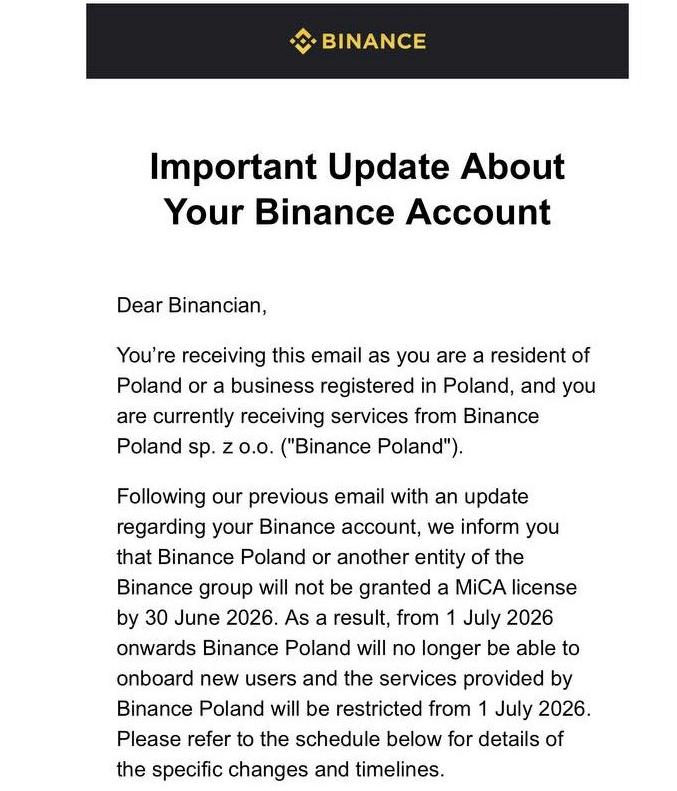
The communications indicated that customers would retain the ability to withdraw their holdings following that date, specifying that "all digital assets are still available for withdrawal," consistent with relevant regulatory mandates.
According to DefiLlama data examined by Cointelegraph on Sunday, Binance experienced $1.96 billion in daily net outflows on Wednesday, in the aftermath of its withdrawal announcement. The exchange subsequently witnessed an additional $2.52 billion and $1.46 billion in net outflows during the subsequent two days.
EU move shows sharp contrast with US enforcement approach
The chronological coordination highlights the European Union's overarching blueprint to establish itself as the preeminent international benchmark-setter for digital finance, standing in stark opposition to the regulation-by-enforcement methodology observable in the United States. Through the articulation of explicit financial sanctions precisely as the licensing requirement becomes operative, authorities in Brussels are communicating to the market that the period of tolerance has definitively concluded.
The industry currently has a three-month consultation period concluding September 28 to advocate for modifications to the EBA's penalty calculation approach. Nevertheless, with the July 1 licensing deadline merely days away, industry leaders will need to operate within a demanding compliance landscape well in advance of the final penalty guidelines being codified into law.