EU regulator cautions prediction platforms: event contracts may violate existing retail investor bans
The European Securities and Markets Authority has issued a clarification stating that numerous event contracts offered on prediction market platforms could already be subject to prohibitions affecting EU retail investors under current securities legislation, eliminating the need for additional regulatory measures.

The European Securities and Markets Authority (ESMA) has issued a warning stating that numerous contracts on prediction market platforms could already be subject to current binary options restrictions, emphasizing that firms cannot sidestep financial regulation merely by labeling these products as "event contracts."
Through a public statement released on Friday, the European regulatory body reminded market participants that event contracts that satisfy the criteria of financial instruments face existing prohibitions preventing their marketing, distribution or sale to retail investors through national measures that implement ESMA's 2018 binary options restrictions.
According to ESMA, the determination hinges on the actual characteristics of a contract instead of its marketing presentation, noting that event contracts featuring binary outcomes alongside fixed payouts would likely meet the definition of financial instruments covered by the restrictions.
The authority further clarified to companies that providing qualifying event contracts to professional or institutional clients continues to require proper authorization under the EU's Markets in Financial Instruments Directive, or MiFID II, irrespective of whether retail investors have been excluded from participation.
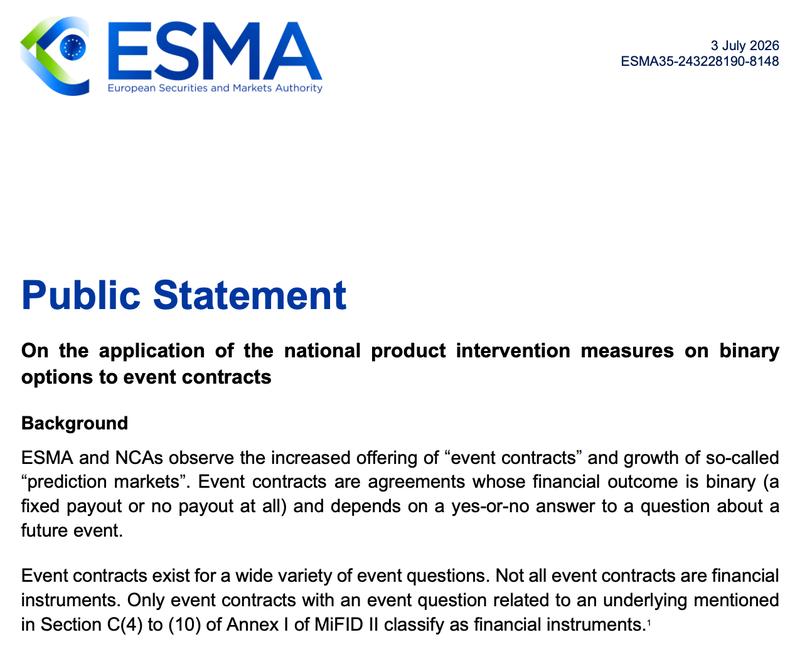
The public statement does not establish new regulatory restrictions. According to ESMA, the reminder was issued following observations of increased event contract offerings and the substantial expansion of prediction markets, highlighting that binary options meeting the qualification criteria have been restricted by national measures throughout the EU since 2018.
US prediction markets face growing legal battle
Across the Atlantic in the United States, an intensifying regulatory dispute over prediction markets is developing, with state gaming regulators challenging the Commodity Futures Trading Commission (CFTC) regarding whether event contracts should be classified as gambling activities or federally supervised derivatives.
By the end of March, regulatory or legal actions had been initiated by authorities in 11 states targeting platforms such as Kalshi and Polymarket. Nevada distinguished itself as the first state to impose a temporary prohibition on Kalshi's business activities, while Arizona pursued criminal charges claiming the platform was conducting an illegal gambling enterprise.
In the subsequent month, the CFTC declared "exclusive jurisdiction" over prediction market operations, stating that Congress had granted the agency singular authority to oversee commodity derivatives markets, which includes event contracts. The federal regulator additionally disclosed that it had initiated lawsuits against multiple states and submitted court briefs in support of platforms, among them Kalshi.
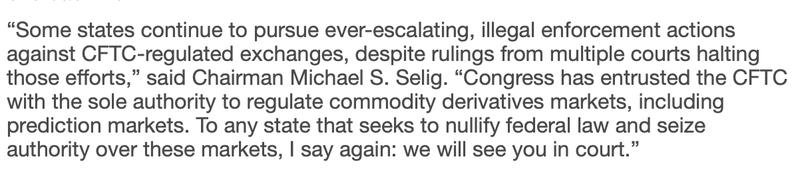
The jurisdictional conflict has continued its escalation. On June 30, a Massachusetts judge granted state authorities permission to file an amended complaint against Kalshi in a pending lawsuit that alleges the platform's sports-event contracts represent illegal gambling activities under state law.
This regulatory dispute has additionally generated demands for congressional intervention. Last month, the Indian Gaming Association and American Gaming Association, alongside tribal and labor organizations, petitioned lawmakers to modify the CLARITY Act to explicitly ban sports-related event contracts on prediction market platforms, contending they exist outside the CFTC's jurisdictional authority and should remain governed by state gambling laws.
According to some legal experts, the escalating jurisdictional conflict between federal and state regulators concerning prediction markets may eventually require resolution by the US Supreme Court.