ETH maintains $2,000 support as $242M spot ETH ETF withdrawals threaten renewed decline
While Ether sustains the $2,000 level, continued downward pressure looms as market participants monitor US corporate financial reports, government bond activity, and escalating international conflicts.

Essential points:
- Corporate and institutional appetite for Ether is diminishing as capital flows into the perceived security of short-duration US Treasury instruments.
- Elevated borrowing costs combined with expanding ETH token circulation render current staking returns less compelling for those with extended investment horizons.
The price of Ether (ETH) has struggled to maintain trading levels exceeding $2,150 from Feb. 5 onward, prompting market participants to worry about additional downward movement. Market confidence weakened in response to capital withdrawals from Ether exchange-traded funds (ETFs) coupled with heightened interest in put (sell) option contracts.
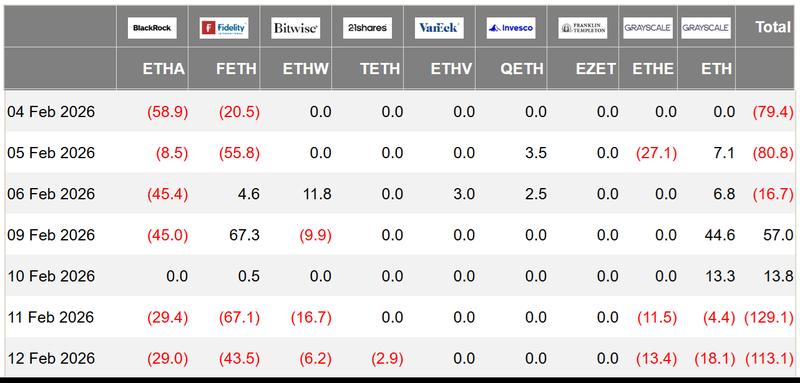
Exchange-traded funds tracking Ether in the United States recorded combined net withdrawals totaling $242 million during the Wednesday through Thursday period, effectively undoing the positive momentum observed in the preceding 48 hours. The institutional buying interest that emerged following Ether's 20% price rebound from its $1,744 low point on Feb. 6 has dissipated as market participants recognized volatility in US economic expansion—demonstrated by the increasing appetite for short-maturity US Treasury securities.
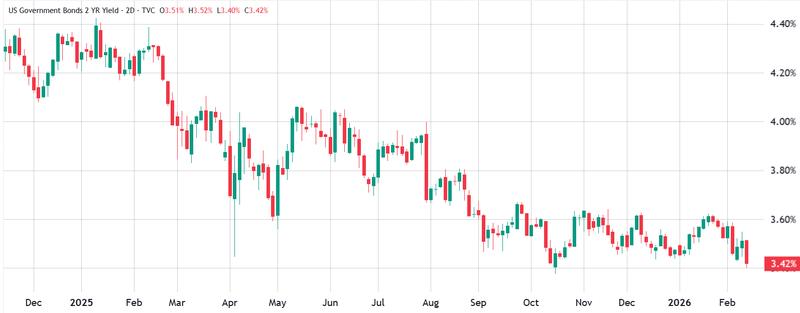
Returns on the US 2-year Treasury note dropped to 3.42% by Friday's close, approaching the most depressed levels observed since August 2022. The elevated interest in government-secured obligations signals market expectations for continued monetary easing by the US Federal Reserve (Fed) over the course of 2026. Indicators suggesting economic slowdown diminish inflationary concerns, creating conditions favorable for expansionary policy actions.
Irrespective of wider economic developments, Ether has lagged behind the performance of the overall cryptocurrency sector, prompting market participants to evaluate whether Ethereum retains competitive advantages compared to blockchain networks featuring native scalability solutions and accelerated onchain transaction processing.
Market participants harbor concerns that ETH valuation faces additional declines, though available data appears to mirror current price weakness instead of signaling expectations for a deeper collapse.
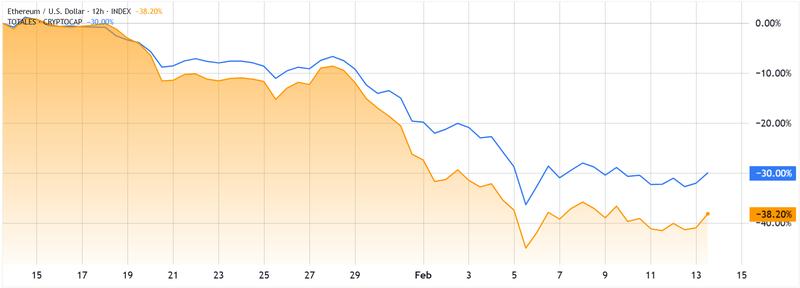
The value of Ether dropped 38% over the preceding 30-day period, creating adverse effects on network transaction costs and consequently diminishing the appeal of staking activities. Extended holding periods represent a vital element for achieving durable price appreciation, and the present 2.9% staking return rate appears uncompelling when compared against the US Fed benchmark rate of 3.5%. Additionally, the circulating ETH token supply is expanding at a 0.8% yearly pace.
Derivatives data for ETH indicates trader anxiety regarding potential price deterioration
Institutional and professional market participants display reluctance to maintain positions vulnerable to downward price movements based on ETH derivatives indicators, which serves to amplify the prevailing pessimistic outlook.
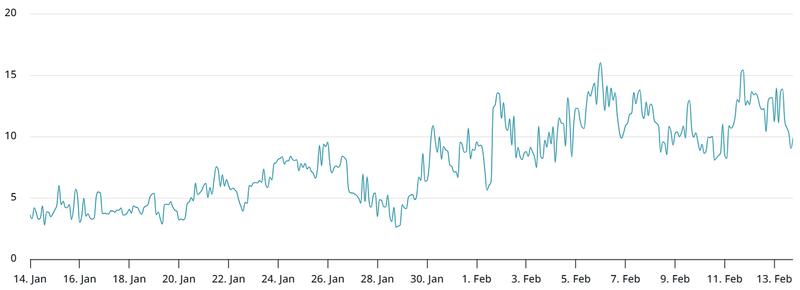
The delta skew metric for ETH options registered at 10% on Friday, indicating that put (sell) option contracts commanded higher prices. The heightened interest in neutral-to-pessimistic trading approaches drives the metric beyond the 6% level, which has represented the standard measurement for the previous fourteen-day span. Trader psychology mirrors a six-month declining market as ETH currently exchanges 58% beneath its historical peak valuation.
Examining the situation from a wider viewpoint, a relatively modest $242 million in Ether ETF capital outflows accounts for under 2% of the aggregate $12.7 billion in total assets under management; therefore, market participants should avoid concluding that ETH valuation has commenced an irreversible downward trajectory. Investor confidence will ultimately rebound given the network's maintained position as the undisputed leader in Total Value Locked (TVL) measurements.
Market focus will probably continue concentrating on quarterly earnings announcements from major corporations and whether the US federal government can successfully refinance its outstanding obligations against a backdrop of intensifying worldwide socioeconomic tensions. Within this environment, ETH valuation will probably face ongoing challenges independent of blockchain activity metrics and derivatives market indicators.