Buterin Proposes Cryptographic Obfuscation as Path to Private Blockchain Voting
Ethereum's Vitalik Buterin has detailed how cutting-edge cryptographic techniques might facilitate private blockchain-based voting systems independent of trusted third parties, despite current technological limitations.

Vitalik Buterin, who co-founded Ethereum, released a detailed technical blog post describing how cryptographic methods might eventually allow individuals to cast votes privately on blockchain networks without requiring a trusted entity to oversee ballots or disclose final outcomes.
Through a Monday blog entry, Buterin explained that a cryptographic technique known as indistinguishability obfuscation (iO), when paired with blockchain technology, has the potential to facilitate voting systems that are both private and resistant to collusion while operating with "almost no trust assumption." This methodology would eliminate the need for threshold committees, which currently work together to decrypt voting information, replacing them with secured programs that only disclose the final results.
Currently, private voting on blockchain platforms depends on groups of operators who protect sensitive information and maintain honest conduct. Eliminating this dependency has the potential to make decentralized governance systems more resistant to manipulation, minimize risks associated with insider tampering, and enable voters to cast their ballots without revealing their individual choices, Buterin noted.
Nevertheless, Buterin acknowledged that this technology is far from being practically viable. He characterized the most conservative implementations as requiring what he termed "galactic" levels of computational resources. He noted that more efficient methods depend on security assumptions that haven't been thoroughly tested, indicating that this concept represents a long-term area for research exploration rather than a system ready for immediate implementation.
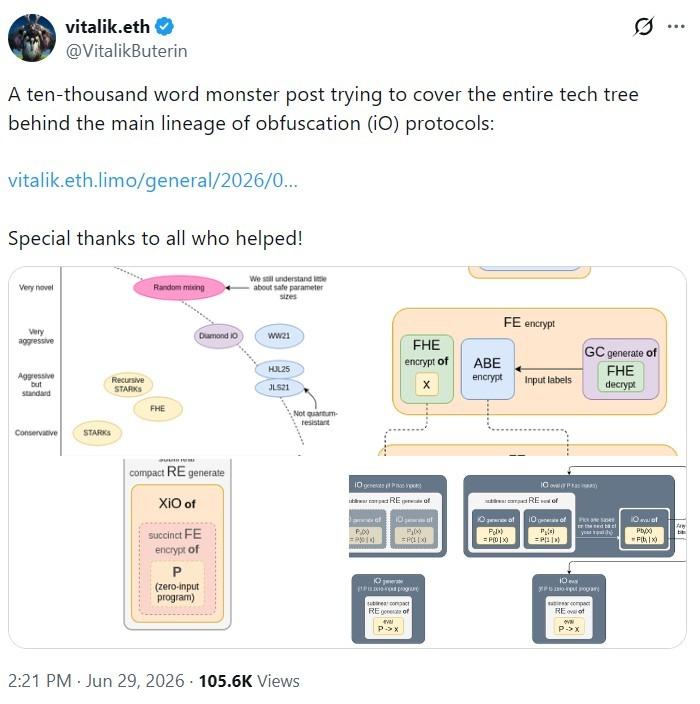
How indistinguishability obfuscation could protect onchain votes
Buterin explained that iO represents a cryptographic approach that transforms software into a protected application. Users have the ability to execute the application and obtain its intended output, but they are prevented from examining its underlying code or retrieving the data contained within it. Buterin characterized this concept as concealing the code itself rather than obscuring the information it processes.
In the context of blockchain-based voting, Buterin explained that an obfuscated application could incorporate the necessary logic to handle encrypted ballots and display the ultimate vote count without disclosing how individual participants voted, effectively eliminating the requirement for a threshold committee whose participants collectively possess the decryption keys needed to reveal the outcome.
Buterin emphasized that blockchain networks would continue to serve an essential function since an obfuscated application lacks the ability to prevent duplication or independently preserve evolving data.
Buterin's broader privacy push
Buterin had previously linked iO with private voting mechanisms in his Ethereum development roadmap that was published in October 2024. He indicated that this approach had the potential to deliver enhanced privacy protections and greater resistance against coercion. His most recent essay builds upon that earlier suggestion by exploring the construction of the underlying cryptographic methods, analyzing the security assumptions they depend on, and identifying the technical obstacles that currently prevent practical implementation.
During April 2025, Buterin put forward a more immediate privacy-focused roadmap for Ethereum, advocating for the integration of privacy-enhancing tools directly into existing wallet applications. This proposal also recommended implementing stronger safeguards against data harvesting by infrastructure service providers that wallets rely on for Ethereum network access.
Buterin has also allocated resources from his personal cryptocurrency holdings to support privacy-enhancing technologies. On Jan. 30, he designated 16,384 Ether (ETH), valued at approximately $45 million at that time, to support projects concentrating on privacy, open infrastructure, and self-sovereign technological tools.