BTC Surges Past $74K Mark Despite Conflicting Signals From ETF Inflows and Miner Distribution
Bitcoin pushes above $74,000, though subdued futures pricing and ongoing miner distribution indicate continued bear market vulnerability.

Key takeaways:
While ETF capital inflows remain robust, Bitcoin continues to track the S&P 500 index and responds to international macroeconomic shifts.
Futures premium indicators and miner distribution patterns point toward an ongoing bear market despite Bitcoin's position above $74,000.
Bitcoin (BTC) successfully regained the $74,000 price level during Monday's trading session after the S&P 500 index posted modest advances in response to US President Donald Trump's announcement of a US blockade targeting the Strait of Hormuz. Market participants seem to be slowly building confidence in light of substantial net capital inflows into United States-listed spot Bitcoin exchange-traded funds (ETFs) and persistent buying activity by Strategy (MSTR US), though questions remain about whether the bearish phase has truly concluded.
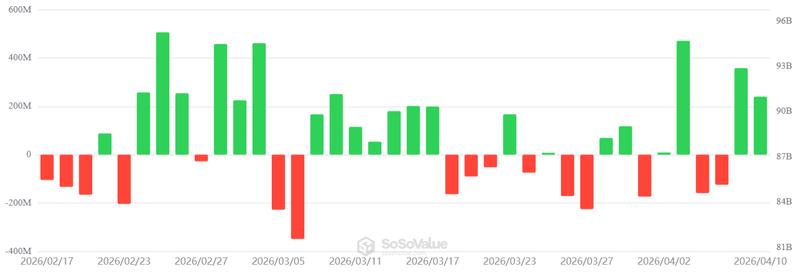
United States-listed spot Bitcoin ETF products recorded $615 million in aggregate net inflows spanning Thursday through Friday, representing a reversal from the outflow pattern observed during the preceding two trading days. Simultaneously, Strategy disclosed the acquisition of 13,927 BTC during the most recent seven-day period. The company financed the $1 billion purchasing program through its yield-generating financial instrument, Stretch (STRC US).
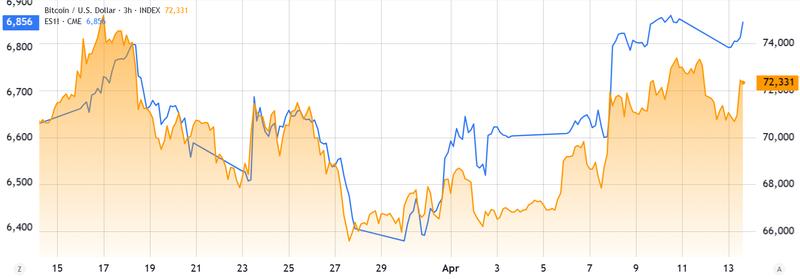
Notwithstanding increasing appetite from institutional capital allocators, Bitcoin maintains a strong correlation coefficient with the S&P 500 index and responds acutely to wider macroeconomic dynamics affecting the United States economy. Bitcoin experienced a decline to $70,500 throughout the weekend period following unsuccessful ceasefire discussions between the US and Iran. Nevertheless, Brent crude oil pricing ultimately pulled back to $99 during Monday's session, creating favorable conditions for risk-on assets including Bitcoin.
Bitcoin demonstrated resilience around the $74,000 level, though derivatives market indicators have not yet shifted to a bullish posture.
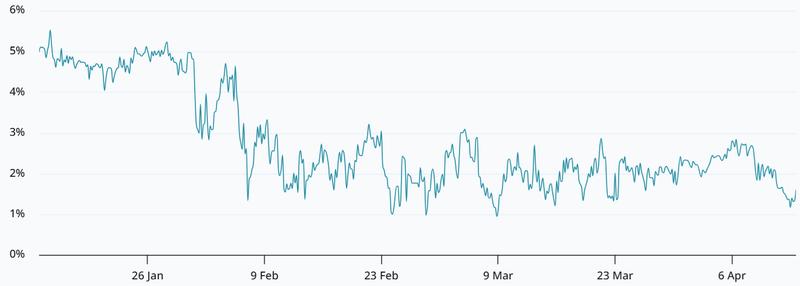
Bitcoin monthly futures contracts exhibited a 2% annualized premium when measured against standard spot market pricing, signaling insufficient appetite for leveraged bullish positions. During typical market conditions, this metric should range between 4% and 8% to adequately compensate traders for their cost of capital. Irrespective of recent weekly performance, Bitcoin has declined 18% during 2026, whereas the S&P 500 has maintained a relatively neutral position on a year-to-date basis.
Legislative clarity could support Bitcoin's upward momentum
Although pinpointing the precise catalyst for Bitcoin's substantial correction during late January remains challenging, the absence of clear direction from United States legislators concerning the regulatory framework probably contributed significantly. United States Senator Cynthia Lummis has publicly called upon her fellow lawmakers to pass the CLARITY Act, legislation that would establish operational guidelines for stablecoin providers and create benchmarks for determining token decentralization status.
The proposed legislation currently faces a pivotal period within the Senate Banking Committee. Leading cryptocurrency exchanges have recently expressed apprehensions regarding eleventh-hour modifications to decentralized finance (DeFi) regulations and the precise parameters governing tokenized asset classifications. United States Securities and Exchange Commission (SEC) Chairman Paul Atkins has likewise declared that "it is time" for Congressional action on regulatory frameworks.
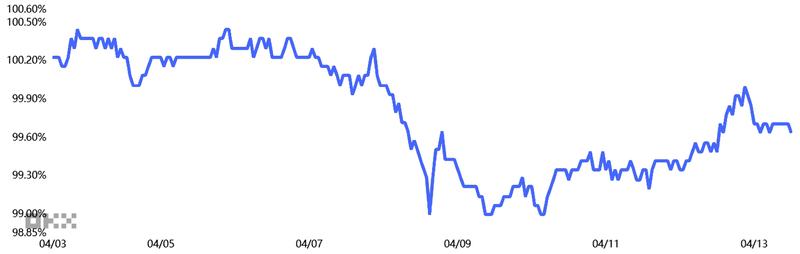
USD-denominated stablecoins exchanged at a 0.4% discount relative to the official United States dollar-to-yuan conversion rate during Monday's trading, representing a characteristic indicator of elevated demand for cryptocurrency market exits. Standard market equilibrium typically produces a 0.5% to 1.5% premium that accounts for conventional foreign exchange remittance expenses and the regulatory obstacles imposed by China's capital control policies.
Mining sector distribution pressure, United States macroeconomic volatility
Considering the pronounced correlation with conventional financial markets and underwhelming derivatives indicators, declaring the conclusion of Bitcoin's bear market based exclusively on ETF inflows and purchasing activity from a limited number of corporate entities lacks foundation, particularly given that publicly traded mining operations have recently decreased their Bitcoin holdings.
MARA Holdings (MARA US) distributed 15,133 BTC, whereas Riot Platforms (RIOT US) diminished its position by 2,325 BTC and Cango (CANG US) liquidated 2,000 BTC during the preceding 30-day period.
At present, Bitcoin's trajectory toward $80,000 depends predominantly on improved risk sentiment across markets, though near-term price action hinges primarily on developments surrounding the US and Israel-Iran War situation.