Bitcoin Shows Historic Value Signals Despite Federal Reserve Hawkishness and AI Stock Competition: Bitwise Analysis
According to Bitwise analysts, Bitcoin has entered a historically significant value territory, though Federal Reserve hawkish positioning and intense liquidity competition may keep potential investors on the sidelines.

Despite markets preparing for a potentially aggressive Federal Reserve policy stance under incoming chair Kevin Warsh, Bitcoin's (BTC) valuation indicators are showing substantial undervaluation. Research published by Bitwise Investments indicates BTC has entered a "deep value" territory following a key valuation indicator dropping beneath the 1.0 threshold, a level that has historically been linked with extended accumulation phases.
Nevertheless, market participation continues to lag, as CryptoQuant's realized cap growth indicator has stayed within bear-phase territory since the end of October 2025. This development signals an ongoing deceleration in new capital flowing into the BTC ecosystem.
Simultaneously, an expanding roster of major corporations preparing for public offerings creates heightened competition for available liquidity throughout the broader investment landscape, prompting questions about whether BTC can successfully draw in fresh capital during these constrained liquidity circumstances.
Deep-value or liquidity squeeze, which is most important?
On Wednesday, the Federal Reserve maintained interest rates at the 3.5%-3.75% range, a move that broadly aligned with Bitwise's forecasts and sidestepped the hawkish shock that markets had been anticipating.
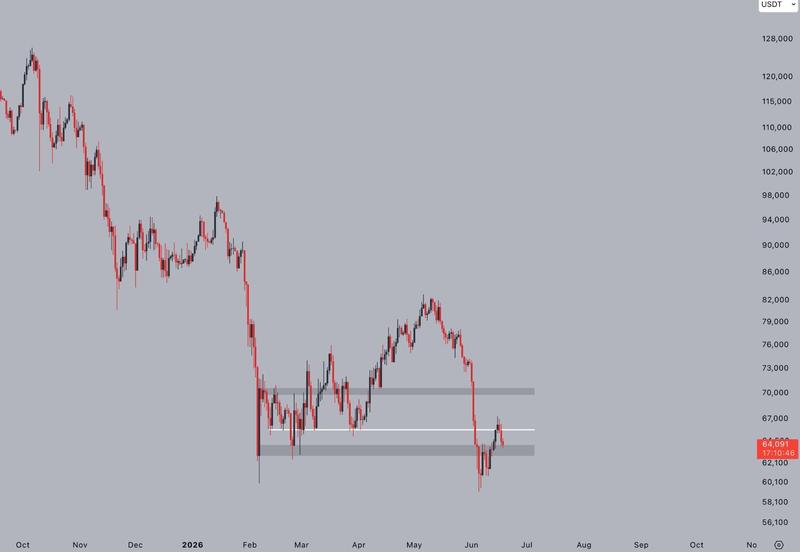
Although BTC retreated to levels beneath $64,000 on Thursday in the wake of the Fed's rate policy announcement, Bitwise characterized the current price point as representing a "deep value" buying opportunity when assessed through its Mayer Multiple framework, which evaluates price relative to the 200-day moving average. The investment firm emphasized that this indicator has continued to register below 1.0, a threshold that has historically correlated with optimal accumulation windows.
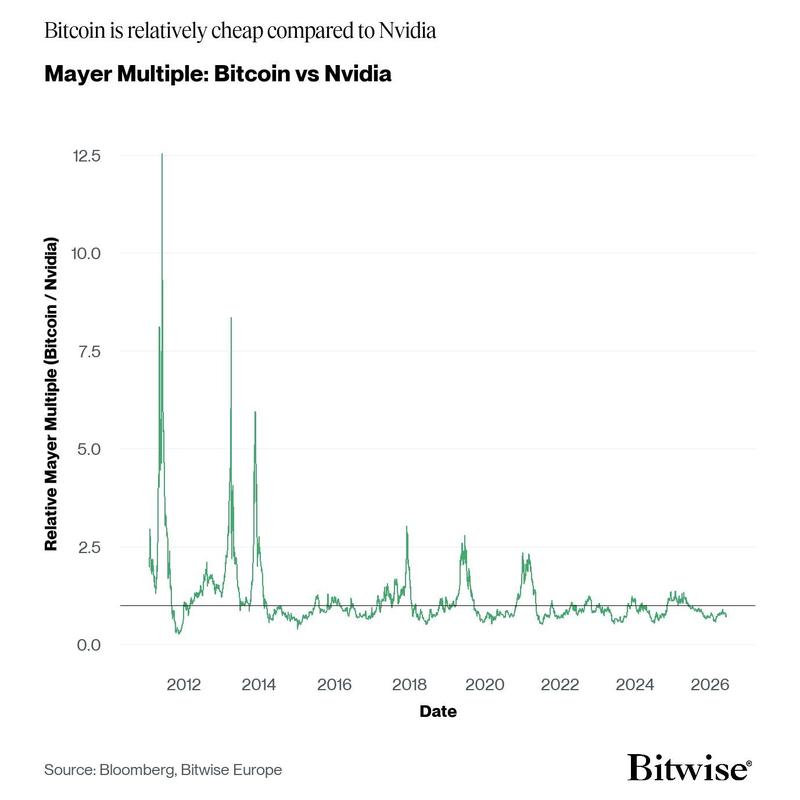
According to Bitwise's analysis, Bitcoin's current valuation presents a stark contrast when compared against AI-focused equity securities such as NVIDIA, which are currently commanding substantial premiums relative to their long-term trend valuations. The firm additionally highlighted an emerging wave of significant capital-raising initiatives, encompassing prospective offerings connected to SpaceX, Anthropic, and OpenAI. When combined, these transactions could generate investor demand exceeding $200 billion.
Major public listings typically correspond with robust investor enthusiasm. However, they simultaneously consume liquidity that could alternatively find its way into equity markets and digital currencies. According to Bitwise's assessment, persistently elevated interest rates continue to constrain the supply of capital available for speculative investment vehicles, notwithstanding Bitcoin's compelling valuation characteristics.
This muted market involvement is further evidenced in Bitcoin's capital inflow patterns. The realized cap growth metric from CryptoQuant has persisted within bear-phase conditions since Oct. 30, 2025, despite Bitcoin's valuation measures entering historically favorable ranges.
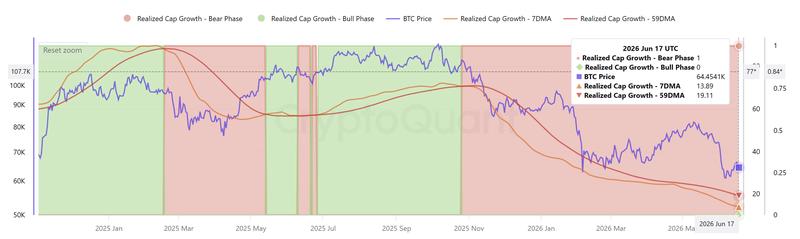
Following the transition into bear-phase territory, the indicator's seven-day and 59-day moving averages have contracted to 13.9 and 19.1 respectively as of June 17, down from approximately 70 during the fourth quarter of 2025. This deterioration indicates that the velocity of fresh capital entering the Bitcoin ecosystem has progressively diminished, underscoring prevailing investor hesitation.
Following the Fed's policy decision, Bitcoin researcher Axel Adler Jr. identified an additional area of concern. Despite rates holding steady, the revised dot plot revealed that nine policymakers anticipate a minimum of one rate increase during the current year, while six are projecting two or more hikes.
Bitcoin exhibited a negative response to this disclosure, with selling pressure intensifying throughout Wednesday's decline, registering the most substantial trading volume at the rejection point of $66,200. Meanwhile, gold experienced a brief rally above $4,300 that subsequently dissipated, leaving the precious metal hovering around $4,244 on Thursday.
This market behavior corresponds with Adler's interpretation that investors are incorporating expectations for an extended period of elevated rates rather than anticipating imminent policy accommodation.
BTC traders split on the next move
Trading data reveals that BTC market participants are drawing divergent conclusions from the Fed's policy announcement.
Market analyst Crypto Rover drew attention to a freshly established $38.5 million Bitcoin short position utilizing 30x leverage initiated immediately following the FOMC announcement. According to reports, this trader had accumulated approximately $750,000 in unrealized gains as Bitcoin's price declined.
Conversely, Bitcoin investor Jelle interpreted the retreat below $64,000 from the weekly peak of $67,255 as a standard support level retest. This analyst designated the $64,000 level as a critical price threshold for purchasing activity, stating,
"Hold here, and we likely see extended relief into $70k in the coming weeks. Big day ahead."