Bitcoin Mining Activity in Iran Drops 77% During Recent Quarter as Regional Tensions Escalate
Global Bitcoin network hashrate's 30-day simple moving average has experienced a downturn, with industry experts attributing the decline primarily to reduced mining profitability driven by Bitcoin's price weakness rather than geopolitical tensions.

The hashrate originating from Iran has experienced a dramatic decline throughout the most recent quarter while the nation faces continuing tensions with both the United States and Israel, although according to fresh analysis from Hashrate Index, the geopolitical conflict has not significantly impacted the worldwide hashrate metrics.
According to Ian Philpot, who serves as marketing director at Luxor Technology, Iran has experienced a loss of approximately 7 exahashes per second (EH/s) when comparing quarter-over-quarter performance, as detailed in a report that was made public on Monday. Based on data from the Hashrate Index heatmap, the nation's current hashrate stands at roughly 2 EH/s.
While Philpot acknowledged that the regional conflict has undeniably affected Iran's operations, he observed that the situation had the potential to create cascading consequences for nearby nations including the United Arab Emirates and Oman, though remarkably, neither country has experienced similar disruptions thus far.
"Iran bore the brunt of the impact; by contrast, neighboring UAE and Oman maintained stability throughout. The global hashrate persisting at approximately ~1,000 EH/s demonstrates that no individual region possesses sufficient capacity to pose a threat to network continuity. What regional disruptions accomplish is a redistribution of hashrate rather than its elimination," he explained.
Tensions in the Middle East intensified throughout February following strikes against Iran conducted by the US and Israel, which subsequently triggered a series of retaliatory actions from all parties involved. On Tuesday, negotiators successfully reached an agreement for a two-week ceasefire arrangement between the US and Iran. Current estimates place Iran's active Bitcoin (BTC) mining rig count at 427,000 units.
The Bitcoin network relies fundamentally on miners as its foundational infrastructure. These participants are responsible for validating and documenting all Bitcoin transactions into newly created blocks. When more miners join the network, the hashrate increases correspondingly, which in turn strengthens the security of the entire network.
Global hashrate down due to Bitcoin price slump
When examining the 30-day simple moving average, the global network hashrate experienced a decrease from 1,066 EH/s during Q1 to approximately 1,004 EH/s in Q2, representing a quarter-over-quarter decline of 5.8% that Philpot traced back to declining Bitcoin price levels.
Each block that miners successfully solve rewards them with Bitcoin, however when prices experience downward pressure, these rewards frequently fail to offset the operational expenses associated with maintaining their mining equipment.
In the meantime, Bitcoin has experienced a decline exceeding 45% from its peak value of $126,000, which was established in October, driving hash prices down to unprecedented lows. According to Philpot's analysis, mining profitability stands as the principal factor driving current geographic redistributions in hashrate, rather than energy costs or regulatory policy considerations.
"When prices reach these levels, equipment from older generations, specifically those with 25+ J/TH efficiency ratings, begins operating with negative gross margins, necessitating shutdown. Our estimates indicate that 252 EH/s of marginal capacity currently remains offline—the majority representing legacy hardware that has already been permanently retired," he elaborated.
"This pattern is cyclical. Mining profitability drives machine deployment and retirement more than energy costs or regulatory frameworks. Geographic shifts observed in Q1 and Q2 reflect operators testing which regions can sustain operations once the down-cycle ends and hashprice normalizes."
Top three countries control 65.6% of the global hashrate
Based on data from the Hashrate Index heatmap, the United States commands the greatest portion of global hashrate at more than 37%, with Russia claiming second position at approximately 17% and China occupying third place at 12%.
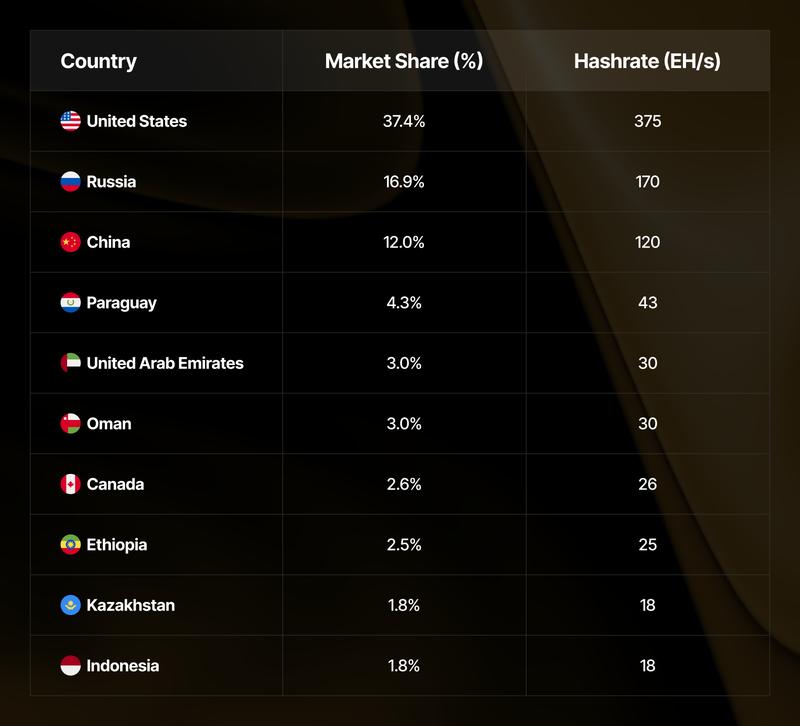
According to Philpot's observations, while hashrate levels among the dominant players have remained relatively flat, the underlying composition is undergoing transformation, with outdated equipment being taken offline as modern hardware gets strategically deployed to geographical locations where long-term profitability can be sustained.
"What characterizes growth is the deployment of contemporary hardware occurring in parallel with the retirement of legacy equipment. Canada demonstrates similar patterns: modest quarter-over-quarter reductions coupled with positive year-over-year expansion, indicating strategic optimization rather than a mass departure," he concluded.