Binance implements new safeguards to prevent unusual spot trade executions
The cryptocurrency exchange Binance announced plans to implement a spot trading mechanism starting April 14 that will prevent trade executions beyond specified price boundaries during times of market turbulence and limited liquidity.

The cryptocurrency trading platform Binance is launching a novel spot trading functionality designed to prevent orders from being filled beyond established price boundaries when markets experience extreme fluctuations.
According to an announcement made by Binance on Tuesday, a system known as the Spot Price Range Execution Rule (PRER) is scheduled for implementation on April 14.
This system permits order executions exclusively within dynamically adjusted price corridors established around a benchmark price calculated from recent trading activity, which according to Binance serves to promote fair and orderly market conditions during periods of atypical volatility. The exchange noted that PRER may not be accessible for every trading pair at all moments, particularly in situations where establishing a dependable reference price proves challenging.
The modification seeks to mitigate a recognized hazard during periods of market pressure, when depleted liquidity has the potential to force transactions significantly away from prevailing prices and result in skewed executions. The announcement arrives several months following a liquidation-triggered market disruption in October 2025 that demonstrated how rapidly liquidity can evaporate under stressful conditions, although Binance has not directly connected this initiative to that particular incident.
How Binance's execution rule differs from user-set orders
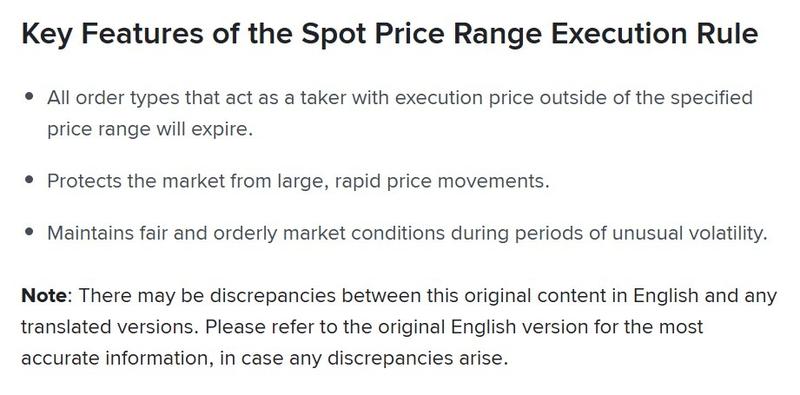
In contrast to stop-loss mechanisms or limit orders established by individual traders, Binance explained that PRER functions as an exchange-level safeguard applied throughout the order matching process. This indicates that transactions may be constrained or partially terminated based on system-determined price thresholds, independent of what users intend.
The mechanism operates by linking execution to a dynamically calculated reference price derived from recent transaction data, with percentage-based boundaries established above and below that threshold. As described by Binance, orders will exclusively be filled within this designated range, and any residual portion that would otherwise execute beyond these limits gets canceled.
According to Binance, the reference price and corresponding bands may differ across trading pairs and are subject to modification in reaction to prevailing market circumstances. The platform clarified that the feature does not remove slippage entirely but aims to restrict extreme executions during volatile market periods.
Binance confirmed receiving Cointelegraph's inquiry for additional information but had not supplied further details at the time of publication.
This development arrives several months following scrutiny directed at Binance during a market sell-off in October 2025, when the platform subsequently disclosed that certain platform modules temporarily encountered technical difficulties and specific assets experienced depegging problems after the wider market decline had already commenced.
Changpeng Zhao, co-founder of Binance, subsequently disputed allegations that Binance played a role in the market liquidation event.