AI and Bitcoin Mining Heading Toward Opposing Decentralization Trajectories, Says Expert
Edge computing for AI applications has the potential to decentralize artificial intelligence, diminishing dependency on large corporate server facilities.

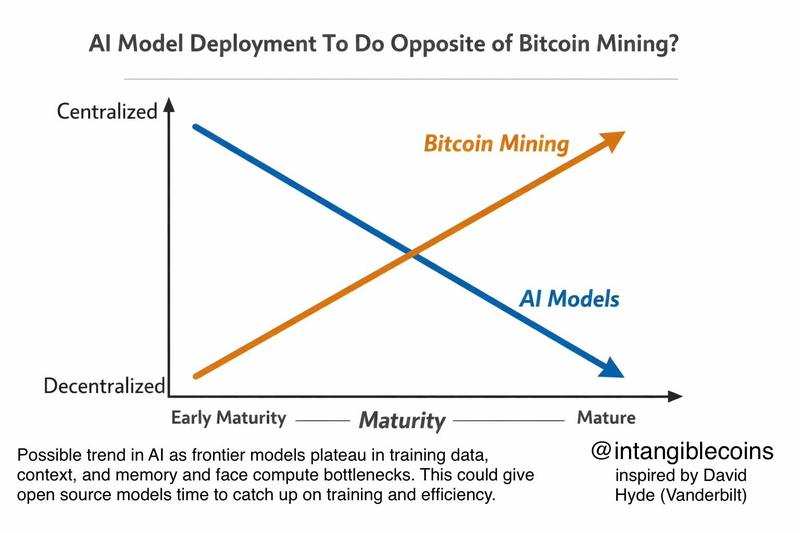
The process of mining Bitcoin faces the possibility of growing increasingly centralized over time, whereas artificial intelligence technology appears to be heading down a contrasting trajectory, according to Alex Thorn, who leads research at Galaxy.
According to Thorn, Bitcoin mining initially started as a decentralized activity where individual users could mine the cryptocurrency using their own personal computing devices, but has subsequently evolved into a far more concentrated operation, now demanding specialized ASIC mining equipment or large-scale industrial mining facilities.
"Artificial intelligence might follow a reverse trajectory," Galaxy's head of research Alex Thorn remarked on Sunday, elaborating that artificial intelligence initially emerged as a centralized technology operating within massive hosted computing clusters, but as cutting-edge models encounter "data scarcity, context limits, and memory bottlenecks, open-source models could close the gap."
"If local models keep getting smaller, cheaper, and more efficient, AI may become increasingly personal and on-device."
This divergence goes to the core of cryptocurrency's fundamental proposition: decentralization. Should Bitcoin mining persist along a trajectory toward centralization, concerns about the network's sustained resilience over the long term could start to emerge.
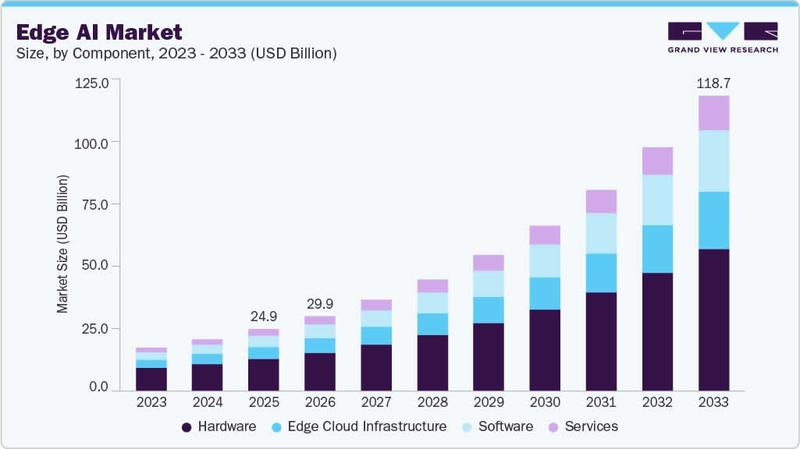
Market for Edge AI projected to expand 300% over the coming eight years
Edge computing for AI applications describes the implementation and operation of artificial intelligence models directly on nearby devices or "at the edge" of networks, as opposed to transmitting all information to centralized cloud-based servers or enormous data processing centers.
The worldwide market for AI at the edge is expected to expand from approximately $25 billion in 2025 to an estimated $119 billion by 2033, based on data from Grand View Research.
The edge computing market is witnessing substantial growth propelled by the "rapid expansion of IoT (Internet of Things) and connected devices," according to GVR's findings.
This drives up the need for instant and minimal-latency data processing capabilities, expanding the uptake of AI-powered automation throughout various industries, and "rising focus on data privacy and localized intelligence at the network edge," GVR further noted.
Geographic decentralization emerges in Bitcoin mining sector
Cryptocurrency trading platform KuCoin disclosed on Friday that the viability of Bitcoin mining operations in the United States has diminished considerably as the expense of mining one BTC has exceeded $100,000 in certain areas due to escalating energy prices.
This situation is triggering a geographical shift with computing hash rate actively relocating toward the "Global South," where Paraguay and Ethiopia are standing out as the primary destination points thanks to their abundant hydroelectric power resources.
This development has the potential to enhance mining decentralization, at minimum from a geographic standpoint.
"This decentralization of mining power across different continents enhances the security of the network by making it less vulnerable to any single country's political or environmental shocks," it stated.