Zano reverses one month of blockchain data following Gateway Address security breach
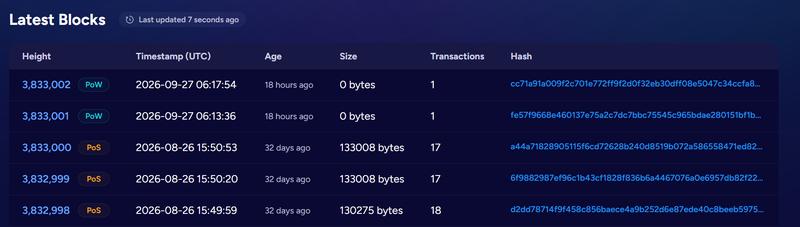
The blockchain network for Zano has undergone a restart at the precise block height that existed just prior to the implementation of Hard Fork 6, the update that brought Gateway Addresses into existence.

Following a security flaw in Gateway Addresses that permitted illegitimate ZANO and Freedom Dollar tokens to be created and distributed, Zano has reversed approximately one month of its blockchain records, as stated by the project's core development team.
Block 3,833,000 marks the point where the Zano blockchain has been restarted, positioning it just before the deployment of Hard Fork 6, the update that brought the compromised functionality into the system. According to the team's announcement on Sunday, this restoration process demands that all participating nodes, mining operations, staking participants, cryptocurrency exchanges, and additional service providers integrate the updated software.
The reversal wipes out one month's worth of valid transactions alongside the illegitimate tokens, which means any transactions that occurred throughout that timeframe will be absent from the restored chain and might require reconciliation efforts. Additionally, it lacks the capability to undo payments that have already been finalized on separate blockchain networks. The development team has stated they are actively working to document any losses sustained and will release details regarding a reimbursement and claims procedure.
Doing nothing meant unauthorized ZANO and fUSD in circulation without limit, diluting every holder and breaking the most basic promise a currency makes: a fixed supply. It would also tell every future attacker that exploited coins get to keep their value. No project survives that.
Quinten van Welzen, Zano's head of marketing and growth
Zano identifies Gateway Address exploit
As of the time this article was published, Zano has not made available a comprehensive post-mortem analysis, though the team has verified that the vulnerability originated from Gateway Addresses, a functionality created to simplify the process for bridges, cryptocurrency exchanges, and payment service providers to connect with Zano by enabling them to control funds via a single account-style balance structure (comparable to other blockchain platforms).
Prior to the introduction of Gateway Addresses, conventional Zano wallets monitored funds as individual transaction outputs (UTXOs), as opposed to maintaining a unified account balance. This meant that exchanges and similar service providers were required to perform blockchain scans to detect incoming payments, maintain records of those outputs, and determine which specific ones to utilize when handling withdrawal requests.
The Zano network made its debut in May 2019 as a layer-1 blockchain platform with an emphasis on private payment capabilities. The standard private transactions on the platform obscure the identities of senders and receivers, along with the amounts being transferred and the types of assets involved. Beyond its native cryptocurrency token, ZANO, the blockchain infrastructure also provides users with the ability to create and issue customized digital assets. Freedom Dollar (fUSD) represents one such digital token that functions within the Zano blockchain ecosystem.
Restarting the chain from before Hard Fork 6 costs a month of history, and it costs trust, which we'll have to earn back. But it restores the supply everyone signed up for, and it leaves a path to rebuild. Which is better than 7 years of hard work left to die. We know it hurts. But not doing it would have hurt more.
Quinten van Welzen