Why Ethereum's Price Momentum Consistently Stalls Below $2,400: Three Key Factors
Several persistent obstacles continue to limit Ether's price advances toward $2,400. Is ETH destined to underperform while Bitcoin and alternative cryptocurrencies stage a comeback?
Key takeaways:
- Exchange activity and revenue from decentralized applications have plummeted by approximately fifty percent, creating headwinds for Ether's price appreciation.
- Major institutional holders such as Bitmine continue to experience significant unrealized losses, putting downward pressure on institutional demand for Ether.
For the last three months, Ether (ETH) has been unable to maintain price levels above $2,400, trailing behind the majority of comparable assets. The altcoin has declined 21% in 2026, leaving market participants questioning why it cannot replicate the recovery seen across the wider cryptocurrency market.
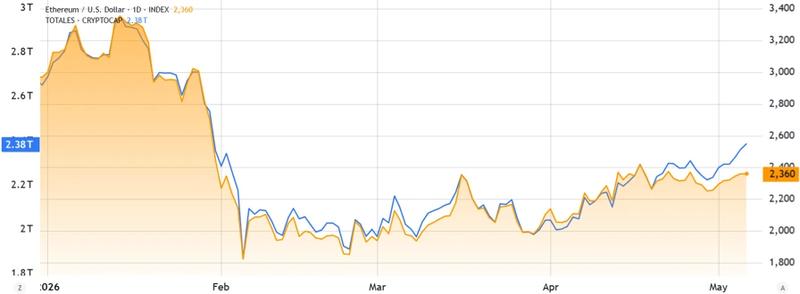
Overall cryptocurrency market capitalization has decreased 11% year-to-date, pointing to the existence of particular challenges unique to Ether. Reduced activity across decentralized applications (DApps) provides one possible explanation for this waning enthusiasm. Whether or not this pattern has impacted the broader industry, it has undeniably created negative consequences for ETH price discovery.
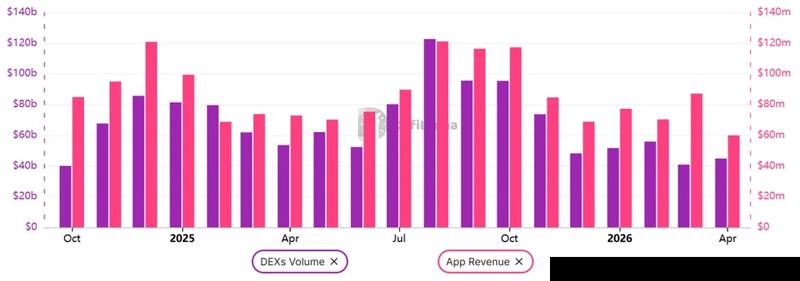
Trading volumes on decentralized exchanges (DEX) decreased by 53% over a six-month period, representing a sector that drives much of Ethereum's DApps engagement. As a direct result, revenue generated by these DApps fell 49% during the identical timeframe. The dramatic collapse in memecoin valuations and new token deployments contributed to diminished DEX attractiveness, though additional elements such as security breaches also influenced outcomes.
Security breaches substantially reduced DApp engagement
Throughout April, the cryptocurrency sector experienced $630 million in security breaches, with KelpDAO and Drift Protocol representing 82% of total losses. Blockchain security firm Hacken linked these attacks to entities associated with the Democratic People's Republic of Korea (DPRK). Across the crypto industry, DEX activity contracted by 47% over a three-month span.
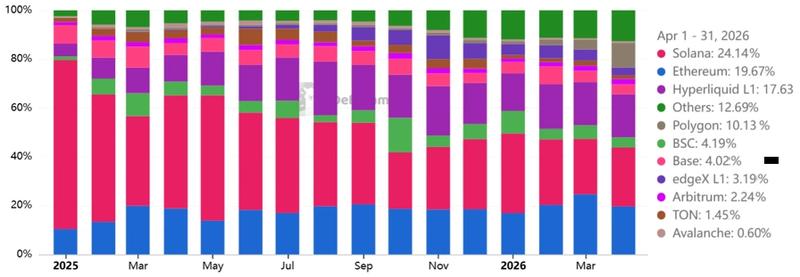
Certain competing blockchains have chosen to implement base layer scalability, offering reduced complexity for everyday users. Though Ethereum continues to dominate as the overall ecosystem leader when including its layer-2 solutions, Solana and Hyperliquid together capture a combined 42% market share in DApp revenue generation. This data becomes even more striking when considering that Ethereum's total value locked is six times larger.
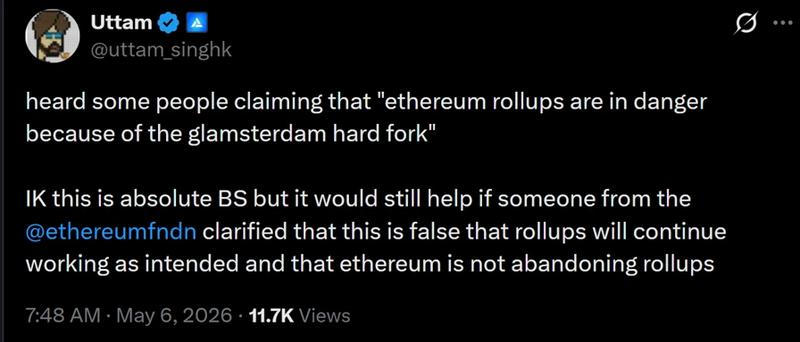
According to Uttam Singh, engineer at Alchemy, a segment of the market mistakenly concluded that Ethereum's forthcoming glamstedam hard fork would place rollups "in danger." The planned network upgrade is expected to deliver a threefold expansion in base-layer capacity and enable clients to pre-fetch block data, thus facilitating parallel transaction execution.
Intense competition among blockchains, institutional ETH holders face losses
Irrespective of how transparent Ethereum's scaling roadmap may be, the majority of users and investors find it difficult to comprehend why layer-2 rollups are necessary after base-layer scalability achieves certain performance levels. Additionally, there remains uncertainty about whether these modifications will genuinely produce increased network fees, which serve as the primary driver for enhanced staking yields.
The perception of Ether among institutional investors has suffered as Bitmine (BMNR US), the largest publicly traded holder of ETH, continues to hold underwater positions in its corporate reserves. The company, under the leadership of chairman Tom Lee, allocated $12.2 billion to acquire ETH, yet its holdings are presently worth $10.8 billion. Though this doesn't represent an imminent liquidation threat, it diminishes the asset's attractiveness to institutional participants.
None of these elements represents an insurmountable barrier preventing Ether price from achieving $2,800. Nevertheless, weakening onchain activity, intense competition within the DApps industry, and diminished institutional attractiveness persist as contributing factors to its relative underperformance compared to the overall crypto market.