Stablecoins draw heightened regulatory focus from China amid expanding global payment functions
PBOC senior official advocates for enhanced oversight, tighter regulations and global cooperation as stablecoins become increasingly significant in international payment systems.

The People's Bank of China is intensifying its scrutiny of stablecoins as these privately backed digital assets assume an increasingly significant position within the global monetary framework and international payment infrastructure.
According to a Wednesday report from Chinese media outlet The Paper, Wang Xin, who serves as director general of the Research Bureau at the People's Bank of China (PBOC), called on regulatory bodies to maintain vigilant oversight of stablecoin developments while enhancing global regulatory cooperation and coordination.
"We also need to pay attention to several new areas, such as whether stablecoins will play a more important role in cross-border payments, and how regulation, international coordination and cooperation should proceed,"
Wang Xin, PBOC Research Bureau Director General
Wang further cautioned that rising levels of uncertainty combined with the potential for payments to be used as weapons could create disruptions in regular cross-border payment flows.
These statements signal heightened interest among China's regulatory establishment regarding the prospective influence of stablecoins within cross-border payment networks and the broader international monetary architecture.
Although Wang called for enhanced regulatory measures and careful examination, his comments stopped short of providing explicit support for stablecoins or revealing any forthcoming policy modifications.
Beyond his focus on stablecoins, Wang also raised concerns regarding central bank digital currencies (CBDCs). According to Wang, the function of CBDCs within cross-border payment systems similarly requires increased monitoring, alongside enhanced coordination on policy matters.
China's stablecoin scrutiny comes amid rapid growth
These statements from Wang follow several months after the PBOC, together with seven additional Chinese government agencies, prohibited the unauthorized creation of renminbi-backed stablecoins and tokenized real-world assets on Feb. 6.
These regulations targeted both international and domestic organizations and encompassed both onshore and offshore iterations of the yuan, mandating that issuers secure governmental authorization, underscoring China's inclination toward government-managed digital currencies rather than tokens issued by private entities.
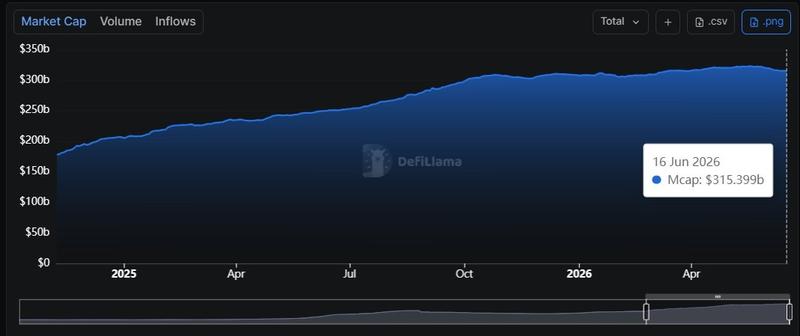
The proportion of digital asset market activity attributed to stablecoins continues to expand. During the first quarter of 2026, total stablecoin supply increased by approximately $8 billion, reaching $315 billion for the first time, based on figures from CEX.io.
According to CEX.io's analysis, transaction volume for stablecoins surpassed $28 trillion during the quarter, while accounting for 75% of total crypto trading volume. Nonetheless, CEX.io calculated that automated bots were responsible for generating approximately 76% of this transaction volume.