SEC Acknowledges Past Crypto Enforcement Actions Failed to Protect Investors
The regulatory agency concedes that certain previous cryptocurrency enforcement efforts didn't provide investor protection and wrongly applied securities regulations, marking a pivot toward cases involving fraud and market damage.

The US Securities and Exchange Commission (SEC) acknowledged on Tuesday that certain previous enforcement measures taken against digital currency firms failed to provide tangible benefits to investors and represented misapplications of federal securities regulations.
The agency disclosed in a statement regarding its 2025 enforcement outcomes that it had initiated 95 actions resulting in $2.3 billion in fines for "book-and-record violations" beginning in the 2022 fiscal year.
"Together with seven crypto firm registration-related and six 'definition of a dealer' cases, these cases identified no direct investor harm from those violations, produced no investor benefit or protection."
The SEC further stated that this approach demonstrated a "bias for volume of cases brought versus matters of investor protection," representing both an improper allocation of agency resources and a fundamental misunderstanding of federal securities legislation.
This represents yet another indicator of the regulatory body's transformed enforcement philosophy following the installation of new leadership when SEC Chair Paul Atkins assumed his role in April 2025.
Gary Gensler, Atkins' predecessor in the role of SEC Chair, faced criticism for implementing what many characterized as a regulation-by-enforcement strategy concerning cryptocurrency. Following Gensler's exit, the commission has demonstrated a more accommodating position regarding digital assets.
SEC said it is shifting its focus to quality over quantity
The SEC stated that its enforcement division engaged in an "unprecedented rush" to file cases in the period preceding Donald Trump's 2025 inauguration, pursuing an "aggressive pursuit of novel legal theories."
Atkins explained that the commission has moved away from such tactics, bringing an end to regulation by enforcement and returning focus to the agency's fundamental mission through emphasis on cases that deliver substantial investor protection while reinforcing market integrity.
"We have redirected resources toward the types of misconduct that inflict the greatest harm—particularly fraud, market manipulation, and abuses of trust—and away from approaches that prioritized volume and record-setting penalties over true investor protection," he added.
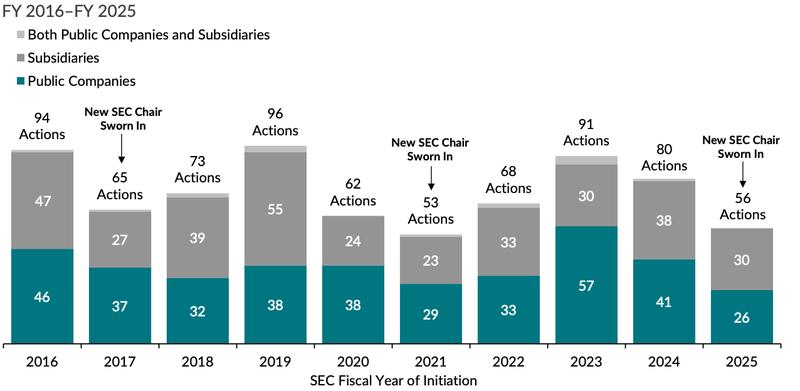
According to a November report from consulting firm Cornerstone Research, enforcement actions targeting public companies, including cryptocurrency-related entities, declined approximately 30% during fiscal 2025 under Atkins' leadership when compared to fiscal 2024 figures.
The SEC disclosed that its 2025 enforcement activities resulted in monetary relief orders amounting to $17.9 billion, which included $7.2 billion in civil penalties with the balance consisting of disgorgement payments and prejudgment interest.
"This year's enforcement results clarify the flaws of these actions and their respective penalties and re-establish the definition and measure of enforcement effectiveness, grounded in Congress' original intent and focused on bringing actions that actually prevent investor harm instead of headlines and inflated numbers," the SEC said.
Some crypto companies are still in the firing line
Notwithstanding the SEC's modified enforcement approach, a number of cryptocurrency firms continued to face enforcement proceedings throughout 2025.
The SEC filed a lawsuit in May 2025 against Unicoin along with four individuals serving as current and former executives, alleging the company raised $100 million through deceptive practices involving investors regarding certificates supposedly granting rights to Unicoin tokens and stock. The platform, however, has countered by claiming the agency manipulated its regulatory disclosures to construct their case.
Additionally, the SEC submitted a civil complaint in April 2025 targeting Ramil Ventura Palafox, who serves as CEO of Praetorian Group International, alleging his orchestration of a $200 million Ponzi scheme. A corresponding criminal prosecution initiated by the US Department of Justice culminated in Palafox receiving a 20-year prison sentence in February.