First International Tokenized Treasury Transaction Executed by Mastercard and JPMorgan Using Ripple's Blockchain
The international tokenized US Treasury transaction leveraging both blockchain technology and traditional banking infrastructure expands upon a previous pilot program where the identical fund was transferred between public and permissioned blockchain networks.
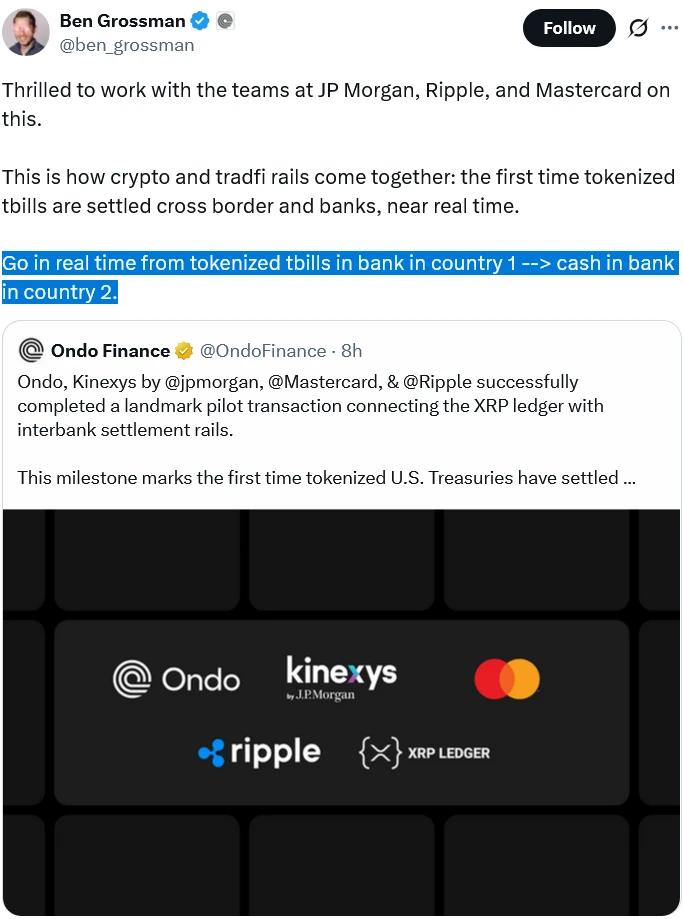
Financial powerhouse JPMorgan and payments processing leader Mastercard have announced the successful completion of what represents the inaugural cross-border, inter-institutional redemption of a tokenized United States Treasury fund, utilizing a combination of Ripple's XRP Ledger technology alongside conventional interbank settlement infrastructure.
The experimental transaction saw Ondo Finance, a blockchain-based tokenization platform, redeem the US Ondo Short-Term US Government Treasuries (OUSG) fund on behalf of Ripple through the XRP Ledger. Settlement instructions were subsequently processed via Mastercard's Multi-Token Network, which directed JPMorgan's proprietary blockchain platform, Kinexys, to complete the delivery of United States dollars into Ripple's Singapore-based bank account.
For the first time, a public blockchain and global banking infrastructure settled a cross-border transaction of a tokenized fund together in real time.
Ondo Finance
The experimental program demonstrates increasing cooperation between cryptocurrency companies and traditional finance institutions as they work to develop more efficient, cost-effective global payment and settlement infrastructure that operates beyond conventional banking operating hours.
The experimental program featuring OUSG expands upon a previous trial in which both JPMorgan and Ondo Finance took part during May 2025, during which the tokenized United States Treasury fund was transferred between a public blockchain and a permissioned blockchain network.
The tokenization of real-world assets has attracted increasing attention from leaders on Wall Street, who picture tokenizing a broad spectrum of assets ranging from equities and fixed-income securities to money market funds and property holdings.
Currently, more than $31.1 billion in value of real-world assets, not including stablecoins, has been tokenized on blockchain networks, based on data from RWA.xyz. In 2022, Boston Consulting Group projected that the tokenization market could expand to $16 trillion by 2030, whereas McKinsey & Co. offered a more cautious estimate of $2 trillion within the same timeframe.
Intercontinental Exchange, the parent company of the New York Stock Exchange, revealed in January its plans to introduce a tokenization platform enabling around-the-clock trading and immediate settlement of equities and exchange-traded funds through a blockchain-based post-trade infrastructure, representing one of the most significant advancements in the tokenization sector thus far.
Tokenization needs regulation before widespread adoption
Notwithstanding these advancements, the International Monetary Fund raised multiple concerns in a report published in April, highlighting that tokenization transfers risk away from the traditional banking system toward shared ledgers and smart contract programming, which makes intervention more challenging during "stress events."
The IMF further noted that in the absence of legal certainty regarding ownership records and settlement finality, markets for tokenized assets face the danger of becoming "fragmented and peripheral."
Kevin O'Leary, an investor on Shark Tank, expressed these same concerns during his appearance on Wednesday at Consensus Miami 2026, asserting that substantial capital will not flow into tokenization until comprehensive crypto market structure legislation is enacted in the United States and achieves compliance with Securities and Exchange Commission regulations.
When that occurs, it's going to change everything.
Kevin O'Leary