Farcaster Plans $180M Capital Return to Backers After Neynar Acquisition
Following its acquisition by Neynar, the decentralized social network Farcaster has announced it will continue operations while returning $180 million in raised capital to its investors.

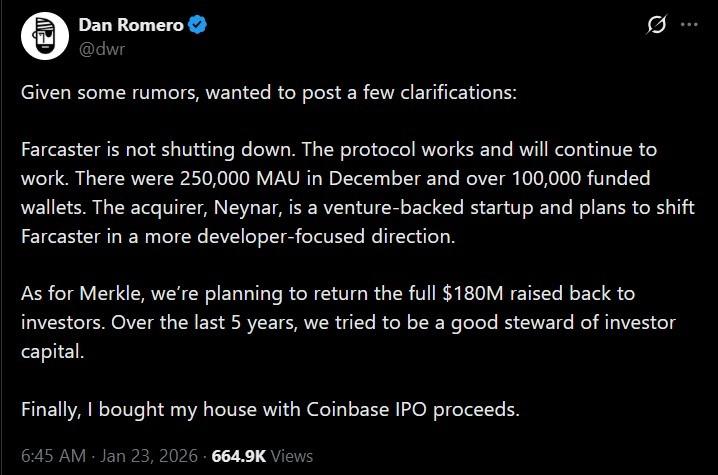
Dan Romero, co-founder of Farcaster, took steps to address growing speculation surrounding the protocol's future operations, clarifying that the platform will not be shutting down despite being acquired by infrastructure provider Neynar.
As a decentralized social networking protocol, Farcaster enables developers to create interoperable social applications where users maintain ownership of their identities, social graphs and connections on the blockchain, preventing them from being confined to a single platform.
Addressing concerns from the community directly, Romero emphasized that Farcaster continues to operate and maintains significant engagement levels, pointing to approximately 250,000 monthly active users recorded in December alongside more than 100,000 wallets that have been funded.
Romero also noted that Neynar, which is a venture-backed startup with a history of building infrastructure for Farcaster, intends to guide the project toward a direction that prioritizes developers.
Farcaster to return $180 million to investors
Back in July 2022, Merkle Manufactory, the development company responsible for Farcaster, secured $30 million in funding from a16z crypto, a prominent venture capital firm. Earlier that year in March 2022, the company completed another funding round with Paradigm leading the investment, which allegedly elevated the company's valuation beyond $1 billion.
According to Romero, Merkle has raised a total of $180 million throughout its existence. In his announcement, he revealed the company's intention to return these funds to its investors. "As for Merkle, we're planning to return the full $180 million raised back to investors," he wrote.
Romero explained that this decision comes after five years of dedicated development work and represents an effort to demonstrate responsible stewardship of the capital entrusted to them by investors.
Cointelegraph attempted to contact Merkle Manufactory to obtain additional details, but had not received a response by the time of publication.
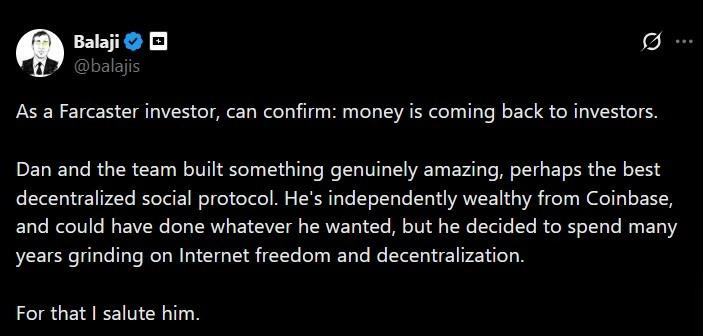
The announcement prompted a response from Balaji Srinivasan, who is an investor in Farcaster, confirming that capital is indeed being returned to investors. He also offered praise for the team's contributions to decentralized social infrastructure development.
This statement comes on the heels of the announcement regarding Neynar's acquisition of Farcaster. Romero had previously indicated that Neynar would take on the responsibility for maintaining the protocol contracts, code repositories and consumer application for Farcaster, signaling a significant leadership transition.
As the handover takes place, Romero along with several other team members will be stepping away from day-to-day operations to pursue new projects and endeavors.
Neynar has maintained a close relationship with the Farcaster ecosystem from its inception, functioning as one of the initial Farcaster clients and delivering infrastructure services that support a substantial portion of developers who are building applications on the protocol.
Aave hands over Lens stewardship to Mask Network
In addition to the Farcaster transition, another decentralized social protocol called Lens Protocol also experienced a leadership change during this week.
The team behind Aave announced that it has transferred stewardship responsibilities for Lens to Mask Network, a move that enables Aave to concentrate its efforts on decentralized finance while maintaining its involvement with Lens through a technical advisory role.
As decentralized social projects navigate these leadership restructuring processes, Vitalik Buterin, co-founder of Ethereum, expressed his strong support for decentralized social media platforms and called on the community to embrace open social platforms.
On Thursday, Buterin encouraged both builders and users to invest more time engaging with decentralized social ecosystems, emphasizing that the industry needs to transition away from centralized information warzones toward new models of online interaction.
If we want a better society, we need better mass communication tools.
Vitalik Buterin