European Union Targets 11 Cryptocurrency Exchanges in Latest Russia Sanctions Package
As part of expanded sanctions efforts, the EU plans to prohibit transactions across 11 cryptocurrency exchanges while broadening its crackdown on networks allegedly assisting Russia in circumventing existing restrictions.
As a component of its 21st round of sanctions against Russia, the European Union has put forward a proposal to prohibit transactions across 11 cryptocurrency platforms.
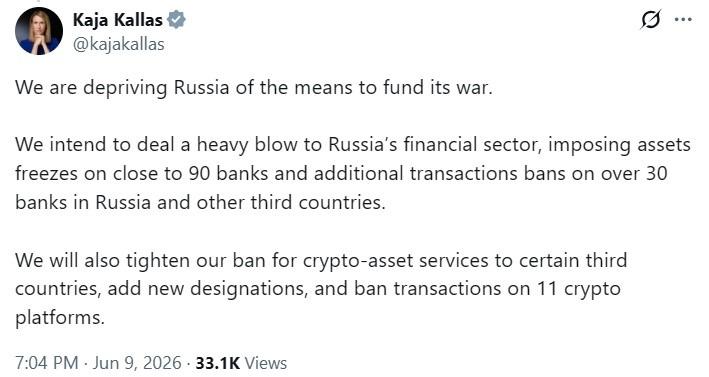
The measures were announced by Kaja Kallas, who serves as vice president of the European Commission and acts as the EU's high representative for foreign affairs and security policy. Her announcement detailed actions targeting financial institutions, arms producers, petroleum traders, processing facilities and various other entities located outside the European bloc.
"We will also tighten our ban for crypto-asset services to certain third countries, add new designations, and ban transactions on 11 crypto platforms," Kallas said in a post on X.
This proposal represents an expansion of the EU's sanctions strategy, extending beyond Russian financial institutions and energy sector income to include cryptocurrency companies allegedly facilitating Moscow's efforts to bypass sanctions implemented in response to its military operations in Ukraine.
The specific identities of the 11 cryptocurrency platforms were not disclosed in the Commission's public announcements. Cointelegraph requested additional information regarding which platforms would be subject to these measures, however, the Commission had not furnished further details prior to publication.
Ursula von der Leyen, President of the European Commission, indicated that the sanctions package encompasses prohibitions against an additional 31 Russian financial institutions and 20 organizations in third countries, which include banking entities, cryptocurrency exchanges and petroleum trading companies.
According to her statement, these designated targets had provided services to sanctioned Russian individuals and organizations or had facilitated the evasion of EU sanctions measures.
EU proposal follows UK sanctions against HTX
This EU initiative comes after the United Kingdom imposed sanctions on May 26 against Huobi Global S.A., the Panama-based corporation operating HTX, citing alleged assistance to Russia-connected financial operations.
British authorities stated there existed reasonable grounds for suspecting that HTX had provided support to the Russian government through financial services and monetary resources enabled by A7 Limited Liability Company and Garantex, both of which are sanctioned organizations.
HTX has rejected these claims, asserting that the sanctioned entity operates independently from the digital exchange platform. Subsequently, a Global Ledger investigation revealed that HTX facilitated approximately $21.06 billion in high-risk cryptocurrency transactions between 2021 and May 2026. From this figure, no less than $7.64 billion was associated with Russian high-risk organizations and darknet marketplaces, including Garantex, its successor platform Grinex, A7A5 and Hydra.
The sanctions imposed by the UK generated pushback from blockchain research professionals, who cautioned that applying broad exchange-level taint designations could result in freezing accounts of legitimate platform users and diminish the effectiveness of cryptocurrency compliance mechanisms in tracking illicit financial activities.