European Regulator Cautions Against Rising Cryptocurrency Integration With Traditional Markets
Europe's financial watchdog has identified tokenized stocks, decentralized finance vulnerabilities, and wagering platforms as emerging concern areas where cryptocurrency integration may threaten conventional financial markets.

The European Union's securities watchdog has issued a warning that deepening connections between cryptocurrency markets and conventional finance may heighten the vulnerability of the entire financial ecosystem to systemic disruptions.
The European Securities and Markets Authority (ESMA) released its most recent risk monitoring assessment on Thursday, emphasizing the need for enhanced surveillance of the "growing linkage between increasingly vulnerable crypto-asset markets and the broader financial system."
The regulatory body highlighted the expanding use of tokenized equities alongside recent security breaches in decentralized finance (DeFi) platforms as developments that could strengthen connections between cryptocurrency and conventional markets, thereby elevating the risk of contagion effects across the financial landscape.
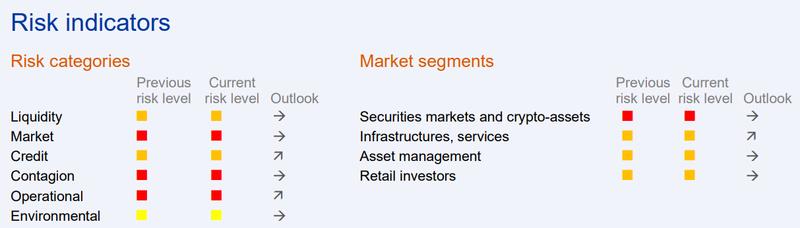
According to the regulatory authority, while tokenized equities currently represent an insignificant fraction when compared to worldwide equity markets, their momentum is building, with the potential to introduce novel market participants and technological frameworks that may fundamentally alter the architecture of financial markets.
The regulator further identified prediction markets as a developing area of concern, noting elevated risks surrounding insider trading activities and manipulation schemes. According to ESMA, the integration of cryptocurrencies in prediction markets creates additional challenges in identifying insider trading, wash trading schemes, and orchestrated market manipulation tactics.
Prediction markets face regulatory battle in US
The concerns raised by ESMA arrive at a time when prediction markets are embroiled in an escalating regulatory conflict within the United States regarding whether event-based contracts should be classified under federal derivatives legislation or governed by state-level gambling regulations.
Throughout 2026, the Commodity Futures Trading Commission (CFTC) has been releasing guidance documents for prediction markets while simultaneously asserting what it characterizes as its sole authority over event contracts that fall under federal regulation.
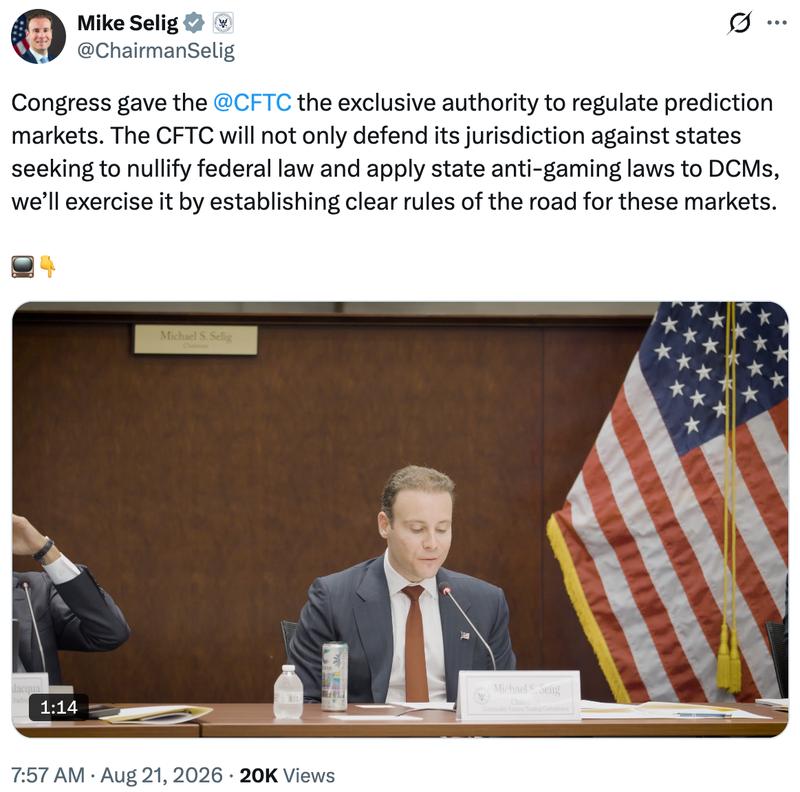
The federal agency has gone so far as to initiate legal proceedings against multiple states, including Kentucky, Minnesota, New Mexico, New York, Illinois and Connecticut, following attempts by these jurisdictions to impose state gambling legislation on operators of prediction market platforms.
This jurisdictional conflict has the potential to escalate all the way to the US Supreme Court. Officials from New Jersey submitted a petition to the nation's highest court on September 2, requesting a definitive ruling on whether state governments possess the authority to enforce sports gambling statutes against prediction market platforms that have obtained CFTC registration, pointing to ongoing legal disputes involving at least 20 states.
It remains uncertain whether the Supreme Court will agree to hear the case, but should the court issue a decision in the future, it would establish a precedent determining whether state governments or federal agencies maintain jurisdictional authority over prediction market operations.