Dragonfly Partner Qureshi Advocates for Terminating Zcash Development Fund in 2028
The future of Zcash's development fund has become a topic of intense discussion among industry experts following the ZEC token's surge past the $95 million threshold.

Haseeb Qureshi, who serves as managing partner at cryptocurrency venture capital firm Dragonfly, has put forward a proposal to discontinue the Zcash developer fund once it reaches its scheduled expiration in 2028 under existing regulations.
"I'm of the opinion that this should be the final Dev Fund," wrote Qureshi in a Friday X post, putting forth the argument that the fund has accumulated sufficient resources to support the remaining development work on Zcash and expressing concern that it could become "politicized" as its value nears the $100 million mark.
According to data from ZecStats, the Zcash development fund contained 63,962 Zcash (ZEC) tokens as of press time, representing approximately $95 million in total value.
These comments come amid a wider industry discussion triggered by the fund's growing value, which has increased alongside the ZEC token's price rally. A counterargument has emerged from those who believe Zcash should continue maintaining its development fund. In a Wednesday X post, Paradigm founder Matt Huang contended that the fund holds particular significance "in this age of AI cyber capabilities" and accelerating quantum computing advancements.
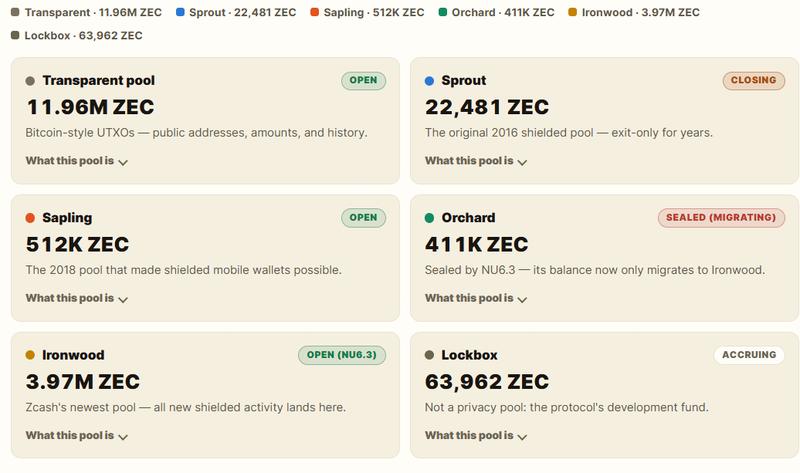
The development fund for ZEC operates as a protocol-level development fund that accumulates 0.1875 ZEC tokens with each block, which constitutes 12% of the block subsidy following the NU6 upgrade. The fund's balance remains outside of circulating supply until it receives governance approval for disbursement.
Industry split over who should control the ZEC development fund?
A parallel debate among industry observers concerns the question of who should exercise control over the development fund. Dragonfly's Haseeb has expressed opposition to transitioning the fund's control toward "pure token holder voting," while indicating his support for a partial governance model in which token holders would select temporary councils to oversee the fund.
Huang expressed alignment with this perspective, further noting that pure token holder governance could introduce "unpredictability that could limit long-term trust as a monetary asset" and advocated for a hybrid governance model that incorporates additional forms of oversight and decision-making.
Maxime Desalle, who works as an investment analyst at Winklevoss Capital, put forward the suggestion that the Zcash community should "completely get rid" of the development fund, which he argued would resolve all governance disputes currently surrounding it, according to a Thursday X post.
In an earlier post dated Sept. 9, Desalle made the argument that the fund could potentially compromise the security of Zcash while simultaneously recreating the same dependencies and bureaucratic structures that plague many welfare states.
In an X post from Sept. 1, Zcash founder Zooko Wilcox stated that the Zcash Community Grants Committee represented one of the primary reasons that Zcash "has survived and grown to where it is today." On Sept. 14, Wilcox provided clarification that the committee is responsible for only 40% of the total development fund.