Digital Dollar Expansion Through Stablecoins May Strengthen US Currency, Treasury Market: Bank of England
Digital dollars have the potential to broaden US currency reach and transform stablecoin providers into major purchasers of American government securities, according to a Bank of England policymaker.

According to Carolyn Wilkins, who serves on the Bank of England's Financial Policy Committee, the expansion of stablecoins has the potential to bolster the US dollar's position in global markets while driving up demand for US Treasurys, highlighting how the expanding digital dollar market could produce effects that reach far beyond the cryptocurrency sector.
During a speech delivered on Tuesday at Queen's University Belfast, Wilkins explained that stablecoins pegged to the dollar could enhance the greenback's position by facilitating cross-border settlement processes, broadening access to assets linked to the dollar for entities outside American borders, and boosting demand for Treasurys that serve as reserve holdings.
Major stablecoin issuers have already emerged as substantial purchasers of US government debt. According to data referenced by Wilkins, Tether's USDt (USDT) and Circle's USDC (USDC) accumulated nearly $150 billion in Treasury bills by the end of 2025 and purchased approximately $33 billion throughout the year.
That said, Wilkins contended that this relationship works in both directions. If stablecoins reach a significant enough scale, widespread redemptions could compel issuers to liquidate Treasury bills, which could potentially intensify volatility in a market already experiencing stress.
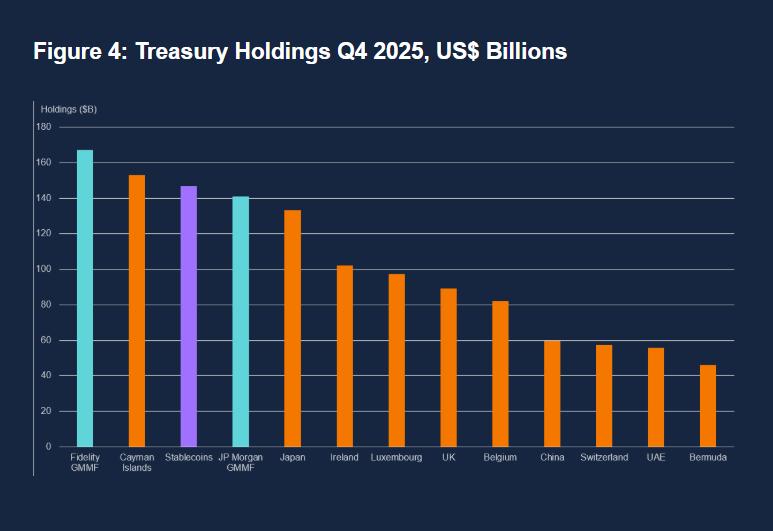
Wilkins' remarks arrive amid continued growth in stablecoin adoption, with circulation now exceeding $300 billion. The market continues to be overwhelmingly dominated by ties to the US dollar, which represents 98% of stablecoin value and provides the currency with what Wilkins characterized as a "considerable first-mover advantage."
UK ramps up stablecoin efforts
In comparison, stablecoins denominated in British pounds have experienced significantly slower adoption, though UK regulatory authorities have implemented several initiatives this year aimed at encouraging their development.
The Financial Conduct Authority launched testing for prospective stablecoin issuers through a specialized regulatory sandbox and completed its framework for UK stablecoin issuance in June. The Bank of England has also been conducting experiments with digital money, including a recent trial examining whether stablecoins and a simulated digital pound could function together for cross-border trade payment purposes.
This transition reflects the Bank of England's adoption of a more welcoming stance toward stablecoins after facing industry pushback that its initially proposed regulations might inhibit innovation.