Cryptocurrency Infrastructure Fuels Emerging AI Agent Economy: New Analysis
According to Keyrock's latest analysis, crypto payment infrastructure has become the primary settlement mechanism for AI agents, offering superior efficiency for micro-transactions compared to traditional systems.

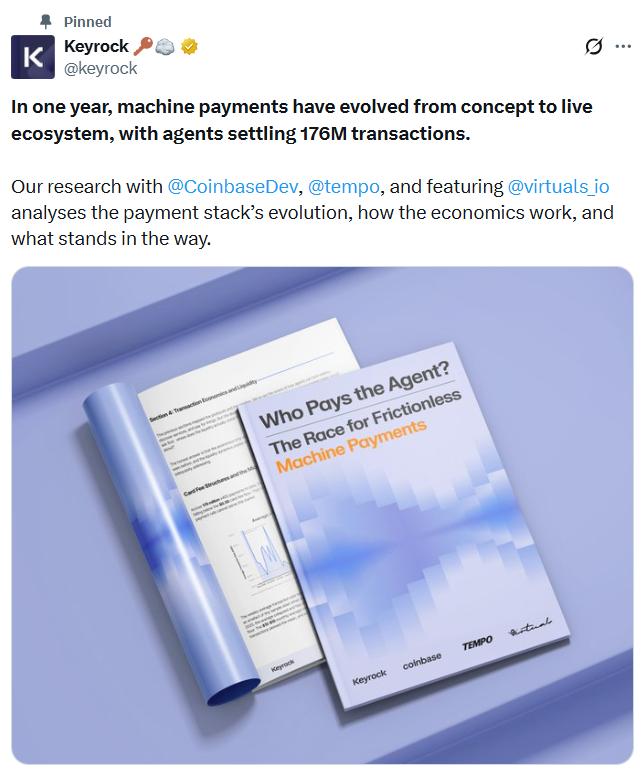
The concept of artificial intelligence agents conducting financial settlements has materialized into a functioning reality over the past year, with transaction settlements reaching $73 million across 176 million individual payments between May of last year and April 2026, as documented by cryptocurrency investment company Keyrock.
According to a Thursday report co-authored with cryptocurrency platform Coinbase and Tempo blockchain, Keyrock's analyst Ben Harvey noted that machine-to-machine financial transactions have evolved "from concept to a developed ecosystem" during the previous 12-month period.
Harvey further stated that "Agents have settled over $73 million across 176 million transactions, and incumbents have deployed more than $8 billion in acquisitions to secure their position in what is emerging as an entirely new payment stack."
The cryptocurrency community has shown growing interest in AI agents. Multiple industry leaders have suggested that transaction settlement by AI agents may accelerate mainstream adoption and boost overall transaction activity, with Circle's chief executive Jeremy Allaire forecasting in January that within a five-year timeframe, billions of AI agents will conduct stablecoin operations on behalf of users.
Traditional payment rails too slow and expensive
Harvey's research indicates that by the conclusion of this year's first quarter, registration data showed over 104,000 agents listed throughout 15 or more directories and registries. The median transaction value stood at approximately 31 cents.
Harvey explained that "That number tells you almost everything about why traditional payment rails can't serve this market. A fixed processing fee of roughly 30 cents per transaction makes sub-dollar payments uneconomical. An agent paying three cents for a weather API call can't route through Visa."
"Stablecoins won the settlement layer for machine commerce almost by default; they were the only instrument that could handle sub-dollar transactions without the economics collapsing."
Beyond settlement functions, AI agents are deployed for constructing Web3 applications, creating tokens, and autonomously engaging with various services and protocols, while certain platforms are investigating AI applications for trading purposes. In April of last year, research conducted by CoinGecko surveying 2,632 cryptocurrency users revealed widespread acceptance of AI-driven trading; 87% of respondents indicated willingness to allow AI agents to control no less than 10% of their cryptocurrency holdings.
USDC the leading settlement option
Harvey's findings show that Circle's USDC (USDC) accounted for more than 98% of all AI agent settlements, which he characterized as functioning as both "validation and a vulnerability" given that the entire infrastructure relies upon a single corporate entity, introducing considerable risk exposure.
He elaborated: "This is a lot of dependence on a single stablecoin issuer's reserve management, regulatory standing, and technical infrastructure. If Circle faces a regulatory challenge, a de-peg event, or even sustained downtime, the agent economy has no fallback."
"This is a systemic risk that nobody in the space is publicly discussing, and one we believe warrants serious attention as volumes scale."