Cryptocurrency and Blockchain Gain Federal Support in Trump's Cyber Security Blueprint
The crypto sector is analyzing Trump's newly released Cyber Strategy, with industry leaders debating implications for privacy-focused tools, digital currencies, and Bitcoin's vulnerability to quantum threats.

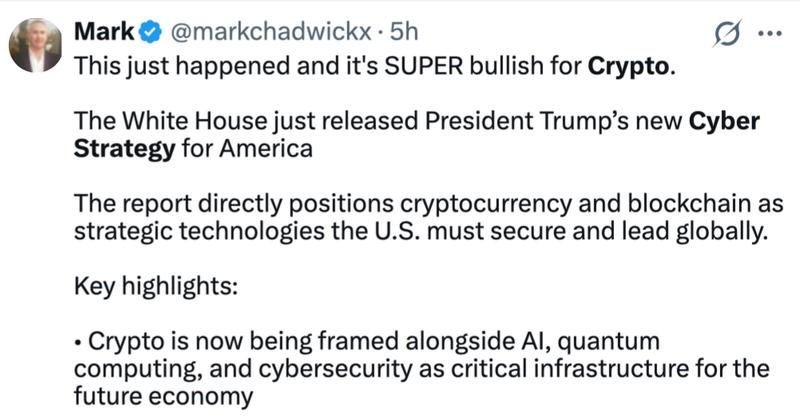
Following the Friday release of President Donald Trump's National Cyber Strategy, cryptocurrency sector leaders are conducting detailed analyses of the document, looking for clues regarding future federal backing of digital asset technologies.
In a Friday post on X, Alex Thorn, Galaxy Digital's head of firmwide research, highlighted the significance of the inclusion: "Crypto and blockchain are explicitly named as technologies to be 'protected and secured.' This is a first for any US cybersecurity strategy."
The six-page strategic document referenced crypto and blockchain technologies on a single occasion:
"We will build secure technologies and supply chains that protect user privacy from design to deployment, including supporting the security of cryptocurrencies and blockchain technologies."
Despite this limited mention, professionals across the cryptocurrency sector have been analyzing additional portions of the strategy document to determine their potential impact on digital assets.
Thorn drew attention to a particular passage committing to "uproot criminal infrastructure and deny financial exit and safe haven." According to his analysis, "This language could easily justify crackdowns on mixers, privacy coins, and unregulated off-ramps."
Venture capitalist highlights quantum computing as a "serious" concern
Nic Carter, a Venture Capital founder who has recently been outspoken regarding quantum computing's potential risks to Bitcoin (BTC), highlighted the portion stating the government "will accelerate the modernization, defensibility, and resilience of federal information systems by implementing cybersecurity best practices, post-quantum cryptography, zero-trust architecture, and cloud transition."
In an X post, Carter remarked: "Sure seems like they're taking quantum seriously. Nothing to worry about, I'm sure."
This development emerges amid ongoing discussions within the cryptocurrency community regarding the timeline for quantum computing becoming a legitimate threat to Bitcoin's security. On Feb. 15, Carter suggested that institutional holders of significant Bitcoin positions might eventually grow frustrated with Bitcoin developers for failing to address quantum computing vulnerabilities with sufficient urgency.
Presidential strategy highlights future workforce development
In his statement, Trump described the National Cyber Security strategy as outlining his administration's priorities for "ensuring that America remains unrivaled in cyberspace." The document placed considerable emphasis on artificial intelligence technologies.
According to the strategy, "We will secure the AI technology stack—including our data centers—and promote innovation in AI security."
Trump additionally stressed the critical nature of attracting and training the upcoming generation of cybersecurity professionals to "design and deploy exquisite cyber technologies and solutions."
Traditionally, the United States publishes a comprehensive national cybersecurity strategy during each presidential administration, establishing governmental priorities and approaches for developing and emerging technological sectors.