Crypto Biz: Federal Reserve grants Kraken direct payment system access
In a historic move, Kraken gains direct Fed payment system connectivity, MARA addresses Bitcoin treasury strategy misconceptions, Fold eliminates $66M convertible debt burden, and experts predict NYSE's tokenization proposal may drive institutional adoption.
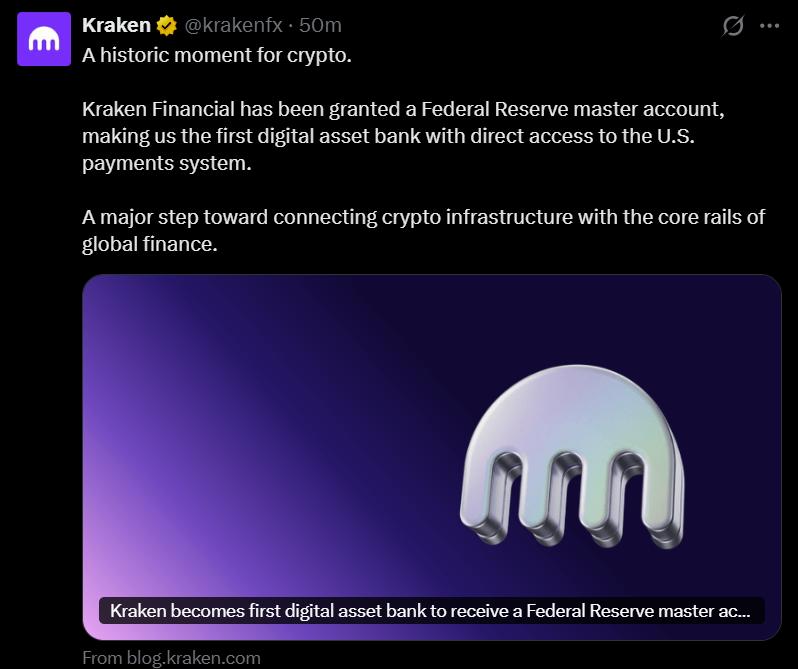
This week marked a significant advancement in the convergence of digital assets and conventional banking when Kraken obtained direct connectivity to the United States Federal Reserve's payment infrastructure — representing a landmark achievement that has the potential to transform how cryptocurrency firms handle US dollar transactions. The ability to tap directly into the Fed's payment systems may provide the cryptocurrency exchange with enhanced autonomy over dollar transaction flows while minimizing dependence on traditional banking intermediaries, a persistent obstacle that has challenged the sector for years.
In related developments, cryptocurrency mining firm MARA Holdings responded to market chatter suggesting the company intends to liquidate its Bitcoin (BTC) holdings, explaining that its latest regulatory submissions merely broaden its treasury management options. Meanwhile, Bitcoin incentives platform Fold improved its financial position by wiping out $66 million worth of convertible debt obligations, and industry observers suggest that the New York Stock Exchange's proposed tokenization blueprint has the potential to catalyze increased institutional market engagement.
Kraken achieves Federal Reserve payment system connectivity in industry-first development
The banking division of Kraken has obtained a limited-purpose master account through the Kansas City Federal Reserve Bank, providing it with direct connectivity to the central bank's payment networks in the United States, marking an unprecedented accomplishment for a company rooted in cryptocurrency.
Through a Wednesday public statement, Kraken Financial verified that it now possesses authorization to utilize the Fed's Fedwire system, which functions as a real-time gross settlement platform enabling financial institutions to transmit and receive funds directly through the Federal Reserve. This connectivity empowers Kraken to handle United States dollar transactions straight through the central banking authority rather than depending on third-party banking institutions.
The authorization has been issued initially for a twelve-month period, accompanied by specific restrictions customized to align with Kraken's operational framework and risk characteristics.
"With a Federal Reserve master account, we can operate not as a peripheral participant in the US banking system, but as a directly connected financial institution," said Arjun Sethi, Kraken's co-CEO.
MARA addresses Bitcoin treasury approach following liquidation speculation
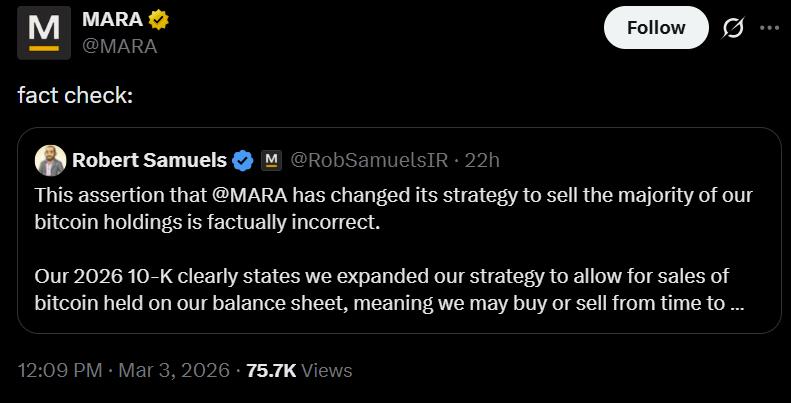
Bitcoin mining enterprise MARA Holdings has clarified that its recent public disclosures regarding potential Bitcoin sales from its corporate balance sheet were meant to communicate strategic flexibility — rather than signaling any immediate plans to liquidate its cryptocurrency reserves.
Company vice president Robert Samuels explained that MARA's most recent Form 10-K submission to the United States Securities and Exchange Commission was designed to make clear that the mining company has broadened its treasury management approach to accommodate possible Bitcoin sales should favorable market circumstances emerge. The updated policy framework simultaneously provides for the acquisition of additional BTC on a periodic basis.
Certain segments of the cryptocurrency community understood the regulatory filing as official approval to divest MARA's treasury holdings exceeding 53,000 BTC, an understanding that Samuels characterized as "factually incorrect."
Bitcoin-centric Fold retires $66M in convertible debt obligations
Bitcoin-oriented financial services provider Fold has announced the elimination of $66.3 million in outstanding convertible debt, clearing away a potential source of balance-sheet strain and the risk of shareholder equity dilution in advance of introducing a new Bitcoin-rewards credit card product.
According to a recent company disclosure, Fold confirmed it successfully retired two separate outstanding convertible notes — financial instruments structured to potentially convert into company equity — thereby eliminating the prospect of issuing supplementary shares down the road. The transaction additionally liberated 521 Bitcoin that had been previously committed as security collateral backing the debt obligations.
The improved financial position may provide support for the introduction of Fold's upcoming Bitcoin rewards credit card offering, which is designed to enable cardholders to accumulate BTC through ordinary spending transactions processed via the Visa payment network.
Fold completed its transition to public market trading on the Nasdaq exchange in February 2025 via a SPAC merger transaction with FTAC Emerald Acquisition, establishing itself among the earliest publicly traded companies centered on Bitcoin-based financial services.
TD Securities analysts suggest NYSE tokenization initiative may catalyze institutional engagement
Tokenization initiatives connected to the New York Stock Exchange have the potential to expedite institutional embrace of blockchain-enabled financial markets, based on analysis from TD Securities strategist Reid Noch.
The NYSE has recently put forward a proposal to tokenize equity securities via an alternative trading system designed to facilitate round-the-clock trading activity and near-instantaneous settlement processes for tokenized equities and exchange-traded funds, all while functioning within the parameters of current market regulatory frameworks.
Noch characterized the framework as resembling a "2.0" advancement of market infrastructure architecture: Custody arrangements and settlement procedures would remain under the purview of the Depository Trust & Clearing Corporation (DTCC), while trading activity would continue adhering to National Best Bid and Offer (NBBO) regulatory requirements.
Crypto Biz is your weekly pulse on the business behind blockchain and crypto, delivered directly to your inbox every Thursday.