Circle Hit with Class Action Lawsuit Following $280M Drift Protocol Breach
The stablecoin company stands accused of negligence and aiding the conversion of stolen assets after failing to freeze funds taken from Drift Protocol during an April cyber attack.
A class action lawsuit has been filed against Circle Internet Group by an investor in Drift Protocol, alleging the company neglected to freeze assets taken during a $280 million breach of the platform that occurred on April 1.
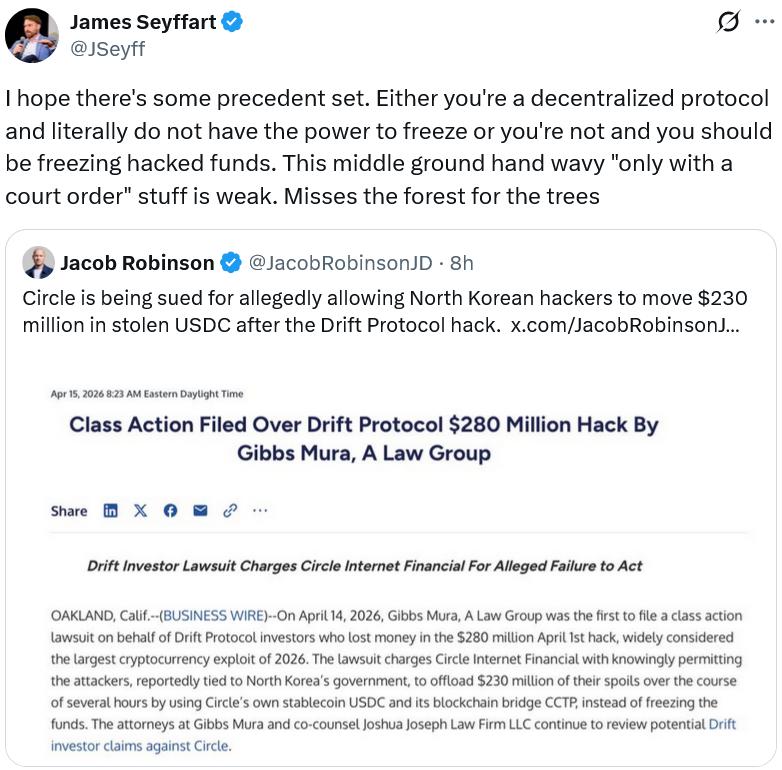
Filed on Wednesday in a US district court located in Massachusetts, the legal action was initiated by Drift investor Joshua McCollum on behalf of more than 100 class members. The complaint alleges that Circle enabled the perpetrators to move approximately $230 million in USDC tokens from Solana to Ethereum using Circle's Cross-Chain Transfer Protocol (CCTP) across multiple hours without any interference.
Attorneys acting on behalf of McCollum stated that "Circle permitted this criminal use of its technology and services," further noting: "These losses would not have occurred, or would have been substantially reduced, had Circle taken timely action."
Circle faces allegations of both negligence and aiding and abetting conversion in the lawsuit. The law firm representing McCollum and fellow Drift investors, Mira Gibb, is pursuing monetary damages, with the exact sum to be established during trial proceedings.
The lawsuit highlights an ambiguous legal territory surrounding cryptocurrency firms that maintain control over customer assets. Although these entities may possess the technological capability to step in or freeze holdings, they frequently point to regulatory limitations or absence of direct legal authorization as justifications for non-intervention — creating uncertainty about responsibility as security breaches occur in real-time.
Legal counsel for McCollum highlighted that approximately one week prior to the Drift incident, Circle had frozen 16 USDC wallets in relation to a sealed US civil proceeding, demonstrating that the company possessed the technical capability to take similar action.
Circle was contacted by Cointelegraph for a statement but had not provided an immediate response at the time of publication.
According to crypto analytics company Elliptic, the breach was likely perpetrated by hackers affiliated with the North Korean state, who executed more than 100 transactions using Circle's bridging infrastructure during standard business hours in the United States, where the stablecoin issuer maintains its operations.
The stolen assets were subsequently converted to Ether (ETH) and routed through the Tornado Cash privacy protocol in an effort to launder the illegally obtained proceeds and hide the transaction history.
Circle was put in a lose-lose position: ARK Invest
Despite criticism directed at Circle for its lack of intervention, Lorenzo Valente, who serves as ARK Invest's director of research for digital assets, maintained on Thursday that the company made the appropriate choice. He contended that freezing assets in the absence of a court order creates a pathway for subjective decision-making.
"Every future freeze is now a judgment call. Every non-freeze is a political statement. Why freeze the Drift hacker but not that sketchy Nigerian fraud wallet? Why this protester but not that one?"
Although Valente supported Circle's course of action, he offered speculation that the pilfered funds would most likely be used to finance North Korea's nuclear weapons program:
"Whether Circle got it right comes down to how much you weigh rule-of-law principles vs concrete harm. Reasonable people disagree."