Circle announces comprehensive quantum protection strategy for Arc blockchain
The stablecoin giant's quantum-resistant initiative for Arc arrives as concerns mount that "Q-Day" could arrive earlier than previously expected.

The company behind the USDC stablecoin, Circle, has announced its comprehensive post-quantum security strategy for Arc, its layer-1 blockchain, with plans to deploy protective measures throughout every layer of the network's technology infrastructure.
In an announcement made Thursday, Circle revealed its intention to roll out the implementation in multiple phases, beginning with quantum-resistant wallets and signatures upon Arc's mainnet deployment. The firm emphasized that this capability will be available on an opt-in basis, with plans to incorporate protections for validator-level operations and related infrastructure at subsequent stages.
"Quantum resilience cannot live only in research papers, exploratory pilots, or distant roadmap slides. It has to show up in the infrastructure,"
Circle
The unveiling of Circle's strategy follows recent alerts from both Google and scientists at the California Institute of Technology, who cautioned that operational quantum computers might emerge earlier than previously forecasted and could require less computational capacity than earlier estimates suggested. Google's assessment went so far as to indicate that quantum computing systems might potentially compromise Bitcoin's cryptographic protections within a mere nine minutes.
"That is what makes inaction risky and why this conversation can't wait,"
Circle
The company emphasized that "active addresses that have already signed transactions must migrate before Q-Day because their public keys have been exposed."
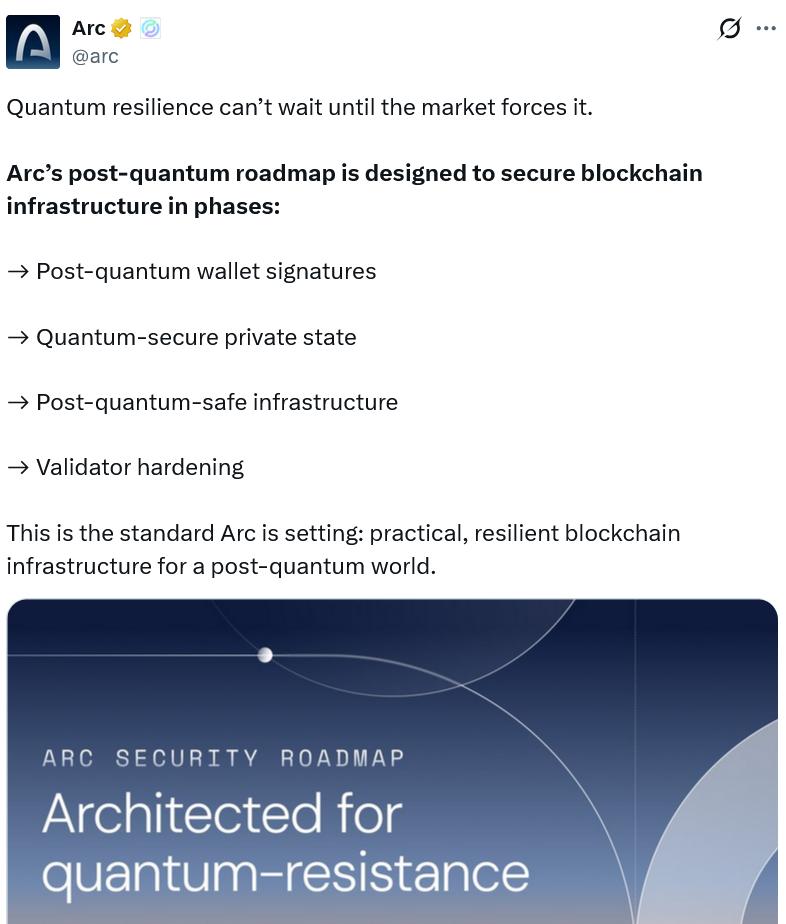
According to Circle's announcement, a post-quantum signature scheme will be integrated into Arc upon its mainnet deployment — anticipated to occur at some point during 2026 — allowing for the use of quantum-resistant wallet technology.
The Arc blockchain is presently operational on public testnet and aims to provide enterprises with access to a comprehensive array of applications utilizing the USDC (USDC) stablecoin.
Following the mainnet rollout, Circle plans to deploy a quantum-protection solution designed to keep balances, transactions and additional financial information secure and private.
Looking toward the future, Circle stated its commitment to deploying quantum-resistant solutions for Arc's validator network along with its offchain systems, encompassing access management, cloud-based environments and physical security hardware.
Although there is broad consensus throughout the cryptocurrency sector that quantum computing represents a genuine threat to digital assets, ongoing discussions continue regarding whether the vulnerability is limited exclusively to crypto wallets with publicly exposed keys or if all cryptocurrency holdings face potential risks.
Many other crypto ecosystems are working on solutions
According to the Google research paper published on March 31, Algorand appears to be the blockchain most prepared for quantum threats, while both the Ethereum and Solana communities are aggressively pursuing protective solutions to ensure readiness ahead of Q-Day.
Within the Bitcoin community, there exists greater division regarding the appropriate course of action for developers to pursue.
Adam Back, CEO of Blockstream and one of the most prominent figures in the Bitcoin space, maintains that quantum threats are significantly exaggerated and that no immediate action is required for several decades.
Conversely, security expert Ethan Heilman along with other researchers have introduced a novel output type for Bitcoin, known as Pay-to-Merkle-Root, through Bitcoin Improvement Proposal 360 (BIP-360), which aims to safeguard Bitcoin addresses against possible short-exposure quantum computing attacks.
That said, implementing this solution could require as long as seven years, according to Heilman's statement to Cointelegraph in February.