CFTC broadens exemptions for software platforms offering passive trading access
This regulatory update from the US commodities watchdog may enable cryptocurrency wallet services and similar applications to provide access to regulated derivatives and prediction market platforms without obtaining introducing broker registration.

The Commodity Futures Trading Commission (CFTC) has broadened its regulatory exemptions for providers of "passive software" that facilitate connections between users and regulated derivatives exchanges and firms.
Through a no-action position released on Thursday, the Market Participants Division at the agency announced it would refrain from recommending enforcement actions against eligible providers and their associated personnel for not registering as introducing brokers or associated persons when enabling trading activity with exchanges and firms registered under CFTC oversight.
This regulatory position has the potential to simplify the process for cryptocurrency wallets and similar applications to provide access to regulated derivatives products, such as perpetual contracts and prediction markets, while avoiding the requirement to register themselves as CFTC-regulated introducing brokers.
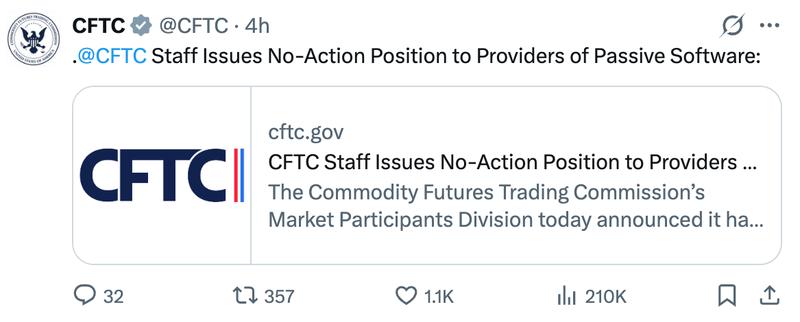
For providers to qualify for this relief, they are required to satisfy specific conditions that limit their involvement in transactions, which includes limitations on their ability to exercise discretionary control over customer orders.
This action builds upon a comparable position that was granted to Phantom Technologies back in March regarding its self-custodial cryptocurrency wallet software. That earlier correspondence permitted Phantom, contingent upon meeting certain requirements, to offer and promote software that connects users to registered futures exchanges and brokers without the obligation to register as an introducing broker.
Both Phantom and the Hyperliquid Policy Center had previously advocated for more comprehensive protections in July, requesting that the CFTC provide protection for non-custodial wallet providers from introducing broker registration requirements and offer clarification on how current regulations apply to blockchain developers and regulated derivatives firms utilizing onchain infrastructure.
Regulators move quickly after CLARITY Act setback
This action by the US regulator arrives just two days following the failure of the CLARITY Act to move forward in the Senate, where a cloture motion garnered 49 votes, falling short of the 60 votes required to proceed to the debate stage.
In the aftermath of the vote, CFTC Chair Michael Selig and Securities and Exchange Commission Chair Paul Atkins indicated on Wednesday that both of their agencies would proceed with crypto regulation efforts utilizing their existing statutory authority.
"The CFTC is locked in and ready to ship its rules for the new frontier of finance," Selig said in a post on X, while Atkins said the SEC would act "with or without legislation" to provide regulatory certainty for digital assets.
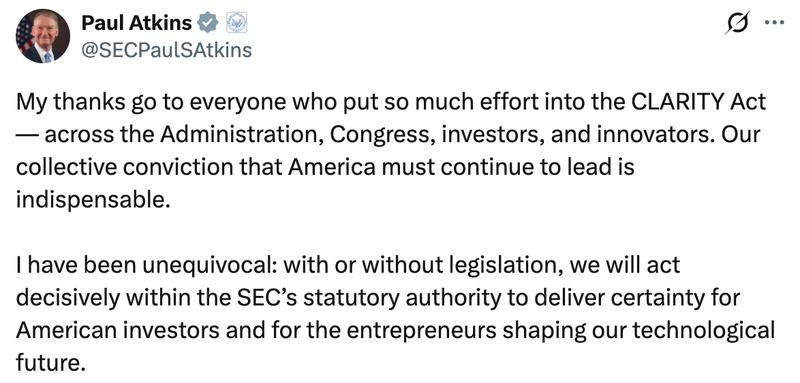
By Thursday, both agencies had begun implementing their commitments. In addition to the CFTC's no-action position, the SEC granted approval for a temporary exemption that permits qualifying platforms to enable restricted onchain trading of tokenized US stocks using permissioned automated market makers and liquidity pools.