Can Bitcoin treasury companies beat BTC performance... and are the dangers justified?
Companies holding Bitcoin as a treasury asset claim they can deliver superior gains compared to direct BTC investment, but do these enhanced returns justify the increased downside exposure?

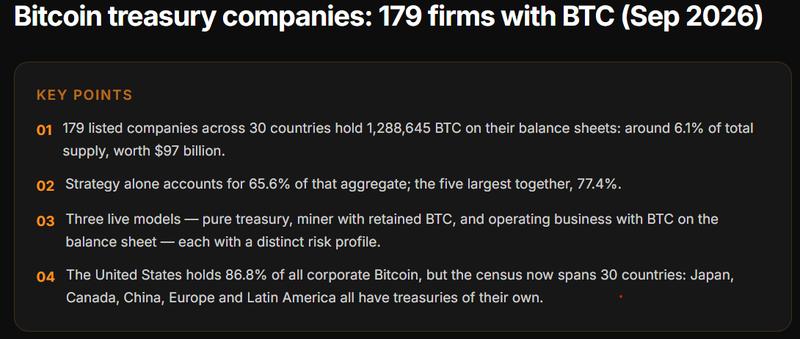
Currently, 179 publicly traded corporations maintain Bitcoin positions on their balance sheets, each executing variations of an identical basic strategy:
Secure funding through conventional financial markets, acquire Bitcoin and work to grow the quantity of BTC supporting each individual share at a rate that exceeds the company's shareholder dilution.
Mark Palmer, who serves as managing director and senior equity research analyst at StoneX, explains this is the method treasury companies use to "beat" the performance of Bitcoin itself.
Executing this strategy successfully becomes significantly simpler during periods when Bitcoin's value is appreciating and market participants are eager to finance additional acquisition rounds. Regrettably, these underlying mechanisms function bidirectionally.
Once the share premium vanishes, appetite from investors diminishes. Capital becomes more difficult to obtain, obligations related to debt and yield persist, and the identical framework that delivered outperformance amplifies losses during downturns. It's unsurprising that the 50 most significant Bitcoin treasury corporations lost $83 billion in collective market capitalization since July 2025.
The recent shareholder revolt at Metaplanet illustrates the types of concerns that emerge when treasury corporations excessively dilute their ownership base.
Bear markets create higher likelihood that treasury companies will need to secure additional funding, but this presents a potential challenge. Palmer explains:
"Issuing shares at a premium to net asset value and buying Bitcoin with the proceeds increases the Bitcoin backing every existing share. The same issuance at a discount destroys value."
So are the outsize returns on offer during the bull market, worth it for the downside risks during the bear?
The math works, until the capital markets stop cooperating
Despite all the sophistication surrounding Bitcoin treasury corporations, the fundamental evaluation for prospective shareholders is comparatively straightforward. Do equity holders ultimately acquire increased Bitcoin backing per share as time progresses?
Palmer suggests that investors ought to look beyond the total quantity of Bitcoin a corporation possesses and concentrate on "Bitcoin per fully diluted share, net of debt and preferred stock claims."
Creating additional shares doesn't inherently present a concern. The critical question is whether the fresh capital produces sufficient incremental value and earnings that the advantages for current shareholders exceed the dilutive impact.
When the company creates shares at prices exceeding the underlying Bitcoin value backing them, and deploys those funds to purchase additional Bitcoin, existing shareholders may finish with increased Bitcoin per share. When capital is raised beneath that threshold, they may conclude with diminished holdings.
This dynamic proved extremely advantageous for Strategy throughout the previous Bitcoin bull cycle, McCarthy notes, due to Bitcoin's rapid appreciation. "They were able to take on new debt. They were able to issue new debt because of that."
The first blow is half the battle
Selecting the appropriate digital asset treasury represents a crucial choice. With approximately two hundred currently available, more established enterprises possess distinct benefits, McCarthy elaborates:
"It's a first-mover advantage, right? Like if you're Michael Saylor or you're Bitmine and you've got this sort of larger-than-life character at the top, it's a bit different."
Michael Saylor, executive chairman of Strategy, has evolved into an integral component of the industry mechanism itself, and according to McCarthy, he possesses the ability to sustain momentum in the narrative even during periods when Bitcoin's valuation stagnates. Bitmine, an Ethereum treasury corporation, features a comparably prominent personality in Tom Lee.
Narratives drive the rises and falls of Bitcoin and alternative cryptocurrencies, making a charismatic spokesperson valuable for maintaining investor engagement — particularly during periods when the underlying digital asset experiences steep declines. McCarthy cautions, however:
"I don't think there's enough room for a hundred Michael Saylors; there's not enough people like that around."
According to McCarthy, numerous corporations that entered the space following Strategy were fundamentally just acquiring Bitcoin and anticipating stock price appreciation. These companies "didn't have an exit plan" for when market dynamics inverted, he notes, and he anticipates the industry consolidation will prove considerably more severe:
"I think it's going to flush out like 95% of it."
The corporate wrapper comes with baggage
Alternative, more straightforward methods exist for obtaining Bitcoin exposure through direct purchase on an exchange, or through a spot Bitcoin exchange-traded fund (ETF).
Spot ETFs provide traditional finance investors the opportunity to acquire Bitcoin through standard brokerage platforms, eliminating the need to evaluate a DAT company's leadership team, capital structure, or governance challenges.
Complex financial structuring can prove challenging for individual investors to comprehend, Palmer observes:
"The biggest risk that investors face in buying Bitcoin treasury company stocks is forgetting that common shareholders' claim is a residual one, as convertible debt and perpetual preferred stock sit ahead of them in terms of priority."
These financial instruments, he continues, "carry cash obligations that Bitcoin itself doesn't generate."
So, can treasury companies beat Bitcoin?
Matt Cole, chief executive of Strive, among the largest Bitcoin treasury corporations, advises investors to simply examine the performance record:
"Strategy has dramatically outperformed Bitcoin since adopting its strategy. Metaplanet has also outperformed Bitcoin since inception and Strive has outperformed Bitcoin both since announcing our strategy in May 2025 and year-to-date in 2026."
He further states that, "Strive has not sold a single Bitcoin, and during a Bitcoin bear market we have increased our holdings approximately fourfold while outperforming Bitcoin."
David Bailey, chief executive of Nakamoto, presents a comparable argument for Metaplanet, characterizing it as "the best performing equity in the world for nearly two years" and noting it is "up 1,300% from genesis."

Notwithstanding the historical performance, maturing debt instruments and yield commitments could generate difficulties in future periods. Additionally, certain corporations lacking equivalent access to financing, investor support or balance sheet strength have discovered how rapidly the strategy can turn unfavorable. The two most prominent cases include Bailey's own Nakamoto Inc, whose equity declined 99% from its 2025 high point and the UK company Satsuma Technology, which experienced a comparable drop.
McCarthy's personal perspective proves illuminating. When questioned about how he would allocate $100,000 for Bitcoin exposure, he indicates he would "mostly buy an ETF" and potentially invest a smaller allocation into Strategy "for the vol."
Ultimately, purchasing Bitcoin represents a wager on Bitcoin. Purchasing a treasury company constitutes a wager on Bitcoin combined with an additional wager on the leadership, capital structure, financial position and corporate governance surrounding it.