August Deadline Looms for Bitcoin Tax Relief as BPI Sounds Urgency Alert
Industry advocacy group Bitcoin Policy Institute expresses optimism about cross-party backing for tax exemptions on minor Bitcoin purchases while cautioning that legislative opportunities are dwindling.

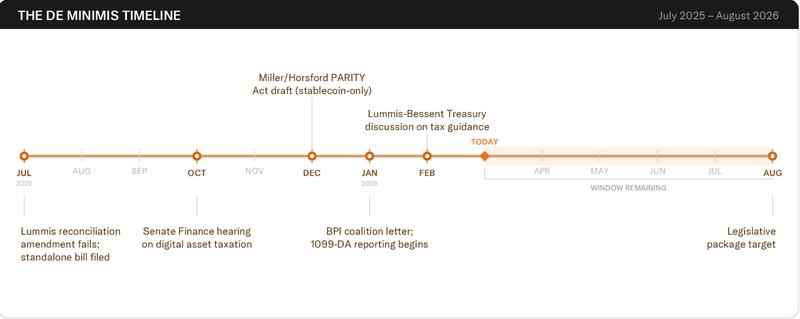
An advocacy organization for the digital currency sector, the Bitcoin Policy Institute (BPI), has identified a critical timeframe spanning from March through August 2026 to successfully shepherd de minimis tax relief measures for Bitcoin through the United States Congress, while simultaneously cautioning that the opportunity to enact substantive legislative reforms is rapidly diminishing.
According to BPI, the organization has conducted outreach and engagement activities with 19 different Congressional offices spanning both chambers of the legislature, the House and Senate, throughout the preceding three-month period to advocate for US policymakers to support tax relief measures for Bitcoin (BTC) purchases that fall beneath a specified dollar amount.
Broadening de minimis tax relief provisions to encompass assets beyond stablecoins pegged to the US dollar has garnered support from both sides of the political aisle, though the BPI has issued a stern warning that the "window is narrowing" for legislative action on Bitcoin taxation matters. According to the BPI's statement:
"Congress will be increasingly consumed by midterm dynamics as summer approaches, and the bandwidth for complex tax legislation shrinks with every passing week. Senator Lummis, the issue's most forceful champion, departs the Senate in January 2027.
If a package does not come together in the next few months, the opportunity may not return for years," the BPI continued.
Within the framework of existing United States tax regulations, utilizing BTC as a payment mechanism for purchasing goods and services creates a taxable event requiring tax documentation to be submitted to the Internal Revenue Service (IRS), effectively hampering Bitcoin's viability as a practical medium of exchange for everyday transactions.
Implementing a de minimis exemption would enable minor cryptocurrency purchases, generally those falling under a predetermined dollar amount, to be exempt from capital gains tax documentation requirements, thereby enabling individuals to utilize Bitcoin for purchases without the burden of tracking and reporting gains or losses associated with everyday spending activities.
Tax policy has kept Bitcoin as an investment and out of commerce
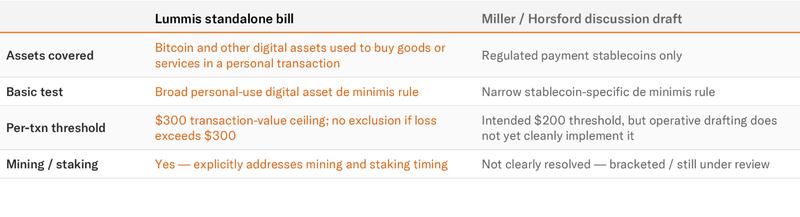
Senator Cynthia Lummis from Wyoming put forward legislation in July 2025 that proposed establishing a de minimis tax exemption applicable to cryptocurrency purchases valued at $300 or less per transaction, with an aggregate annual ceiling of $5,000.
The proposed legislation, however, did not succeed in building sufficient momentum within the Senate, and an alternative piece of legislation concentrating exclusively on establishing tax exemptions specifically for stablecoin transactions was brought before the House of Representatives by Representatives Max Miller and Steven Horsford during 2025.
The adoption of Bitcoin as a payment system faces significant obstacles due to how digital assets are currently classified and handled within the United States tax framework, as noted by Pierre Rochard, who serves on the board of directors for Strive, a company specializing in BTC treasury management.
"The number one impediment to Bitcoin payments adoption is tax policy, not scaling technology," Rochard said on X.