Why DeFi Protocols That Weathered 2022's Crypto Winter Are Closing in 2026
A wave of DeFi protocols that made it through the 2022 Terra and FTX disasters are now closing their doors in 2026. Analysts explain this isn't about market consolidation — it's quite the reverse.
Following Zapper's announcement earlier this month that it would cease operations after operating for almost seven years, the DeFi dashboard became the latest addition to an expanding roster of decentralized finance platforms closing down in 2026.
This year has also witnessed the closure or ongoing shutdown of Bitcoin DeFi platform Botanix, Solana-based portfolio monitoring tool Step Finance, analytics platform for DeFi called Parsec, and DEX aggregation service Odos Protocol — all projects that weathered several market cycles.
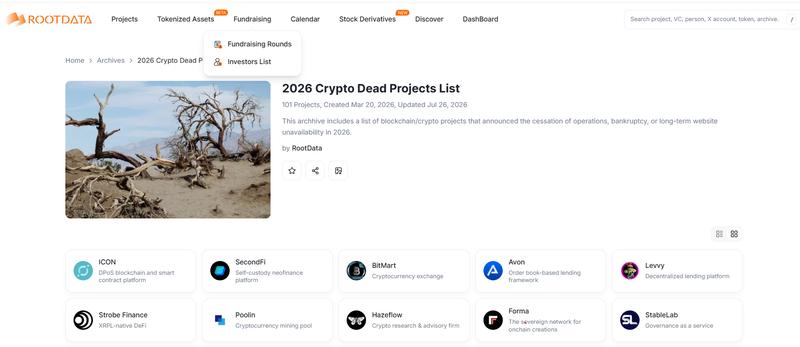
While the devastation extends beyond decentralized finance — RootData's tracking shows 101 cryptocurrency projects in total have ceased operations this year through July 26 — DeFi represents over half of these casualties.
Does this wave of closures simply reflect bear market pressures, or are deeper forces at work beneath the surface?
When Botanix's leadership announced their platform would close, they cited insufficient demand, explaining to Cointelegraph in June that the migration of onchain activity toward a handful of platforms such as Hyperliquid and major centralized exchanges accelerated Botanix's demise.
Despite widespread concerns that the broader industry is concentrating around fewer, larger platforms, Magazine received a different perspective from Alex Weseley at Artemis Research, who suggests DeFi tells another story:
"The prevailing narrative has been that concentration is increasing in DeFi, caused by a series of exploits and capital rotation into the most 'Lindy' protocols. But the data disagrees."
This raises the question: what's causing the shutdown of projects that endured Terra's collapse, survived FTX's implosion, and withstood Chokepoint 2.0's stranglehold? If these DeFi protocols made it through the 2022 bear market, what aspects of the 2026 market environment are proving fatal?
Capital has rotated rather than exited
Data from Artemis reveals that concentration levels among monitored DeFi protocols have actually declined since 2024.
Though dominant players continue leading each major category — Uniswap in decentralized exchanges, Aave in lending services, and Jupiter in perpetuals markets by total locked capital — Weseley points out that "every one of those leaders holds a smaller share of its sector now than it did two years ago."
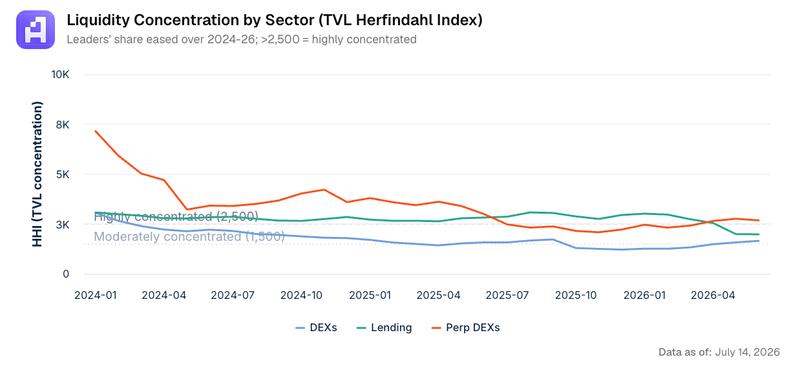
His analysis suggests that onchain economic activity has migrated to different areas within the cryptocurrency ecosystem instead of departing entirely.
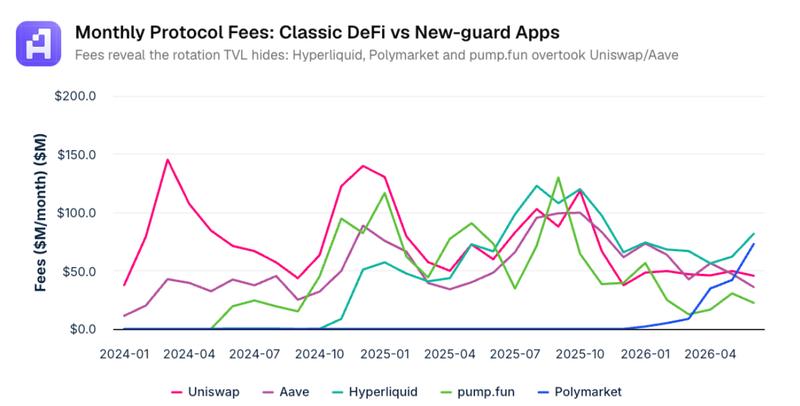
"The economics didn't disappear; they rotated to adjacent apps (Hyperliquid, Polymarket, pump.fun), so classic DeFi viability shrank even as total onchain fee generation stayed high."
Markus Levin, who co-founded blockchain infrastructure company XYO, observes that today's environment bears little similarity to DeFi's early era.
"The DeFi space is much more competitive than it was during the last bear cycle," Levin explains to Magazine.
"Early DeFi projects benefited from first-mover advantage and a relatively small field of competitors. Now, there are thousands of protocols competing for the same users and liquidity."
Wesley suggests that examining revenue generation provides more valuable insights into where DeFi economic activity is concentrated, rather than relying solely on the commonly-used total value locked (TVL) metric.
"TVL is the right tool for the narrow 'liquidity' question but misleads elsewhere," Wesley explains.
"Fees and revenue are best, because they measure economic viability directly and expose shifts that TVL and headline usage hide."
According to Artemis calculations, the count of DeFi applications producing at least $1 million monthly in fees reached approximately 33 or 34 during the middle to later parts of 2025, then decreased to around 25 or 26 throughout 2026's first half. Those generating over $10 million in monthly fees saw their numbers cut roughly in half during this same timeframe.
The rules for attracting capital have changed
Gauntlet, a firm specializing in DeFi risk management, contends that the overall market maintains its health, notwithstanding the numerous DeFi protocol closures witnessed this year.
"Demand is the strongest it has ever been," states Nicholas Cannon, who serves as chief business officer at Gauntlet, in conversation with Magazine. "Stablecoin supply keeps growing, and traditional finance is moving toward DeFi rather than away from it."
Gauntlet's assessment identifies the critical shift from the prior market downturn: investors now exercise greater selectivity and no longer fall for short-term token incentive schemes designed to attract yield farmers.
"What changed is that capital got discerning. In previous cycles, liquidity followed incentives wherever they pointed. Today it follows sustainable yield, track record, and curation. Incentives still have a role in bootstrapping, but they no longer carry a protocol on their own."
Levin notes that institutional capital particularly demonstrates increased selectivity in 2026, gravitating toward platforms with proven histories instead of protocols attempting to attract users through attractive token incentive programs.
"The projects that survive this cycle are likely to be the ones that already have meaningful user distribution or can reach users beyond the traditional DeFi audience," he explains, suggesting this may constitute a more rigorous challenge than surviving the bear market.
Areas where fresh experimentation is occurring include tokenized assets, stablecoins, and emerging sectors like agentic DeFi.
Infrastructure is consolidating while innovation moves higher
Cannon identifies one outcome of the industry's evolution: fewer development teams now attempt to create the next Aave or Uniswap. They're instead leveraging established DeFi infrastructure as the building blocks for their own products and services.
This pattern also appears in investment allocation trends. DeFi lending protocol Morpho secured a $175 million funding round in June to facilitate institutional lending onchain, representing one of the sector's most substantial capital raises, while agentic DeFi startup Alpaca obtained $135 million in July for developing infrastructure supporting AI-driven financial applications.
Merlin Egalite, co-founder of Morpho Labs, predicts that the coming generation of thriving protocols will place increasing emphasis on distribution rather than engaging in direct competition with established infrastructure.
"The protocols growing fastest will be the ones embedded into the platforms where users already are. Fintechs, wallets, exchanges building on top of you rather than competing with you."
Egalite further contends that future expansion will emerge from simplifying DeFi infrastructure adoption for traditional financial institutions.
"The next wave of growth comes from fintechs, banks, and platforms that want to embed DeFi infrastructure without rebuilding it," he says.