Vitalik Buterin Declares 2026 the Era of Computing Self-Sovereignty
Vitalik Buterin, Ethereum's co-creator, outlines his 2026 tech ecosystem centered on self-sovereignty, replacing mainstream technology platforms with privacy-focused, encrypted, and open-source alternatives.

Vitalik Buterin, the cofounder of Ethereum, has announced that 2026 marks the "year we take back lost ground in computing self-sovereignty," beginning with transformations to his personal technology setup.
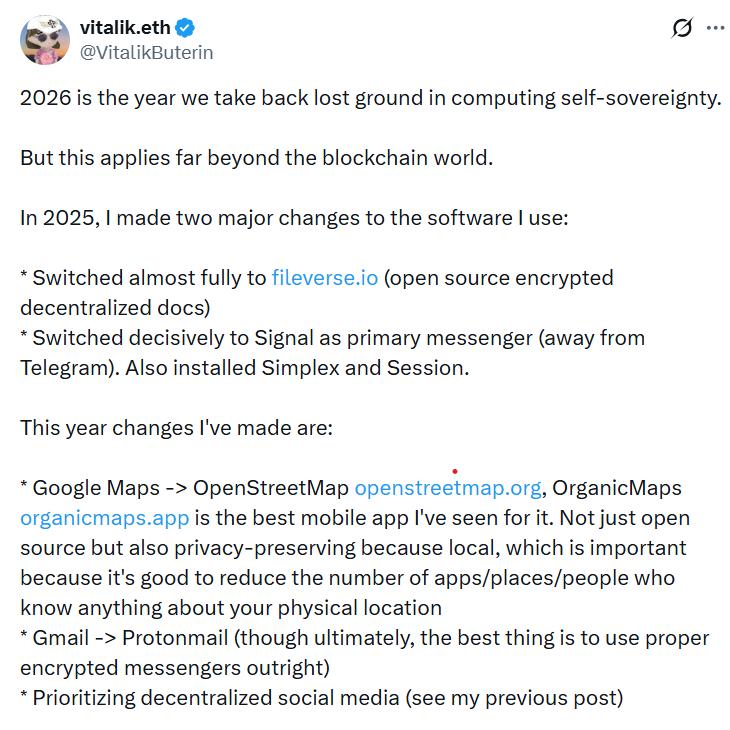
Through a Friday post shared on X, he outlined a comprehensive set of software transitions he has implemented to minimize his dependence on centralized platforms that collect extensive user data.
The "two major changes" in the software applications he adopted throughout 2025 included a shift to "almost fully" utilizing Fileverse, which is an open-source, decentralized platform for documents — functioning as a privacy-focused alternative to Google Docs — and making a "decisive" transition to Signal for his primary communication needs.
Signal implements end-to-end encryption as a standard feature for all individual and group conversations, and maintains minimal metadata storage, which means only basic details such as account creation dates or the most recent connection timestamp are retained.
By comparison, Telegram provides end-to-end encryption exclusively in its optional "secret chats" feature and typically stores messages along with metadata on centralized servers, an approach that has attracted attention as requests for data from law enforcement agencies have grown in nations such as France.
Local AI and self-hosted tools
Throughout 2026, Buterin has transitioned away from Google Maps toward OpenStreetMap accessible through OrganicMaps and shifted from Gmail to Proton Mail, all while making decentralized social media platforms a priority in his digital life.
Buterin additionally shared details about his testing of locally hosted large language models, making the case that routing all information to third-party service providers is "unnecessary" given that users can now increasingly operate artificial intelligence tools directly on their personal hardware.
He noted that improvements in user interfaces, integration capabilities and operational efficiency remain essential to transform local models into a seamless standard option, though he emphasized that "huge progress" has already been achieved when compared to one year prior.
Privacy advocates see broader shift
His statements align with arguments presented by privacy advocate and NBTV founder Naomi Brockwell, who has characterized running models on local hardware as the most privacy-conscious approach to utilizing AI without transmitting prompts or documents to servers operated by external parties.

Brockwell has dedicated years to educating mainstream audiences on privacy-enhancing practices, asserting that privacy fundamentally concerns autonomy instead of secrecy and advocating for the adoption of tools such as Bitcoin (BTC), encrypted messaging applications and self-hosted services as methods to diminish surveillance capabilities held by governments and corporations.
Buterin's post arrives during a period of intensified discussion regarding the appropriate level of access that governments and technology platforms should possess to users' private communications and associated metadata.
The European Union's contentious Chat Control proposal, as an illustration, initially incorporated pre‑encryption scanning of messages for the purpose of detecting abusive material, and triggered concerns from civil liberties organizations and technology experts that client‑side scanning mechanisms could compromise trust in applications offering encryption.
Gradually replacing conventional applications with encrypted, open-source and locally-operated alternatives represents, in the view of Buterin and fellow privacy advocates, a practical approach for users to begin reasserting authority over how their data flows and is utilized.