Singapore's crypto market surges 55% while regional activity declines
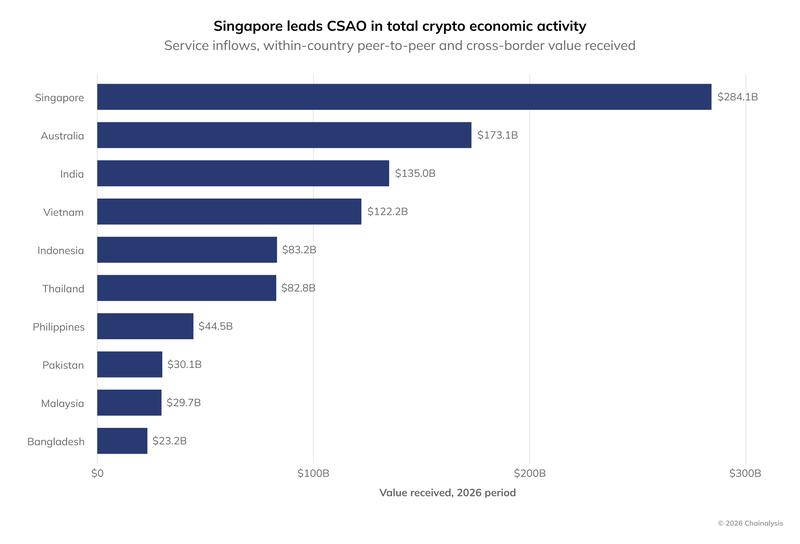
The city-state's digital asset economy expanded 55.4% to reach $284 billion, driven by a 94% jump in institutional platform usage, as the Philippines, Thailand, and Vietnam emerged as leaders in low-value peer-to-peer transactions.

Digital asset activity in Singapore climbed 55.4% to reach $284 billion during the twelve-month period ending in June 2026, defying a broader regional downturn and reclaiming its status as the dominant crypto market in Central and Southeast Asia and Oceania (CSAO), based on findings from Chainalysis.
A significant portion of this expansion originated from institutional platform operations, which saw a 94% increase to $60 billion, largely driven by a limited group of market makers, over-the-counter trading operations, and institutional brokerage services. According to Chainalysis, the wider CSAO digital asset market experienced a 6.8% decline during the identical timeframe.
The growth in Singapore's institutional platform ecosystem was very concentrated and marked by mostly high-volume activity by existing platforms rather than the dynamic entry of new services.
Chainalysis
These results emerge as Singapore has been actively strengthening cryptocurrency oversight while simultaneously promoting tokenization, stablecoins and digital-asset settlement infrastructure.
During 2025, the Monetary Authority of Singapore (MAS) mandated that domestic cryptocurrency companies serving international customers obtain proper licensing or cease operations, a regulatory action that StraitsX CEO Tianwei Liu indicated curtailed speculative trading while maintaining a stronger presence of institutional participants, including banking institutions and major corporations, utilizing blockchain technology in operational environments.
Concurrently, MAS has broadened its tokenization and settlement programs. The authority's BLOOM program facilitates experimental trials leveraging regulated stablecoins and tokenized banking currency. On March 25, Ripple became part of this initiative to conduct testing of cross-border trade settlement utilizing RLUSD.
Philippines, Thailand and Vietnam drive small-value P2P activity
Whereas Singapore demonstrated exceptional performance in institutional operations, Chainalysis discovered expanding small-value peer-to-peer (P2P) transaction activity throughout the Philippines, Thailand and Vietnam.
These three nations recorded an aggregate of 5.4 million P2P transactions, encompassing both domestic and international transfers, valued at under $10,000 throughout the analysis period, constituting 14.4% of worldwide totals despite representing merely 2.5% of the global cryptocurrency market.
Over 80% of domestic P2P transactions throughout these three jurisdictions fell below $1,000, with an average transaction value of $618, in comparison to $1,210 for the remainder of global markets.
Within the Philippines, the International Monetary Fund has previously indicated that regulatory authorities perceive cryptocurrency adoption as predominantly fueled by remittance flows and investment purposes, while World Bank statistics demonstrate personal remittances equaled 8.5% of GDP during 2025.
During June, Vietnamese news publication Tuoi Tre documented that P2P commerce has evolved into a crucial fiat currency gateway given that the Vietnamese dong lacks widespread support in direct cryptocurrency trading pair offerings. In March, Reuters documented that the majority of cryptocurrency traders operating in Vietnam depend on international exchange platforms, establishing P2P channels as a vital mechanism for users to transfer funds between domestic banking accounts and cryptocurrency traded through those platforms.
Regarding Thailand, the nation's Securities and Exchange Commission announced in September that it had detected a substantial rise in both the volume and value of stablecoin transactions, with particular emphasis on USDT.
At the same time, international stablecoin utilization is experiencing growth. Chainalysis reported that cross-border stablecoin operations surpassed domestic activity across every market within its analysis, with regional cross-border activity measuring 3.2 times greater than domestic usage.
Stablecoins account for a growing share in all three. Plausibly, the drivers of this adoption link to ease of use, speed and low transfer costs.
Chainalysis
Thailand and Vietnam maintained substantial domestic stablecoin markets, valued at $10.4 billion and $6.9 billion, correspondingly, while cross-border stablecoin operations considerably exceeded domestic activity levels.
In the Philippines, Nichel Gaba, CEO and founder of cryptocurrency exchange PDAX, projected that 5% to 10% of incoming remittances are processed through stablecoin settlement, further noting that prominent remittance corporations are actively pursuing stablecoin settlement programs within the country.
In July, the Bank of the Philippine Islands disclosed intentions for a stablecoin settlement experimental program designed to reduce both the expense and transaction duration of international payments directed to Filipino freelancers and remote workers.