SEC Faces Calls from Bitwise and Hyperliquid for Crypto Rule Modifications on Airdrops, Token Trading
As the Securities and Exchange Commission's comment period nears its end, both organizations are pushing for more transparent regulations regarding cryptocurrency asset categorization and trading on secondary markets.

Two major players in the cryptocurrency space, Bitwise Asset Management and the Hyperliquid Policy Center, are calling on the United States Securities and Exchange Commission (SEC) to modify its proposed cryptocurrency regulations. Through comment letters filed on Monday, both entities are requesting more definitive guidance regarding token categorization, airdrop protocols, and secondary-market trading operations.
These appeals arrive at a critical juncture, as Tuesday marks the deadline for public commentary on the SEC's proposed Regulation Crypto Assets. This regulation aims to establish exemptions for eligible cryptocurrency fundraising initiatives and provide a conditional safe harbor framework for tokens linked to investment contracts.
Through a comment letter dated Oct. 19, Bitwise Asset Management called upon the SEC to provide clarity regarding the methods investment managers should employ to assess whether a cryptocurrency asset falls under securities regulations. The firm emphasized that managers require a framework they can implement utilizing "publicly available information."
Additionally, the investment management company requested more precise regulations concerning when managers may depend on an issuer's proposed Form TR submission, which serves to verify that an investment contract has been terminated, along with guidance on how they should evaluate tokens in the absence of such documentation.
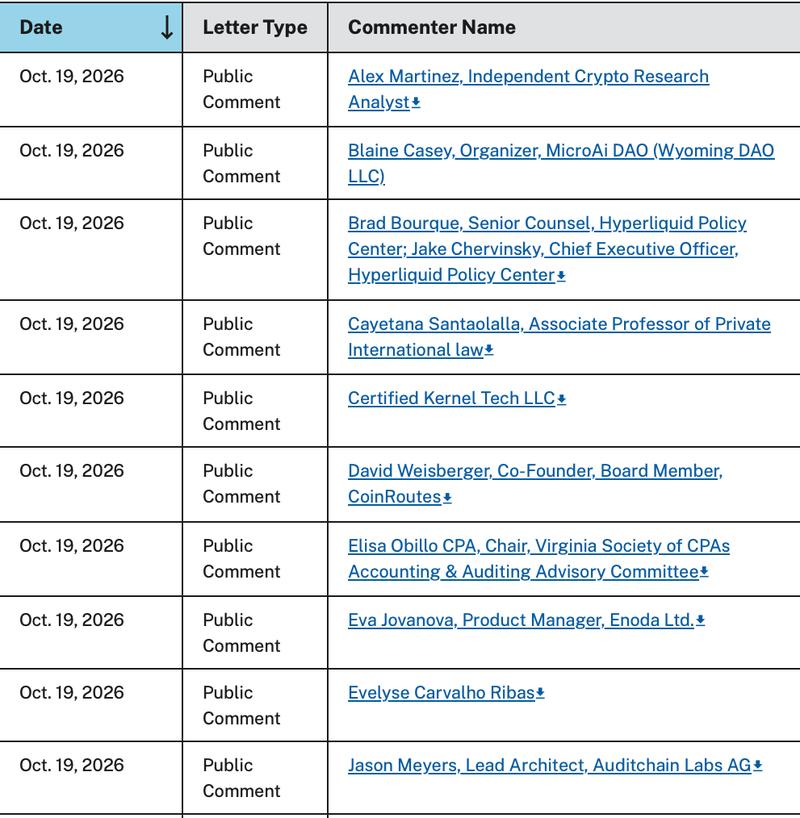
Through its own filing, the Hyperliquid Policy Center requested that the SEC expand the scope of its proposed safe harbor provisions, contending that the current framework may arrive too late in a project's lifecycle. The organization advocated for enhanced protections covering airdrops designed to incentivize network engagement, alongside comprehensive guidance addressing token repurchase programs.
The Hyperliquid group further cautioned that the current proposal "fails to provide clarity" regarding whether unregistered intermediary platforms can enable token trading activities or if tokens may be traded without restriction via onchain protocols. The center emphasized the need for the SEC to explicitly address secondary-market transactions instead of leaving cryptocurrency exchanges and decentralized trading platforms in a state of regulatory ambiguity.
SEC proposal faces legal and investor protection objections
In contrast to industry stakeholders seeking modifications to the proposed regulations, former SEC enforcement attorney John Reed Stark and Duke University finance professor Lee Reiners adopted an entirely opposing stance. Through an Oct. 16 comment letter, they advocated for the commission to completely retract the proposal, contending that it surpasses the agency's legal authority and would compromise investor safeguards.
According to Stark and Reiners, current securities regulations and the Supreme Court's established Howey test already furnish a sufficient structure for overseeing cryptocurrency offerings. Their argument suggested that the fundraising exemptions would diminish investor protections, and the proposed safe harbor mechanism would enable issuers to essentially exempt their tokens from securities regulation via self-certification processes.
The pair additionally cautioned that implementing the rules in substantially their present configuration would provoke an immediate legal challenge, with the potential outcome being the complete invalidation of the framework.
As the public commentary period concludes on Tuesday, the SEC will conduct a comprehensive review of all submissions before determining whether to modify, implement, or rescind the proposed regulations. The commission has yet to publish a timeline for reaching a final determination, and any finalized rule would necessitate approval by commission vote prior to implementation.