New Legislative Effort Targets Insider Trading in Prediction Markets
Proposed legislation would ban government employees from leveraging non-public information to place bets on prediction market platforms, imposing penalties of up to twice their earnings.

A second legislative proposal targeting insider trading activities by government personnel on prediction markets has been presented by US legislators this week, reflecting mounting worries about such behavior on prominent platforms including Kalshi and Polymarket.
During a Thursday announcement, US legislators Todd Young, Elissa Slotkin, John Curtis and Adam Schiff revealed the cross-party Public Integrity in Financial Prediction Markets Act of 2026.
"No one should be profiting off the information and knowledge gained as a public servant, period," Slotkin said, adding: "This bill is an important first step in placing common sense rules around prediction markets, and it has real teeth to ensure those who break these rules face real consequences."
The proposed legislation highlights increasing concerns that prediction markets may emerge as a novel avenue for insider trading activities, given that wagers connected to actual events create ambiguity between gambling and financial transactions.
Bill aims to stop insider profiteering
This most recent proposal, presented during the second session of the 119th Congress, seeks to bar government executives from leveraging "insider information to bet on a prediction market contract."
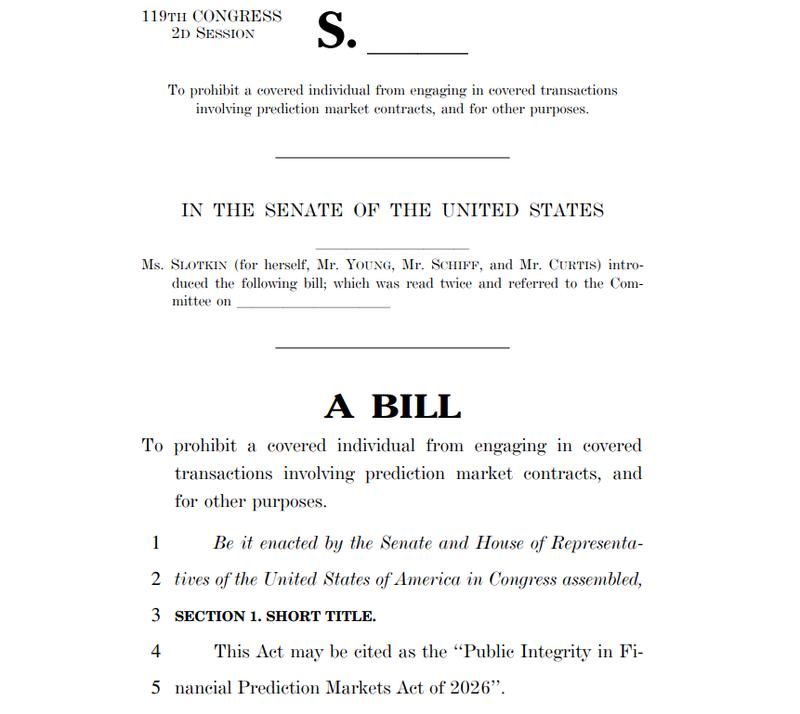
Should it become law, the Public Integrity in Financial Prediction Markets Act of 2026 would apply to the president, vice president and legislators throughout Congress, the House of Representatives and the Senate.
The legislation would additionally encompass political appointees and "employees of an Executive agency or independent regulatory agency."
According to the bill, insider information is defined as any details that a "reasonable investor would consider important in making a decision related to a prediction market contract and is not publicly available."
The proposal further specifies reporting obligations requiring government officials to disclose any contract wagers exceeding $250 within 30 days to their supervising ethics office. The reporting individual would need to provide "the number of contracts purchased, price of contract, date and time of transaction, name of contract, position taken on contract, name of trading platform used, profit or loss made on transaction."
Under the penalty structure, individuals would be charged whichever is greater between $500 or double the amount of profit earned from the prediction market contract.
These legislative efforts arrive during a period of growing interest from state and federal lawmakers in regulating prediction markets.
This also represents the second proposal put forward this week aimed at preventing government officials from exploiting insider information for prediction market profits, following the PREDICT Act presented by US Representative Adrian Smith and Representative Nikki Budzinski on Tuesday.
In contrast, the PREDICT Act concentrates on blocking insider trading on prediction markets connected to political events, policy decisions and other government actions.
In recent times, both Kalshi and Polymarket have undertaken efforts to strengthen their regulations to prevent insiders from placing wagers on their platforms.