Licensed crypto companies gain banking access in Pakistan as multi-year prohibition ends
The State Bank of Pakistan has authorized financial institutions to provide account services to licensed virtual asset service providers, bringing an end to years of prohibitions and signaling a transition to a structured regulatory approach.

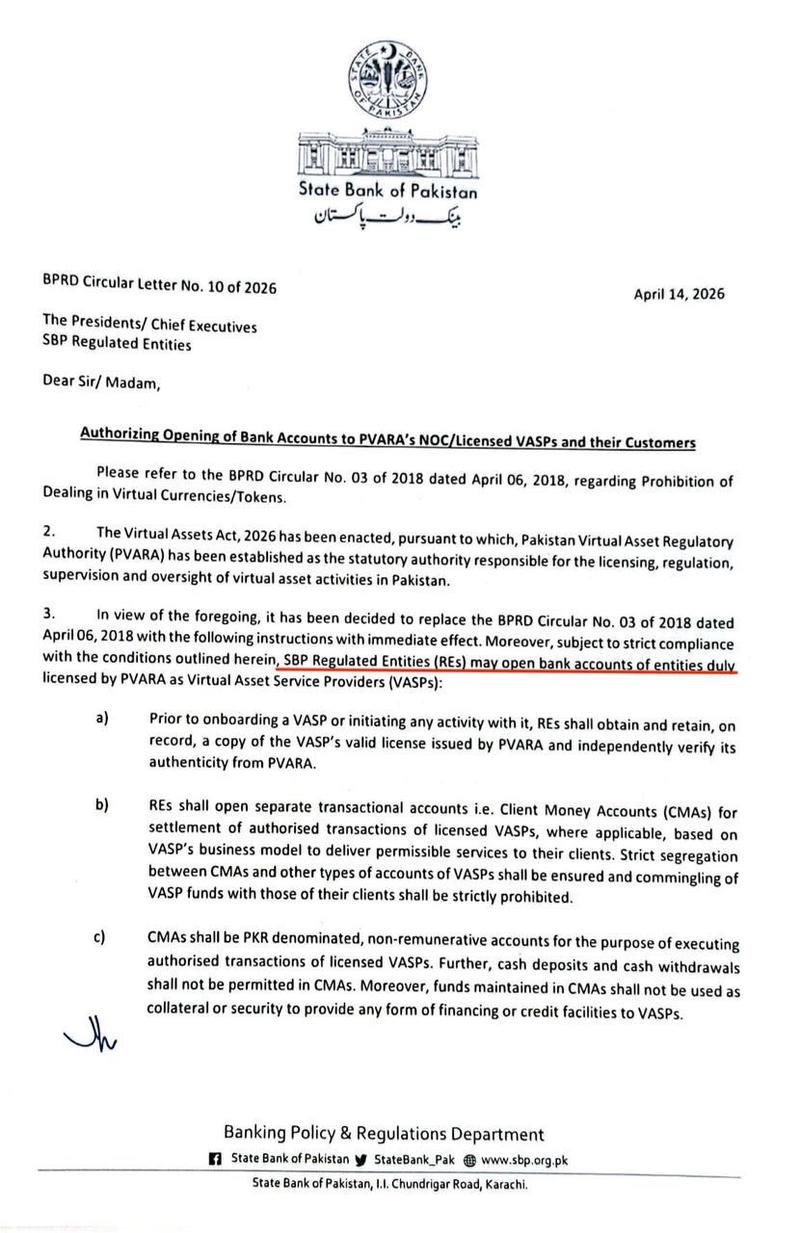
The State Bank of Pakistan has granted authorization for financial institutions to provide account services to licensed virtual asset service providers (VASPs) along with their clients, thereby superseding an eight-year prohibition that banned dealings involving virtual currencies.
According to a circular issued on April 14, the State Bank of Pakistan (SBP) indicated that regulated financial institutions are now permitted to establish banking accounts for entities that have received licensing from the Pakistan Virtual Assets Regulatory Authority (PVARA), which serves as the statutory organization tasked with licensing, regulation and supervisory functions over virtual asset operations within Pakistan.
This development comes after Pakistan enacted the Virtual Assets Act 2026 during March and represents a transition toward establishing a more comprehensive regulatory structure for digital assets following years of restrictive measures that began with a complete prohibition implemented in 2018.
Government officials have recently indicated a more organized methodology toward the industry, which has included conducting discussions with prominent exchanges like Binance and HTX during December 2025, as components of initiatives designed to bring in regulated trading venues.
Simultaneously, Pakistan has additionally investigated blockchain-based financial systems through interactions with entities connected to World Liberty Financial, featuring conversations surrounding the utilization of stablecoins for international payment transactions.
Banking access opens under strict regulatory framework
According to the new regulatory structure, regulated financial institutions are prohibited from investing, trading or maintaining virtual assets utilizing their proprietary funds or deposits from customers, as stated in the circular, which highlights that the role of banks is confined to delivering banking services to firms holding licenses.
The SBP further specified that financial institutions continue to bear responsibility for adhering to all relevant central bank regulations, which include foreign exchange requirements, and that entering into any agreement with a VASP does not release them from such obligations.
Financial institutions must establish distinct transactional accounts denominated in Pakistan rupees, which are designated as Client Money Accounts (CMAs), for the settlement of approved transactions involving licensed VASPs, featuring rigorous segregation between CMAs and additional VASP accounts along with a ban on mixing VASP funds together with client assets.
Beyond the existing customer due diligence requirements mandated under SBP's anti-money laundering (AML) and counter financing terrorism (CFT) regulations, regulated financial institutions are obligated to perform comprehensive due diligence on every VASP, modify their customer risk profiling frameworks to incorporate VASP-associated risks, and assign risk ratings to VASPs in accordance with those assessments.
Financial institutions receive instructions to monitor their business relationships with VASPs on a continuous basis and submit reports regarding any suspicious transactions to Pakistan's Financial Monitoring Unit.