Institutions Cannot Engage in DeFi's 'Pirate Game,' States ERC-7943 Creator
As Ethereum developers reconsider institutional finance's blockchain transition, the real-world asset standard ERC-7943 advances to its final implementation stage.
The cryptocurrency ecosystem has flourished for years on the backbone of speculative investment movements and the surging demand for decentralized finance (DeFi) applications and tokens.
This pattern remains accurate for emerging niches including perpetual decentralized exchanges and prediction market platforms. However, as traditional Wall Street firms venture more aggressively into real-world asset (RWA) tokenization, the industry's current infrastructure doesn't entirely accommodate the regulatory-compliant financial instruments institutions seek to migrate onchain.
A contributor to the recently finalized ERC-7943 (uRWA) token standard explained that the scattered infrastructure supporting a significant portion of DeFi wasn't built with regulated financial instruments in mind, which typically demand identity verification frameworks and interoperability protocols.
"If you want to bring regulated assets onchain, you can't really escape regulations," Dario Lo Buglio, co-founder and head of blockchain at tokenization platform Brickken, told Cointelegraph.
"You can still play your pirate game on DeFi without regulated assets."
Current standards fail to address all RWA scenarios
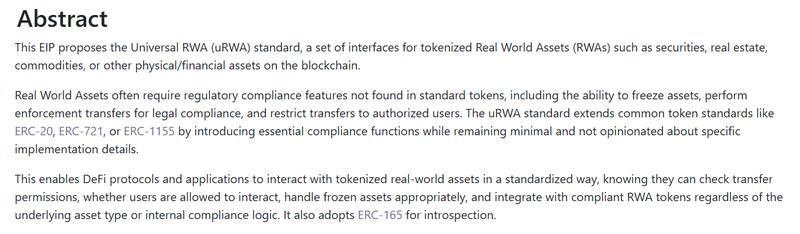
The ERC-3643 token standard — alternatively recognized as the T-REX or Token for Regulated Exchanges — represents one of the prevailing frameworks utilized for security tokenization on the Ethereum network.
This standard already incorporates numerous compliance-focused capabilities that institutions demand, including identity-based access controls and provisions enabling issuers to take action under particular conditions.
However, the framework was constructed primarily with securities in mind and doesn't necessarily apply to the expanding spectrum of tokenized assets currently making their way into blockchain ecosystems, Lo Buglio explained. Consequently, achieving interoperability becomes progressively challenging as additional institutions explore migrating conventional financial instruments onchain.
"As tokenization becomes easier, the harder problem is making those assets work across different compliance systems, custodians, exchanges, wallets and institutional platforms," Markus Levin, co-founder of XYO, told Cointelegraph.
According to Levin, standards like uRWA have the potential to standardize the manner in which tokenized assets transmit data related to identity verification, access permissions, regulatory compliance requirements and transfer restrictions throughout Ethereum-based infrastructures.
"Done well, that makes regulated assets far easier to move, verify and integrate without every institution building its own isolated infrastructure," he said.
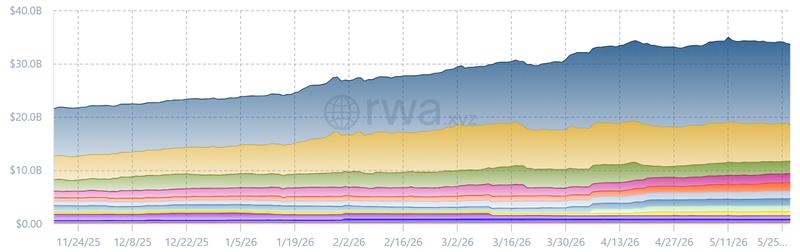
The tokenized RWA market expanded from approximately $6.4 billion at the beginning of 2025 to roughly $34 billion as of Thursday, based on data from RWA.xyz. Standard Chartered forecasts this valuation will surge to $2 trillion by the conclusion of 2028, whereas the Boston Consulting Group anticipates $18.9 trillion by 2033.
Levin further noted that financial institutions have predominantly focused on assets featuring reliable cash flows, genuine yield generation and well-established legal frameworks.
"The market is tokenizing what benefits most from faster settlement, programmable collateral and lower operational friction," he said.
Privacy emerges as the subsequent institutional demand
Privacy continues to represent a substantial barrier for institutions testing onchain financial systems, especially for organizations reluctant to reveal portfolio holdings or transaction movements on publicly accessible blockchains.
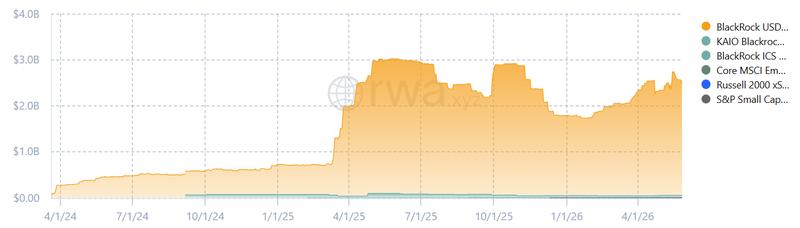
"We don't want BlackRock listing their entire portfolio onchain transparently to everyone, but they still want to transact onchain," he said.
Lo Buglio contended that numerous existing tokenization frameworks were initially constructed for public Ethereum-based infrastructures and don't invariably transfer smoothly to privacy-focused blockchain networks, where transaction architectures and data schemas frequently diverge from conventional EVM ecosystems.
The Canton Network, which launched with financial support from organizations including Goldman Sachs, Microsoft and Cboe Global Markets, was built specifically for privacy-preserving financial coordination among institutional participants.
In contrast to public blockchain networks where transaction information remains broadly accessible throughout the ecosystem, Canton permits data visibility exclusively to authorized participants while simultaneously coordinating settlement operations between financial institutions.
The network's design has frustrated certain developers who contend that the platform is missing fundamental characteristics typically associated with public blockchain systems, including a universally shared state.
This discussion highlights an expanding schism between crypto-native DeFi infrastructure and the categories of blockchain platforms that numerous major financial institutions seem more prepared to embrace for regulatory-compliant assets.
AI agents could expand RWAs beyond traditional finance
A substantial portion of the ongoing discourse surrounding tokenized RWA has concentrated on banking institutions and traditional financial systems. However, certain developers suggest the infrastructure currently under development for RWAs might ultimately extend into machine-operated financial ecosystems.
"As AI agents begin to move capital autonomously, they will need assets that exist on-chain in a form they can read and act on," Taran Dhillon, head of digital assets at tokenization company Kula, told Cointelegraph.
In Dhillon's assessment, numerous productive RWAs continue to remain primarily isolated from automated financial infrastructures due to their absence of standardized digital frameworks.
"The standards being built today need to work across jurisdictions and asset classes, not just within the existing corridors of established financial markets," he said.
Lo Buglio likewise maintained that ERC-7943 was constructed not as a singular dominant implementation but rather as a framework enabling tokenized assets to traverse increasingly interconnected blockchain ecosystems.
The ERC-7943 standard progressed to the "final" phase in its Ethereum Improvement Proposal pathway on Wednesday, signifying that developers may deploy smart contracts utilizing the standard without anticipating additional specification modifications. The subsequent phase will probably concentrate on implementation across tokenized asset platforms.
The introduction of yet another tokenization standard may not instantly resolve the standardization deficiency issue it seeks to remedy.
Lo Buglio recognized that ERC-7943 was deliberately constructed as a more adaptable and less "opinionated" framework compared to certain earlier standards.
Major financial institutions and blockchain developers are continuing to experiment with proprietary infrastructure solutions and customized compliance architectures.